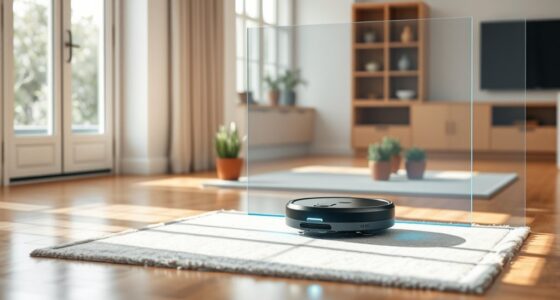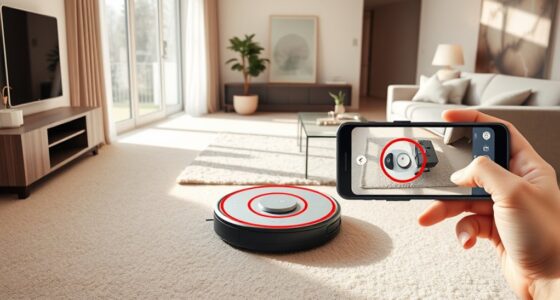
AI robot vacuums map your home by using sensors, cameras, and advanced technology to perceive your environment. They detect obstacles, dust, and layout changes, then create a digital blueprint to guide efficient cleaning routes. These maps are regularly updated to account for furniture moves or new obstacles. This smart mapping improves navigation, saves battery, and guarantees thorough cleaning. Keep exploring to discover how these robots adapt and optimize their performance over time.
Key Takeaways
- AI robot vacuums use sensors, cameras, and laser scanners to perceive and understand your home environment.
- They create digital maps by collecting data on walls, furniture, and obstacles through advanced mapping algorithms.
- Sensor fusion combines multiple data sources to accurately detect obstacles, furniture boundaries, and layout changes.
- The vacuums update their maps regularly to adapt to furniture rearrangements or new obstacles.
- Path planning and obstacle avoidance enable efficient, targeted cleaning while conserving battery life.
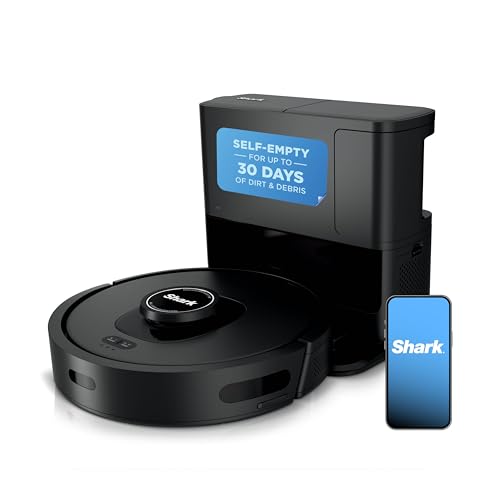
Shark AV2501S AI Ultra Robot Vacuum, with Matrix Clean, Home Mapping, 30-Day Capacity HEPA Bagless Self Empty Base, Perfect for Pet Hair, Wifi, Dark Grey
INCREDIBLE SUCTION: Powerful Shark suction picks up dirt and debris on all floor types—tackling even the toughest of…
As an affiliate, we earn on qualifying purchases.
As an affiliate, we earn on qualifying purchases.
Understanding the Basics of Robot Vacuum Navigation
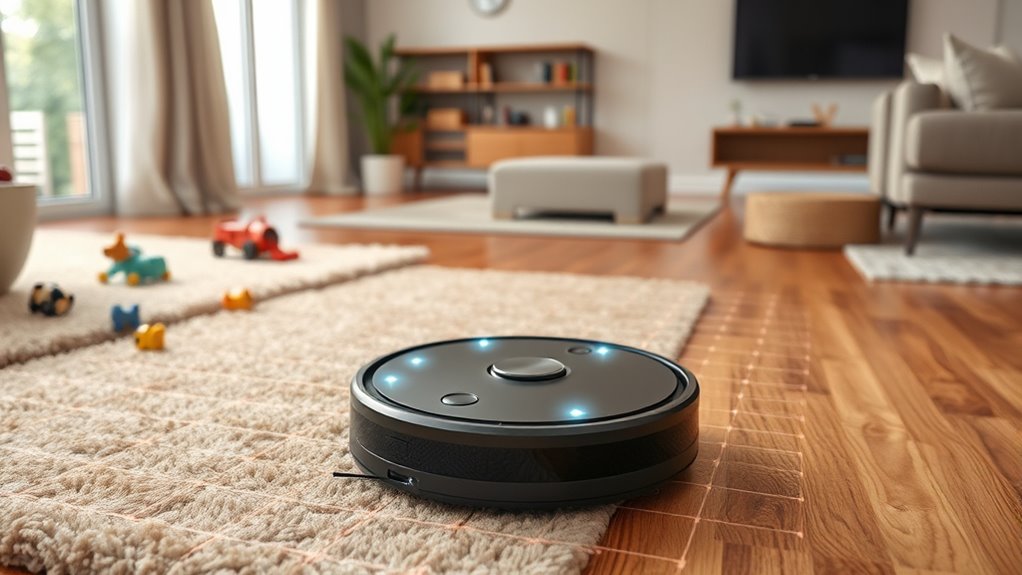
Robot vacuum navigations rely on a variety of sensors and algorithms to efficiently clean your home. These systems help your robot understand the layout of your space, making household cleaning more effective. When you set your robot to work, it uses its sensors to detect walls, furniture, and obstacles, guiding movement without human intervention. Maintaining your robot involves regular cleaning of brushes and sensors to guarantee ideal navigation and prevent issues during household cleaning tasks. Proper robot maintenance keeps the navigation systems accurate, reducing missed spots or repeated paths. Understanding these basics helps you troubleshoot and maximize your robot’s performance, ensuring it covers every corner and maintains its mapping accuracy over time. Additionally, many models incorporate SLAM technology to create detailed maps of your home, enhancing navigation precision. This foundational knowledge enhances your experience with AI robot vacuums. Regular updates to the robot’s firmware can also improve its navigation algorithms, keeping the device functioning optimally as technology advances. Moreover, sensor calibration plays a crucial role in maintaining the accuracy of the robot’s mapping capabilities, especially over extended use. Keeping these components well-maintained ensures consistent cleaning coverage and prolongs the lifespan of your robot.
Shark AV2501S AI Ultra Robot Vacuum, with Matrix Clean, Home Mapping, 30-Day Capacity HEPA Bagless Self Empty Base, Perfect for Pet Hair, Wifi, Dark Grey
INCREDIBLE SUCTION: Powerful Shark suction picks up dirt and debris on all floor types—tackling even the toughest of…
As an affiliate, we earn on qualifying purchases.
As an affiliate, we earn on qualifying purchases.
Sensors and Cameras: The Eyes of the Robot

Your robot vacuum uses sensors and cameras to see and understand its surroundings. These tools gather visual data and help detect obstacles in real-time. With this information, your robot can navigate efficiently and avoid crashes. Additionally, some models incorporate advanced mapping technologies that utilize spatial awareness to optimize cleaning paths and adapt to changes in your home layout. The integration of mapping algorithms further enhances these systems by allowing the vacuum to remember room layouts for more effective cleaning. These sensor-based systems continuously improve their accuracy through updates and machine learning techniques.
Visual Data Collection
Sensors and cameras serve as the eyes of AI vacuum robots, enabling them to perceive and understand their environment. They capture visual data that helps identify areas with dust accumulation, ensuring thorough cleaning. By analyzing images and patterns, the robot can focus on dirtier spots, improving cleaning efficiency. This visual data collection also aids in mapping your home accurately, reducing the need for repetitive passes that waste battery life. When the robot detects less dust in certain areas, it can adjust its cleaning path to conserve energy and optimize battery usage. Additionally, real-time visuals allow the robot to adapt to changes in your home’s layout or furniture, ensuring effective cleaning without unnecessary power drain. The integration of visual data collection with advanced algorithms allows for more precise navigation and obstacle avoidance. Ultimately, this technological synergy enhances both cleaning performance and battery longevity.
Obstacle Detection Methods
Obstacle detection methods are essential for AI vacuum robots to navigate safely and efficiently around your home. These methods use sensors and cameras to identify obstacles, such as furniture, walls, or even small objects, preventing collisions. Dirt detection sensors help the robot recognize areas with more debris, ensuring thorough cleaning while avoiding unnecessary passes that waste battery life. Cameras provide visual data, allowing the robot to better understand its environment and adapt to changes. This extensive sensing not only improves cleaning coverage but also supports effective battery management by avoiding obstacles that could cause delays or excessive energy use. Additionally, mapping accuracy is enhanced through the integration of these detection methods, leading to smarter and more reliable cleaning patterns. Furthermore, these advanced detection techniques contribute to home safety by preventing accidental damage or falls during operation. Incorporating sensor fusion technology enables the robot to combine data from multiple sources for even more precise obstacle recognition.

ROPVACNIC Robot Vacuum Cleaner Robot Vacuum and Mop Combo with 5200Pa Suction, Personalized Cleaning Adjustments, Self-Charging Robotic Vacuum Cleaner, Advanced Obstacle Avoidance
【2-in-1 Mopping and Vacuuming】 The ROPVACNIC Robot S1 integrates advanced electronically controlled mopping technology, significantly enhancing both cleaning…
As an affiliate, we earn on qualifying purchases.
As an affiliate, we earn on qualifying purchases.
Mapping Technologies Used in AI Robot Vacuums
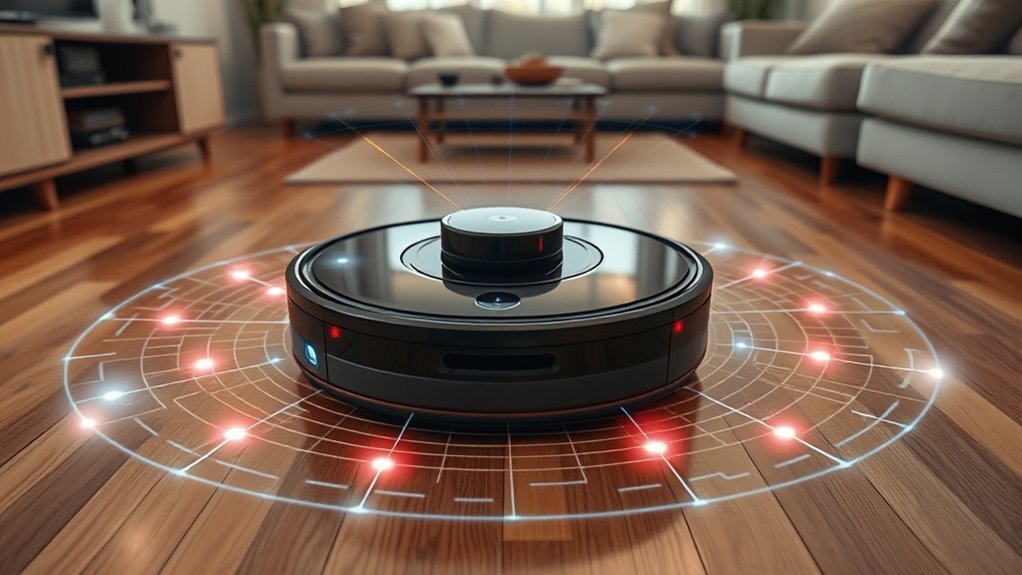
You might wonder how AI robot vacuums create accurate maps of your home. They use a variety of mapping technologies like laser navigation, camera-based systems, and infrared or ultrasonic sensors. Each method helps the vacuum understand your space better and clean more efficiently.
Laser Navigation Systems
Have you ever wondered how AI robot vacuums create detailed maps of your home so they can clean efficiently? Laser navigation systems play a vital role by using laser beams to scan your space rapidly and accurately. This technology builds precise 3D maps, allowing your vacuum to navigate around furniture and obstacles seamlessly. With voice command integration, you can direct your vacuum easily, while laser systems ensure it moves efficiently without unnecessary detours. Additionally, these systems help optimize battery life by planning the most effective cleaning routes, reducing power consumption. Laser navigation provides quick setup and reliable mapping, making your cleaning sessions smarter and more precise. Overall, laser navigation systems improve your vacuum’s performance by combining advanced mapping with user-friendly features.
Camera-Based Mapping
Camera-based mapping is revolutionizing how AI robot vacuums navigate your home by providing real-time visual data. Instead of relying solely on sensors, these vacuums use cameras to capture detailed images of your environment, enabling precise mapping during robot cleaning. This technology helps the vacuum recognize obstacles, furniture, and room layouts more accurately, leading to more efficient cleaning paths. As part of home automation, camera-based mapping allows your robot vacuum to adapt quickly to changes in your home, such as moved furniture or new objects. It also improves navigation in complex spaces, reducing missed spots and avoiding collisions. Overall, this advanced mapping method enhances the cleaning experience and integrates seamlessly with your smart home setup.
Infrared and Ultrasonic Sensors
Infrared and ultrasonic sensors are essential tools that enable AI robot vacuums to navigate effectively without relying solely on visual data. These sensors help your vacuum detect obstacles and map rooms by emitting signals and measuring responses. With infrared sensors, your robot bounces infrared light off surfaces to gauge distance, ideal for close-range detection. Ultrasonic sensors send out high-frequency sound waves, which bounce back from objects, providing accurate distance measurements. Imagine:
- The vacuum detects furniture edges with infrared sensors.
- Ultrasonic sensors measure open space to avoid falls.
- It detects walls and obstacles in real-time.
- The sensors work together to create a basic layout of your home. By combining infrared and ultrasonic sensors, your AI vacuum navigates more reliably, avoiding bumps and ensuring thorough cleaning.

MONSGA Robot Vacuum Cleaner, 4000Pa Powerful Suction Robotic Vacuum, 3.2" Super-Slim, 140Min Runtime, Vacuum Robot for Hard Floor/Low Pile Carpet/Pet Hair, Remote/App/Voice Control, Schedule Clean
🌪️【4000Pa Mighty Suction Power】➤Meet MR1 SE robot vacuum—engineered with a high-speed brushless motor and 150,000 RPM hyper-spin turbine…
As an affiliate, we earn on qualifying purchases.
As an affiliate, we earn on qualifying purchases.
Creating a Digital Blueprint of Your Home

Creating a digital blueprint of your home, AI robot vacuums rely on advanced sensors and mapping algorithms that work together to scan every room. These devices collect data about walls, furniture, and obstacles, forming a detailed map for efficient cleaning. The process enhances home automation by allowing your vacuum to navigate seamlessly and adapt to your environment. Accurate mapping also helps optimize battery usage, reducing unnecessary movements and conserving power. As your robot builds its digital blueprint, it learns the layout, enabling smarter cleaning routes and better coverage. With this precise map, your vacuum can plan its tasks more effectively, ensuring your entire home gets cleaned without wasted effort or energy. This combination of mapping and optimization maximizes both performance and convenience, while sensor technology plays a crucial role in capturing accurate spatial data.
Path Planning and Obstacle Avoidance
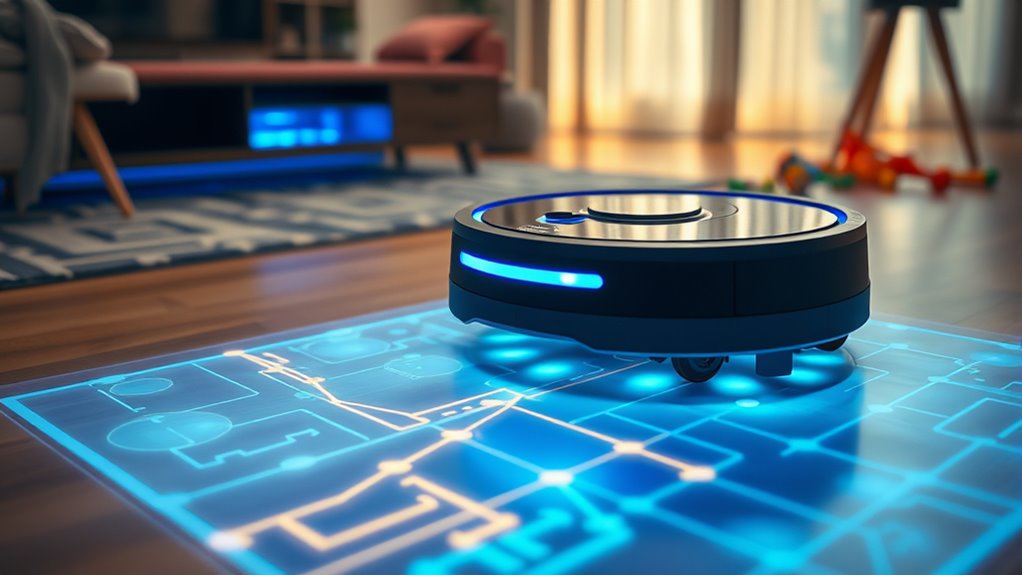
Once your robot vacuum has mapped out your home, it uses that information to plan the most efficient routes. It considers the layout, furniture, and obstacles to navigate smoothly. You can give voice commands to direct it to specific areas or start cleaning manually with a remote control. During cleaning, it performs real-time obstacle avoidance by:
- Detecting objects with sensors and rerouting around them
- Recognizing walls and furniture boundaries to prevent collisions
- Using infrared or ultrasonic sensors to sense drop-offs like stairs
- Adjusting its path dynamically if it encounters unexpected obstacles
- Utilizing sensor technology to improve navigation accuracy and adapt to changing environments. The integration of mapping and localization techniques enhances its ability to update the map as it cleans, ensuring comprehensive coverage. Additionally, sensor fusion helps combine data from multiple sensors for more precise navigation. Modern robots also incorporate real-time obstacle detection to respond swiftly to unexpected changes in their environment. To further optimize cleaning, many models employ machine learning algorithms that help them recognize and adapt to familiar objects and layouts. This combination of smart path planning and obstacle avoidance guarantees thorough cleaning while preventing damage, giving you a seamless experience whether you command it by voice or manual control.
Updating and Maintaining the Map Over Time

As your robot vacuum continues to operate, it’s essential to update and maintain its map to guarantee ongoing efficiency. Regularly updating the map ensures it recognizes changes in your home, like new furniture or rearranged rooms. This home layout accuracy helps the vacuum navigate more accurately and avoid missed spots. Additionally, keeping the map current supports your overall home electrical safety by preventing the vacuum from attempting to access unfamiliar or hazardous areas. Incorporating deep-sky imaging concepts, such as precise mapping, can improve how the vacuum interprets complex environments. Adjusting your cleaning schedules based on the updated map ensures thorough cleaning at ideal times. Proper battery management is also vital; as the map evolves, your vacuum may need to return to charging stations more frequently or extend cleaning sessions. Keeping the map current prevents unnecessary re-mapping and improves overall performance. By maintaining your vacuum’s map, you maximize cleaning efficiency, reduce missed areas, and prolong the device’s lifespan.
Benefits of Smart Mapping for Efficient Cleaning

Smart mapping considerably improves your robot vacuum’s cleaning efficiency by enabling it to create precise, detailed layouts of your home. This allows for smarter cleaning strategies, such as:
- Smart scheduling: Your vacuum can plan cleaning times based on room usage, avoiding busy periods.
- Targeted cleaning: It focuses on high-traffic or dirty areas, saving time and energy.
- Battery optimization: The robot knows the most efficient routes, reducing unnecessary coverage and conserving power.
- Zone cleaning: You can instruct it to clean specific areas without re-mapping, ensuring thoroughness where needed.
These benefits ensure your home gets cleaned more effectively, with less effort and better use of your vacuum’s capabilities. Overall, smart mapping makes cleaning faster, smarter, and more tailored to your lifestyle. Additionally, home layout understanding enables the robot to adapt to changes in your environment over time, maintaining optimal cleaning performance.
Frequently Asked Questions
How Accurate Are AI Robot Vacuum Maps Compared to Manual House Layouts?
AI robot vacuum maps are generally quite accurate, with high mapping precision that closely matches your manual house layout. You’ll notice that the layout accuracy allows the vacuum to navigate efficiently and avoid obstacles. However, some minor discrepancies can occur in complex or cluttered spaces, but overall, these maps provide a reliable representation of your home, enhancing cleaning performance and ensuring thorough coverage.
Can the Robot Vacuum Recognize and Differentiate Between Different Rooms?
Like a seasoned detective, your robot vacuum can recognize and differentiate between rooms through advanced room recognition technology. It uses sensors to identify distinct features and obstacle differentiation, helping it adapt to various spaces. This allows precise navigation and targeted cleaning. While it may not always match manual layouts perfectly, it’s smart enough to understand different rooms, making your cleaning routine more efficient and thorough.
How Does the Vacuum Update Its Map After Furniture Changes?
When you change furniture, your robot vacuum updates its map by re-calibrating sensors and obstacle detection systems. It detects new objects or obstacles, adjusts its understanding of the space, and updates the map accordingly. This process guarantees the vacuum navigates efficiently around new furniture, avoiding collisions. Regular sensor calibration helps it recognize changes quickly, keeping cleaning effective and thorough even after your home’s layout evolves.
Do Multiple AI Robot Vacuums Share Mapping Data?
Yes, multiple AI robot vacuums can share mapping data, especially if they’re connected through a smart home system. This shared data helps improve cleaning efficiency and navigation. However, you should be aware of privacy concerns, as your mapping data could be accessed or stored externally. Always review your vacuum’s privacy settings and data sharing options to make sure your home information remains secure.
Can the Map Be Customized or Edited by the User?
You can customize and edit your robot vacuum’s map, turning your home into a detailed blueprint. Imagine drawing new boundaries or designating specific areas for cleaning—these customization options let you tailor your floor plan. With intuitive map editing, you gain control over where your robot cleans, avoiding fragile décor or high-traffic zones. This flexibility makes your cleaning experience more personalized, efficient, and perfectly suited to your home’s unique layout.
Conclusion
By understanding how AI robot vacuums map your home, you can appreciate their smart cleaning capabilities. Did you know that 85% of users report cleaner floors thanks to precise mapping and obstacle avoidance? As technology advances, these vacuums become even more efficient, adapting to changes in your space. Embrace these innovations to enjoy a cleaner home with less effort, knowing your robot is working intelligently to keep your floors spotless.