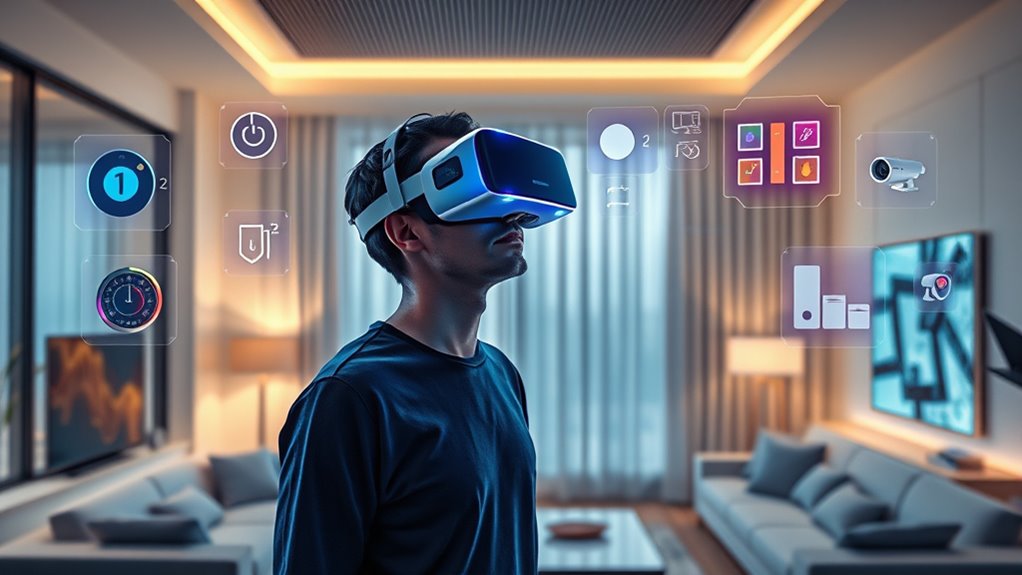

Yes, in the near future, you’ll control your smart home seamlessly through AR and VR environments. These technologies let you manipulate devices, visualize changes, and manage routines as if you’re physically present. You can walk through virtual blueprints, adjust lighting, or check security cameras with intuitive gestures or voice commands. As AR and VR evolve, managing your home will become more immersive and natural. Keep exploring to discover how these innovations will transform your living experience.
Key Takeaways
- AR and VR enable immersive control of home systems, replacing traditional interfaces with virtual interactions.
- Virtual walkthroughs allow users to visualize and modify home layouts before physical changes.
- Smart home devices can be managed seamlessly through virtual overlays and gestures in VR/AR environments.
- Enhanced visualization and intuitive controls improve efficiency and user experience in home management.
- Future advancements will deepen integration, making virtual control more personalized, engaging, and immersive.

Augmented reality (AR) and virtual reality (VR) are transforming the way you interact with your smart home, making everyday tasks more intuitive and immersive. Instead of relying solely on traditional screens or voice commands, these technologies put you directly into a digital environment where you can see, manipulate, and control your home systems in real-time. Imagine putting on a VR headset and stepping into a virtual blueprint of your house. From there, you can walk through each room, adjusting lighting, temperature, or security settings with simple gestures or voice prompts. AR, on the other hand, overlays digital controls onto your real-world environment, so you can look at a wall and see options to turn on lights or check security cameras without opening an app. This seamless integration creates a more natural and engaging way to manage your home’s features.
AR and VR revolutionize smart home control with immersive, intuitive digital environments for seamless management.
With AR and VR, you gain a sense of presence and control that’s hard to match with conventional methods. For example, instead of scrolling through menus on a small screen, you could virtually stand in front of a device or appliance and manipulate it directly. This not only makes controlling your smart home more intuitive but also quicker. You can visualize your home’s layout in 3D, plan changes, or troubleshoot issues with ease, all from a virtual perspective that mimics real-world interactions. As these technologies become more sophisticated, they could enable you to pre-visualize renovation projects or reconfigure room setups in a virtual space before making any physical adjustments.
Moreover, VR and AR open doors to new levels of automation. You might set up scenarios where your home responds to your virtual commands, like entering a virtual room to activate bedtime routines or morning alarms. The immersive experience also enhances security. You could virtually walk through your home remotely, inspecting cameras, locks, or alarms, gaining peace of mind without physical presence. As smart home devices become more integrated with AR and VR platforms, your control will feel more fluid and natural, blurring the line between digital commands and physical actions. Additionally, understanding the importance of high refresh rates in VR headsets can significantly improve your experience by reducing motion sickness and providing smoother visuals.
Ultimately, these technologies promise a future where controlling your smart home is less about tapping screens and more about experiencing your environment in a whole new way. They make managing your home more engaging, personalized, and efficient. As AR and VR continue to evolve, you’ll likely find yourself exploring your living space in ways that are both familiar and groundbreaking, transforming how you perceive and interact with your home every day.

Virtual Reality Headset for Phone with Controller, 3D VR Glasses Adjustable VR Virtual Reality Goggles, Compatible 4.7-6.5 inch for iPhone & Android, for Movies Games(Black)
3D VR Headset View: Let your smartphone become a virtual reality viewer, immerse yourself in a magical world…
As an affiliate, we earn on qualifying purchases.
As an affiliate, we earn on qualifying purchases.
Frequently Asked Questions
How Secure ARe AR and VR Systems in Smart Homes?
AR and VR systems in smart homes can be quite secure, but they aren’t foolproof. You should use strong, unique passwords, enable two-factor authentication, and keep your software updated regularly. Be cautious with shared networks and avoid connecting to unsecured Wi-Fi. While these measures improve security, always stay informed about new vulnerabilities and best practices to protect your smart home environment effectively.
What Are the Privacy Concerns With Virtual Home Control?
You should be aware that virtual home control raises privacy concerns like data breaches, unauthorized access, and surveillance risks. When using AR or VR, your personal preferences and behaviors can be collected and potentially shared or hacked. To protect yourself, make certain your systems have strong encryption, update software regularly, and limit data sharing. Stay vigilant about who has access to your virtual environment to maintain your privacy.
Can AR and VR Help With Home Maintenance Tasks?
AR and VR act like a magic wand, transforming home maintenance into an interactive adventure. You can visualize repairs, identify issues, and follow step-by-step guides in real-time, making complex tasks feel like a walk in the park. These technologies help you troubleshoot appliances, fix plumbing, and even repaint walls with pinpoint accuracy. They turn tedious chores into engaging experiences, saving you time and reducing mistakes in your home improvement journey.
How Accessible Are These Technologies for Elderly Users?
AR and VR are becoming increasingly accessible for elderly users, with user-friendly interfaces and tailored designs. Many devices now feature simple controls, voice commands, and adjustable settings to accommodate different needs. As technology advances, expect more intuitive experiences that help you manage your home easily, stay connected, and maintain independence. While some initial adaptation may be required, manufacturers are focused on making AR and VR tools more inclusive and straightforward for seniors.
Will AR and VR Integration Increase Energy Consumption?
Yes, integrating AR and VR can increase energy consumption since these technologies require additional devices and processing power. You might notice higher energy use from powering headsets, sensors, and related hardware. However, manufacturers are working on more energy-efficient solutions. By optimizing device performance and managing usage time, you can minimize the impact on your energy bills while enjoying enhanced control and immersive experiences in your smart home.
AR home automation overlay device
As an affiliate, we earn on qualifying purchases.
As an affiliate, we earn on qualifying purchases.
Conclusion
As you explore the possibilities of AR and VR in smart homes, one thing becomes clear: the future holds surprises you can’t yet imagine. Will you truly be able to control every aspect of your home through virtual reality? Or will new challenges emerge, blurring the line between the digital and physical worlds? The answer remains uncertain, but one thing’s certain—you won’t want to miss what’s coming next. The revolution in home control is just beginning.

KIWI design VR Cable Management, 6 Packs VR Pulley System Compatible with Quest 3S/3/2/1/Pico/PSVR/PSVR2
Free to Move, Play Impressively- This VR pulley system dramatically reduces the cable's presence and lets you freely…
As an affiliate, we earn on qualifying purchases.
As an affiliate, we earn on qualifying purchases.

VR Remote Controller Gamepad Bluetooth Control VR Video, Game, Selfie, Flip E-Book/PPT/Nook Page, Mouse, in Virtual Reality Headset PC Tablet Laptop iPhone Smart Phone
✅1. It is designed for mobiles iCade VR games, also compatible with MID, TV box, smart TV, PC,…
As an affiliate, we earn on qualifying purchases.
As an affiliate, we earn on qualifying purchases.