The best smart air conditioners pair useful app or voice controls with cooling performance that suits the room and installation. My best overall pick is the Midea 12,000 BTU U-Shaped Smart Inverter Window Air Conditioner, which stands out for its inverter design and window-friendly U-shaped format. The Midea 8,000 BTU Smart Inverter Window Air Conditioner with Heat is a strong choice for shoppers who want heating as well as cooling, while the GE 10,000 BTU Smart Window Air Conditioner is a straightforward smart window option. The main tradeoffs are room capacity, installation style, energy-conscious inverter operation, and whether portability or added heating matters more than a window unit’s fit. Read on for the full breakdown and guidance on matching a smart AC to your space.

Get home appliances delivered free — and shop member deals
- Fast, free delivery on millions of items
- Access to Prime Big Deal Days deals on October 6–7
- Prime Video, Amazon Music and more included
Complete the kit


Key Takeaways
- The Midea 12,000 BTU U-Shaped model earns the overall lead by combining smart control, inverter operation, and a design that can leave more of the window opening available than a conventional window unit.
- Room size and installation type matter more than app extras. The lineup ranges from a 6,000 BTU DELLA window unit to 14,000 BTU portable and window models, so the right match depends on the space and whether a window installation is possible.
- Midea’s inverter models serve different needs rather than one identical use case. The 8,000 BTU model adds heat, the U-shaped 8,000 BTU version prioritizes its window format, and the 14,000 BTU model targets larger rooms.
- Portable units trade simpler room-to-room placement for setup demands. Both BLACK+DECKER models avoid a fixed window AC installation, but buyers still need a suitable window for the exhaust hose and should choose between their two capacities based on room needs.
- The strongest shortlist depends on the buyer’s priority. Midea leads for inverter and U-shaped designs, GE offers a conventional smart window route, and DELLA’s 6,000 BTU capacity is aimed at smaller spaces.
| BLACK+DECKER Smart Portable Air Conditioner, 14,000 BTU, BPACT14WT |  | Best Portable Smart AC | Model: BPACT14WT | Cooling capacity: 14,000 BTU ASHRAE; 10,200 BTU SACC | Room coverage: Up to 700 sq. ft. | VIEW LATEST PRICE | See Our Full Breakdown |
| GE 10,000 BTU Smart Window Air Conditioner |  | Best Straightforward Smart Window AC | Cooling capacity: 10,000 BTU | Room coverage: Up to 450 sq. ft. | Connectivity and controls: Wi-Fi, SmartHQ app, Alexa, Google Assistant, remote | VIEW LATEST PRICE | See Our Full Breakdown |
| Midea 8,000 BTU Smart Inverter Window Air Conditioner with Heat |  | Best for Quiet, Year-Round Room Comfort | Cooling capacity: 8,000 BTU | Room coverage: Up to 350 sq. ft. | Modes: Heat, Auto, Cool, Dry, Fan | VIEW LATEST PRICE | See Our Full Breakdown |
| Midea 12,000 BTU U-Shaped Smart Inverter Window Air Conditioner | 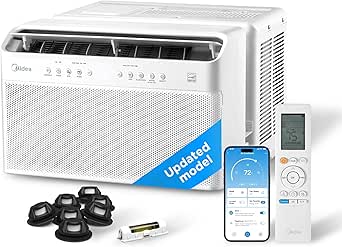 | Best for Quiet Operation and an Openable Window | Cooling capacity: 12,000 BTU | Coverage area: Up to 550 sq. ft. | Noise level: As low as 32 dBA | VIEW LATEST PRICE | See Our Full Breakdown |
| Midea 14,000 BTU Smart Inverter 115V Window Air Conditioner, 700 sq. ft. |  | Best for Large Rooms | Cooling capacity: 14,000 BTU | Room coverage: Up to 700 sq. ft. | Voltage: 115 V | VIEW LATEST PRICE | See Our Full Breakdown |
| DELLA 6,000 BTU Wi-Fi Window Air Conditioner |  | Best for Small Rooms | Cooling capacity: 6,000 BTU | Coverage area: Up to 250 sq. ft. | Noise level: As low as 51 dB | VIEW LATEST PRICE | See Our Full Breakdown |
| BLACK+DECKER Smart Portable Air Conditioner, 12,000 BTU, BPACT12WT, White | | Best Portable Smart Pick | Cooling power: 12,000 BTU; 8,350 BTU SACC | Coverage: Listed as 500 sq. ft. and up to 550 sq. ft. | Functions: Air conditioner, dehumidifier, fan | VIEW LATEST PRICE | See Our Full Breakdown |
| Midea 8,000 BTU U-Shaped Smart Inverter Window Air Conditioner |  | Best for Quiet Smart Cooling | Cooling capacity: 8,000 BTU | Room coverage: Up to 350 sq. ft. | Noise level: As low as 32 dBA | VIEW LATEST PRICE | See Our Full Breakdown |
| smart air conditioner | Cooling capacity | Noise level | Room coverage | Window fit |
|---|---|---|---|---|
| BLACK+DECKER Smart Portable Ai | 14,000 BTU ASHRAE; 10,200 BTU SACC | — | Up to 700 sq. ft. | — |
| GE 10,000 BTU Smart Window Air | 10,000 BTU | 59 dB | Up to 450 sq. ft. | 25–36 in wide; 14.56 in minimum height |
| Midea 8,000 BTU Smart Inverter | 8,000 BTU | As low as 45 dBA | Up to 350 sq. ft. | 24–38.5 in wide; 14.5 in minimum vertical opening |
| Midea 12,000 BTU U-Shaped Smar | 12,000 BTU | As low as 32 dBA | — | 22–36 in wide; 13.75 in minimum height |
| Midea 14,000 BTU Smart Inverte | 14,000 BTU | As low as 41 dBA | Up to 700 sq. ft. | — |
| DELLA 6,000 BTU Wi-Fi Window A | 6,000 BTU | As low as 51 dB | — | 23–34 in wide; minimum height 14.5 in |
| BLACK+DECKER Smart Portable Ai | — | 54 dB | — | — |
| Midea 8,000 BTU U-Shaped Smart | 8,000 BTU | As low as 32 dBA | Up to 350 sq. ft. | 22–36 in wide; minimum height 13.75 in |
More Details on Our Top Picks
BLACK+DECKER Smart Portable Air Conditioner, 14,000 BTU, BPACT14WT
For renters or households that cannot install a window unit, the BLACK+DECKER BPACT14WT brings app and voice control in a portable format. Its advertised capacity is 14,000 BTU by ASHRAE, but the lower 10,200 BTU SACC rating gives a more grounded picture of cooling performance; the stated room coverage is up to 700 square feet. The included Follow Me remote reads temperature where the remote is placed, which can help when the unit sits far from the occupied area. Unlike the fixed GE 10,000 BTU Smart Window Air Conditioner, this model can move between rooms, but it still needs a window for exhaust and takes up floor space. Its AC, dehumidifier, and fan modes add flexibility, though buyers prioritizing quiet or a permanent installation may prefer a window model.
Pros:- Wi-Fi app control and compatibility with Alexa and Google Assistant
- Three functions: air conditioning, dehumidifying, and fan operation
- Follow Me remote measures temperature at the remote’s location
- Window installation kit is included
Cons:- Its 10,200 BTU SACC rating is lower than the 14,000 BTU ASHRAE figure
- Exhaust hose must vent through a window
- Portable format occupies indoor floor space
Best for: Renters or homeowners who want app and voice control, need to move cooling between rooms, and can vent the unit through a window.
Not ideal for: Buyers seeking a window-free cooling option, a compact floor footprint, or capacity based solely on the 14,000 BTU headline.
- Model:BPACT14WT
- Cooling capacity:14,000 BTU ASHRAE; 10,200 BTU SACC
- Room coverage:Up to 700 sq. ft.
- Connectivity:Wi-Fi, mobile app, Amazon Alexa, Google Assistant
- Functions:Air conditioner, dehumidifier, fan
- Dimensions:16.5 × 14.06 × 27.09 in
- Color:White
Our verdict“Choose this portable model if room-to-room flexibility matters more than avoiding a window vent or giving up floor space.”
GE 10,000 BTU Smart Window Air Conditioner
The GE 10,000 BTU Smart Window Air Conditioner is a practical pick for buyers who want app and voice control without the extra features of an inverter or heat-pump model. Its stated coverage of up to 450 square feet suits a medium room, while three cooling modes, three fan speeds, and Eco Mode provide useful ways to adjust operation. The SmartHQ app and voice-assistant support make remote changes possible; a physical remote remains available for guests or anyone who would rather not use a phone. Compared with the Midea 8,000 BTU Smart Inverter Window Air Conditioner with Heat, the GE offers greater listed cooling capacity, but it lacks that model’s supplemental heating and low-noise claim. Its listed 59 dB noise level and double-hung window requirement make it less appealing for noise-sensitive bedrooms or nonstandard windows.
Pros:- SmartHQ app control plus Alexa and Google Assistant compatibility
- Three cooling modes and three fan speeds allow basic adjustment
- Washable filter and Eco Mode support routine upkeep and energy-conscious operation
- Installation kit and remote control are included
Cons:- Listed noise level is 59 dB, which may bother noise-sensitive users
- Requires a compatible double-hung window
- Does not provide the supplemental heat offered by the Midea 8,000 BTU Smart Inverter Window Air Conditioner with Heat
Best for: Households with a compatible double-hung window who want app and voice control for cooling a medium-size room.
Not ideal for: Light sleepers, buyers who need supplemental heat, or anyone whose window does not fit the specified double-hung installation range.
- Cooling capacity:10,000 BTU
- Room coverage:Up to 450 sq. ft.
- Connectivity and controls:Wi-Fi, SmartHQ app, Alexa, Google Assistant, remote
- Cooling modes:3
- Fan speeds:3
- Noise level:59 dB
- Window fit:25–36 in wide; 14.56 in minimum height
- Dimensions and weight:19.75 × 19 × 14.5 in; 58 lb
Our verdict“Pick the GE for app-controlled cooling in a medium room if your window fits and its listed noise level is acceptable.”
Midea 8,000 BTU Smart Inverter Window Air Conditioner with Heat
For a smaller room where quieter operation and a shoulder-season heat option matter, the Midea 8,000 BTU Smart Inverter Window Air Conditioner with Heat offers a different balance from the higher-capacity models here. It covers up to 350 square feet, and its inverter design pairs with a noise claim as low as 45 dBA, making it a better fit for bedrooms than the GE 10,000 BTU model with its listed 59 dB level. The app, Alexa, and Google Assistant controls let buyers adjust settings remotely, while Heat, Cool, Dry, Fan, and Auto modes serve more than one seasonal need. The tradeoff is limited reach: it is not the choice for a large open area like the Midea 14,000 BTU Smart Inverter Window AC. Supplemental heat also works only when outdoor temperatures are above 41°F.
Pros:- Supplemental heat, cooling, dehumidifying, and fan modes in one window unit
- Smart app and Alexa and Google Assistant controls
- Noise level specified as low as 45 dBA
- ENERGY STAR certified inverter design
Cons:- Supplemental heat is limited to outdoor temperatures above 41°F
- Coverage is smaller than the 550-square-foot Midea U-shaped and 700-square-foot Midea 14,000 BTU models
- Requires a double-hung window within the specified size range
Best for: People cooling a bedroom or small living space who want smart controls, lower-noise operation, and supplemental heat in mild weather.
Not ideal for: Buyers cooling spaces larger than 350 square feet or relying on the unit for heat when outdoor temperatures are 41°F or lower.
- Cooling capacity:8,000 BTU
- Room coverage:Up to 350 sq. ft.
- Modes:Heat, Auto, Cool, Dry, Fan
- Noise level:As low as 45 dBA
- Energy certification:ENERGY STAR
- Controls:Control panel, remote, app, Alexa, Google Assistant
- Window fit:24–38.5 in wide; 14.5 in minimum vertical opening
- Dimensions:19.41 W × 22.17 D × 13.9 H in
Our verdict“Choose this Midea for a smaller room where quieter smart cooling and mild-weather supplemental heat outweigh the limited coverage.”
Midea 12,000 BTU U-Shaped Smart Inverter Window Air Conditioner
The Midea 12,000 BTU U-Shaped Smart Inverter Window Air Conditioner stands apart through its installation design: the window can still open, and the U-shaped layout is intended to reduce outside noise. Its stated 32 dBA low setting makes it a strong option for buyers who put room noise ahead of maximum cooling capacity. Wi-Fi, app, Alexa, and Google Assistant controls cover the smart basics, while the included bracket helps with setup. Compared with the Midea 14,000 BTU Smart Inverter Window Air Conditioner, this model covers less space—up to 550 rather than 700 square feet—but its U-shaped layout offers the more distinctive window and noise benefits. That format is not a universal fit, though: buyers need a window at least 13.75 inches high and 22–36 inches wide, and the unit weighs 58.9 pounds.
Pros:- U-shaped design allows the window to open and helps limit outside noise
- Noise level specified as low as 32 dBA
- Wi-Fi app and Alexa and Google Assistant controls
- Quick-snap installation bracket is included
Cons:- Lower stated coverage than the Midea 14,000 BTU model
- Requires a window 22–36 inches wide and at least 13.75 inches high
- At 58.9 pounds, installation may require help
Best for: People cooling a medium-to-large room who value quieter operation and want to retain the ability to open their window.
Not ideal for: Buyers with windows outside the stated dimensions, anyone who needs coverage beyond 550 square feet, or people unable to manage a 58.9-pound installation.
- Cooling capacity:12,000 BTU
- Coverage area:Up to 550 sq. ft.
- Noise level:As low as 32 dBA
- Connectivity and controls:Wi-Fi, app, Alexa, Google Assistant, remote
- Cooling power and voltage:1,140 W; 115 V
- Window fit:22–36 in wide; 13.75 in minimum height
- Dimensions and weight:19.17 × 21.97 × 13.46 in; 58.9 lb
- Refrigerant:R-32
Our verdict“Choose this U-shaped Midea if quieter operation and an openable window matter more than the added coverage of the 14,000 BTU model.”
Midea 14,000 BTU Smart Inverter 115V Window Air Conditioner, 700 sq. ft.
When a large room needs substantial cooling without switching to a portable unit, the Midea 14,000 BTU Smart Inverter Window Air Conditioner offers the broadest stated coverage in this group: up to 700 square feet. Wi-Fi app control, Alexa, Google Assistant, and a remote give several ways to adjust it, while inverter technology, an energy-saving mode, and a 24-hour timer support more controlled operation. Its noise claim of as low as 41 dBA is quieter than the GE’s listed 59 dB, though not as low as the Midea U-shaped model’s 32 dBA claim. The tradeoff is that this standard window unit does not offer the U-shaped model’s window-opening design, nor the 8,000 BTU Midea’s supplemental heat. Buyers also need a compatible window and a reliable smart-home connection to use app or voice controls.
Pros:- Stated coverage of up to 700 square feet
- Inverter technology with an energy-saving mode
- App, Alexa, Google Assistant, remote, and control-panel operation
- 24-hour timer and washable filter
Cons:- Requires a compatible window for installation
- Smart app and voice features rely on connectivity
- Does not provide supplemental heat or the U-shaped design of other Midea options
Best for: Households cooling a large room up to 700 square feet that want inverter operation and app or voice control in a window unit.
Not ideal for: People with small rooms, incompatible windows, or a priority for supplemental heat or the U-shaped Midea’s lower noise claim and openable-window design.
- Cooling capacity:14,000 BTU
- Room coverage:Up to 700 sq. ft.
- Voltage:115 V
- Noise level:As low as 41 dBA
- Modes:Auto, Cool, Dry, Fan
- Fan speeds:3
- Controls:SmartHome app, Alexa, Google Assistant, remote, control panel
- Timer and filter:24-hour timer; washable filter
Our verdict“Choose this Midea for a large room if you want smart inverter cooling and do not need supplemental heat or a U-shaped window design.”
DELLA 6,000 BTU Wi-Fi Window Air Conditioner
I’d choose the DELLA for a bedroom, home office, or other compact space where smart scheduling matters more than high cooling capacity. Its 6,000 BTU output is rated for rooms up to 250 square feet, while app control, Alexa compatibility, and a remote give you several ways to adjust settings without reaching the unit. The 24-hour timer and energy-saving mode add practical control for daily routines. Compared with the BLACK+DECKER Smart Portable Air Conditioner, this window unit is a more space-conscious fit, but it requires a suitable window and cannot be moved from room to room as easily. Its 51 dB minimum noise level is also less suited to noise-sensitive sleepers than the Midea U-shaped model, which is rated at 32 dBA. Its main tradeoff is limited coverage.
Pros:- Wi-Fi app control, Alexa compatibility, and a remote offer flexible operation
- Rated for rooms up to 250 square feet
- Energy-saving mode and a 24-hour timer support scheduled use
- Installation accessories are included
Cons:- Limited to smaller rooms compared with higher-capacity options
- Requires a compatible window opening
- Listed noise level starts at 51 dB, higher than the Midea U-shaped model’s 32 dBA rating
Best for: People cooling a bedroom or home office of up to 250 square feet who want app and Alexa control in a window-mounted unit.
Not ideal for: People cooling a large open room, moving the AC between rooms, or seeking especially quiet operation.
- Cooling capacity:6,000 BTU
- Coverage area:Up to 250 sq. ft.
- Noise level:As low as 51 dB
- Operating modes:Auto, Cool, Fan, Dry
- Controls:Wi-Fi app, Alexa compatibility, remote, LED panel
- Power:115 V; 550 W
- Dimensions and weight:15.2 × 15.98 × 12.52 in; 38.6 lb
- Window fit:23–34 in wide; minimum height 14.5 in
- Warranty:1 year
Our verdict“Choose the DELLA for smart, scheduled cooling in a compact room, but pick a higher-capacity or quieter model for larger spaces or noise-sensitive bedrooms.”
BLACK+DECKER Smart Portable Air Conditioner, 12,000 BTU, BPACT12WT, White
The BLACK+DECKER is the flexible choice for renters or households that want cooling without mounting a unit in the window. Its portable, three-function design cools, dehumidifies, and circulates air, while Wi-Fi control and Alexa and Google Assistant compatibility make it a smart option beyond the included remote. The remote’s Follow Me temperature control can help the unit respond to conditions near the person using it rather than relying only on the AC’s position. Compared with the DELLA 6,000 BTU Window Air Conditioner, this model offers much greater listed cooling capacity and room coverage, but takes up floor space and still needs a window connection for its installation kit. Coverage is reported as both 500 and up to 550 square feet, so I’d avoid treating the higher figure as a guaranteed result. It also lacks heating.
Pros:- Combines air conditioning, dehumidifying, and fan functions
- Wi-Fi app control works with Alexa and Google Assistant
- Remote includes Follow Me temperature control
- Window installation kit and washable filter are included
Cons:- Coverage information varies between 500 and up to 550 square feet
- Portable design uses indoor floor space and still requires a window opening
- No heating function
Best for: Renters and households that need a portable unit with app and voice controls for a room listed at 500–550 square feet.
Not ideal for: People who want a permanent window installation, need heating, or require a clear, consistent coverage rating.
- Cooling power:12,000 BTU; 8,350 BTU SACC
- Coverage:Listed as 500 sq. ft. and up to 550 sq. ft.
- Functions:Air conditioner, dehumidifier, fan
- Noise level:54 dB
- Controls:Wi-Fi app, Alexa, Google Assistant, remote, LED panel
- Dimensions and weight:13.8 × 17.1 × 28.1 in; 28 lb
- Window opening range:26.5–48.4 in
- Electrical:115 V; 3,516 W
- Filter and refrigerant:Washable filter; R410a
Our verdict“Pick this BLACK+DECKER when portability and voice control matter more than saving floor space or having a consistent published coverage figure.”
Midea 8,000 BTU U-Shaped Smart Inverter Window Air Conditioner
For a bedroom or living space where noise is a deciding factor, the Midea U-shaped unit has the clearest advantage in this group: its inverter operation is rated as low as 32 dBA. The distinctive window-spanning design lets the window open and is intended to help block outdoor noise, while Wi-Fi and Alexa or Google Assistant control support hands-off scheduling and adjustment. Its 8,000 BTU capacity is rated for up to 350 square feet, making it a step up from the smaller DELLA without moving into the portable BLACK+DECKER’s roomier but floor-occupying format. The tradeoff is installation: the unit weighs 55.6 pounds and needs a compatible window, so setup may be more demanding than with a lighter model. It also costs space at the window and offers no listed heating function.
Pros:- Inverter operation is rated as quiet as 32 dBA
- U-shaped design allows the window to open and helps block outdoor noise
- Wi-Fi app control supports Alexa and Google Assistant
- ENERGY STAR certified, with dehumidifier and dust filter
Cons:- At 55.6 pounds, installation and handling may be difficult
- Requires a window 22–36 inches wide and at least 13.75 inches high
- Window-mounted design is less flexible to relocate than the portable BLACK+DECKER
Best for: People cooling bedrooms or living rooms up to 350 square feet who value quiet operation, smart controls, and the ability to open the window.
Not ideal for: People with windows outside the specified size range, those who need a lightweight installation, or shoppers seeking a portable unit.
- Cooling capacity:8,000 BTU
- Room coverage:Up to 350 sq. ft.
- Noise level:As low as 32 dBA
- Cooling power:710 W
- Controls:Wi-Fi app, Alexa, Google Assistant, remote
- Airflow:215 CFM high; 150 CFM low
- Dimensions and weight:19.17 × 21.97 × 13.46 in; 55.6 lb
- Window fit:22–36 in wide; minimum height 13.75 in
- Features:Inverter, dehumidifier, dust filter, anti-theft window lock; ENERGY STAR certified
Our verdict“Choose the Midea U-shaped model for quiet, app-controlled cooling in a compatible window, especially when bedroom noise matters more than easy installation.”

How We Picked
I ranked these eight models by how well their smart controls work alongside practical cooling needs, not by connectivity alone. I weighed stated capacity and format against likely buyer priorities: fitting the unit to the room, managing installation, choosing between window and portable designs, and finding useful extras such as inverter operation or heating. I also looked at how much flexibility each design offers and what a buyer gives up in exchange for that advantage.
The Midea 12,000 BTU U-shaped model ranks first because its inverter operation and distinctive window design give it a compelling balance of cooling, control, and installation flexibility. Other Midea models follow where their specific strengths fit narrower needs, such as heating or higher capacity. GE and DELLA are useful conventional-window alternatives, while the BLACK+DECKER portable units serve buyers who cannot or do not want to install a window AC. The two BLACK+DECKER capacities are ranked by room-cooling needs, with the larger model better suited to a higher-capacity requirement and the smaller one a more restrained portable choice.
| smart air conditioner | Room coverage | Controls |
|---|---|---|
| BLACK+DECKER Smart Portable Ai | Up to 700 sq. ft. | — |
| GE 10,000 BTU Smart Window Air | Up to 450 sq. ft. | — |
| Midea 8,000 BTU Smart Inverter | Up to 350 sq. ft. | Control panel, remote, app, Alexa, Google Assistant |
| Midea 12,000 BTU U-Shaped Smar | — | — |
| Midea 14,000 BTU Smart Inverte | Up to 700 sq. ft. | SmartHome app, Alexa, Google Assistant, remote, control panel |
| DELLA 6,000 BTU Wi-Fi Window A | — | Wi-Fi app, Alexa compatibility, remote, LED panel |
| BLACK+DECKER Smart Portable Ai | — | Wi-Fi app, Alexa, Google Assistant, remote, LED panel |
| Midea 8,000 BTU U-Shaped Smart | Up to 350 sq. ft. | Wi-Fi app, Alexa, Google Assistant, remote |
Factors to Consider When Choosing Best Smart Air Conditioners
Before choosing among these smart ACs, decide what problem the unit needs to solve: cooling one room, fitting a difficult window, or avoiding a permanent installation. The product list shows that capacity, unit format, and extra functions vary more than the basic promise of app control. These checks can prevent an appealing feature from distracting from a poor room or installation match.
Match Capacity to the Room and Its Conditions
Start with the room’s area, but do not treat a BTU figure as a complete sizing answer. Sun exposure, ceiling height, insulation, occupancy, and heat from cooking or electronics can all affect how hard an AC must work. An undersized unit may run for long periods without making the space comfortable, while an oversized unit may cool quickly without managing humidity as well. Use the manufacturer’s room guidance as a starting point, then account for unusual heat loads. The range here—from DELLA’s 6,000 BTU model to 14,000 BTU options—shows why comparing capacity before app features is a better first step.
Choose Window or Portable Before Comparing Smart Features
A window unit and a portable unit solve different installation problems. Window models generally require a compatible opening and secure support, while portable models need floor space and a route for the exhaust hose through a window. Portable does not mean effortless to move: the hose and window panel still need to be set up, and frequent relocation can become a chore. Check window dimensions, opening style, nearby outlets, and any building rules before ordering. If a standard window unit will not fit or is not allowed, the BLACK+DECKER portable options may be more practical; otherwise, a window design may keep the room less cluttered.
Decide Whether Inverter Operation Is Worth Prioritizing
Inverter models can vary compressor output rather than relying only on repeated full-power starts and stops, which may support steadier room temperatures and quieter operation. Those benefits depend on how the unit is installed and used, so an inverter label alone does not tell the whole story. Compare the model’s capacity and physical design with the room before paying extra for this feature. In this lineup, several Midea models use inverter technology, but they differ in capacity, window format, and added heating. A conventional smart model can still make sense if straightforward cooling and a fitting installation matter more to you.
Treat Heating as a Separate Requirement
An AC with heat may extend the usefulness of a room unit, but it should not be assumed to replace a home’s primary heating system. Check the product’s heating specifications and the temperatures it is designed to handle before relying on that function. Heat can be especially useful during mild shoulder-season weather when running a whole-home system feels unnecessary. If you only need summer cooling, the heating feature may add complexity without solving a real need. Among these picks, the Midea 8,000 BTU Smart Inverter Window Air Conditioner with Heat is the clear option for buyers who want both functions.
Check Smart-Home Fit Before You Buy
“Smart” can mean app scheduling, remote temperature changes, or voice-assistant compatibility, and those functions are not interchangeable. Check the exact model’s supported platforms, Wi-Fi requirements, and whether core controls remain available if the internet connection drops. A schedule can be more useful than voice commands if you want the room cool before arriving home, while remote control matters more when routines change. Also confirm that the unit can connect reliably from its intended location; a weak signal near a window can make setup frustrating. Choose the control features you will actually use rather than treating every connected function as equally valuable.
Plan for Noise, Drainage, and Upkeep
Installation is only part of ownership: filters need cleaning, and some units may require attention to condensate or drainage depending on conditions and design. Review the maintenance instructions before purchase so the routine fits your household. Noise also deserves a room-specific check, especially for a bedroom or work area; published sound information can help compare models, but installation quality and room acoustics affect what you hear. A unit with more cooling capacity is not automatically the better bedroom choice if it disrupts sleep. Leave enough clearance for airflow and cleaning access, since a cramped setup can make regular maintenance less convenient.
Frequently Asked Questions
Should I choose a 12,000 BTU unit or a 14,000 BTU unit for my room?
Choose by room size and heat load rather than assuming the larger capacity is always better. Compare the manufacturer’s recommended coverage with your room’s sun exposure, insulation, ceiling height, and typical number of occupants. The 14,000 BTU Midea window model and BLACK+DECKER portable model also use different formats, so their capacity figures do not remove the need to check installation fit. If your room is near a model’s coverage limit or receives strong afternoon sun, those conditions may affect the choice. When the room is modest and reasonably insulated, moving up in capacity without a clear need may add more cooling than you require.
Is a portable smart air conditioner a better choice if I rent?
It can be, particularly if your lease or building rules restrict permanent window-unit installation, but a portable AC still needs an exhaust route through a window. Check whether the included window setup suits the window style and whether the hose will block access or create a trip hazard. Portable models also occupy floor space, which can matter in a small room. If your rental allows a properly supported window unit, that format may be less intrusive inside the room. Ask the landlord or building manager about both options before deciding based on portability alone.
Does an inverter smart AC make sense if I only cool one room?
It may, because inverter operation can adjust output to maintain a steadier temperature rather than repeatedly cycling at full power. The value depends on how often you use the unit, the room’s cooling demand, and how much you care about more consistent operation. If you run an AC for long stretches, comparing inverter models such as the Midea options is sensible. For occasional short cooling sessions, capacity, fit, and ease of use may matter more than inverter technology. Compare the full feature set and installation requirements rather than choosing solely from the inverter label.
Can a smart air conditioner cool a room when I am away from home?
Smart controls can let you adjust settings remotely or set schedules, depending on the model and its app support. They do not make an AC a whole-home cooling system, and the unit still cools the room where it is installed. Check whether remote features require a working internet connection and whether your home Wi-Fi reaches the unit’s location. Scheduling can help avoid cooling an empty room all day, but it should match your routine and the room’s heat buildup. Review each model’s specific app and voice-control compatibility before treating “smart” as a guarantee of a particular feature.
Should I pick the Midea model with heat if I already have central heating?
It depends on whether you want targeted heat in that room during mild weather, not simply on whether your home has another heating system. The Midea 8,000 BTU model with heat may suit a room where central heating is inefficient to run for a short period. Check its heating limits and specifications before using it as more than a supplemental option. If your central system already keeps the room comfortable and you only need summer cooling, a cooling-focused model may be the simpler match. Compare the added heating function with the room’s actual seasonal use.
Conclusion
For the strongest balance of smart control, inverter operation, and window design, I recommend the Midea 12,000 BTU U-Shaped Smart Inverter Window Air Conditioner as the best overall pick. My best value choice is the DELLA 6,000 BTU Wi-Fi Window Air Conditioner for buyers cooling a smaller room who do not need a higher-capacity or inverter-focused model. For a premium-feature priority, choose the Midea 14,000 BTU Smart Inverter Window Air Conditioner when a larger room and its window installation suit the higher capacity. Beginners who want a conventional smart window-unit format can start with the GE 10,000 BTU Smart Window Air Conditioner. For specific needs, pick the Midea 8,000 BTU model with heat for added heating, the Midea 8,000 BTU U-shaped model for its window design at a smaller capacity, or a BLACK+DECKER portable AC when a fixed window unit is not practical. The right choice comes down to room fit and installation first, then the smart features you will use.
Fall yard work Picks
leaf blowers
As an affiliate, we earn on qualifying purchases.