TL;DR

Get home appliances delivered free with Prime
- Fast, free delivery on millions of items
- Prime Video, Amazon Music and more included
- Member-only deals all year
House Beautiful published a roundup of 27 designer approaches to hiding or visually blending televisions in homes. The examples include cabinetry, millwork, credenzas, fabric panels, artwork and screens designed to resemble framed images; the report does not establish that any one method works for every room or budget.
House Beautiful has published 27 designer examples of ways to conceal televisions or make them less visually prominent, from folding cabinet doors and custom millwork to framed screens and artwork panels. The roundup documents approaches used in individual homes, offering readers practical design ideas for balancing television use with rooms intended to feel less centered on a screen.
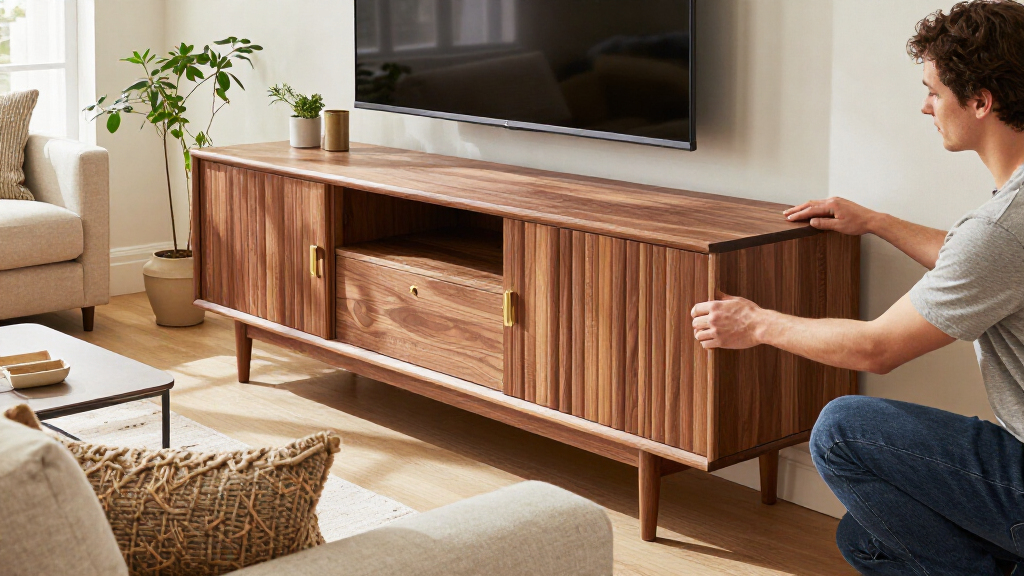
The examples rely on several distinct strategies. Some hide the television behind a physical cover: designer Kylie Buhagiar placed one inside a wall-hung metal cabinet with doors that fold back, while Gillian Segal used a simple folding millwork door system. Other projects put screens in a closet or credenza, including a guest-room closet designed by Lynne Uhalt and a mid-century wooden piece in a cottage designed by John Wooden.
Other designers make the screen blend into its surroundings rather than disappear. Ariel Okin added a frame to a Samsung Frame television so it relates to nearby accents, and Denise McGaha used a Frame model displaying an image suited to a room’s blue-and-gray palette. Emily Del Bello mounted a television against a dark accent wall, while Shazalynn Cavin-Winfrey used fabric over cabinet glass to connect a concealed screen to the room’s colors.
The roundup also describes more customized solutions, including a floating credenza built into a steel-and-walnut feature wall, abstract-looking panels above a fireplace, and a bi-fold painting that conceals a screen. In one kitchen, a Frame television was used in a family space where household members had different preferences about watching TV. These are project examples, not a comparative review: the source does not provide prices, installation specifications or performance testing across the 27 designs.
Designing Rooms Beyond the Screen
The projects address a common interior-design tension: televisions are useful for entertainment and family routines, but their dark rectangular screens can dominate a room when switched off. Concealment offers one way to let a space serve more than one purpose, such as a formal living room that also hosts movie nights or a guest room where visitors can watch television without making it the room’s main visual feature.
The examples also show that hiding a screen does not require the same solution in every home. A cabinet or closet can cover it entirely, while a framed display or dark wall makes it less conspicuous. Choice depends on the room and its use; the report illustrates designs but does not claim that concealment improves a home’s value, reduces screen use or suits every household.
Products Worth Considering

Samsung Odyssey G7 40-Inch WUHD Curved Gaming Monitor (G75F)

Samsung Odyssey G93SC 49-Inch QD-OLED Curved Gaming Monitor

Samsung 49-Inch Odyssey G9 G91F Curved Dual QHD Gaming Monitor, 144Hz
As an affiliate, we earn on qualifying purchases.
From Cabinets to Moving Artwork
The report’s central distinction is between concealing a television with a movable or built-in cover and integrating the screen into the decor. Cabinet doors, closet storage and folding millwork conceal the device when it is not in use. A television disguised as a picture, or placed against a dark wall, remains visible but is intended to attract less attention.
Several examples are tailored to particular settings: outdoor entertaining, a kitchen shared by family members, a compact cottage and a guest room. The designs also vary in complexity, from using an existing credenza to commissioning custom steelwork or a kinetic art panel. House Beautiful presents these as inspiration from named designers and projects; it does not supply a complete technical guide to ventilation, wiring, mounting or construction.
“In the main living room, the TV is discreetly integrated into a wall-hung metal joinery box, with hinged doors that elegantly stack back to reveal the screen when needed.”
— Kylie Buhagiar, designer at Golden
Costs and Installation Details Absent
The source material does not give a publication date, prices, dimensions or installation instructions for the featured designs. It is also unclear which of the 27 approaches are suitable for specific television models, wall types or outdoor conditions. The roundup does not compare durability, ventilation, accessibility or the amount of custom work required.
Some concepts, such as placing a television in furniture or behind a moving panel, may require careful planning around equipment, wiring and safe operation. The report does not provide technical guidance on those issues, so readers should not treat the examples as construction specifications.
Planning a Concealed Screen
House Beautiful’s source article is a design roundup rather than an announcement of a new product or a scheduled project, and it identifies no forthcoming milestone. Readers considering a similar installation would need to determine whether they want the television fully hidden or simply less prominent, then check the room layout and the requirements of the chosen screen and covering system.
For custom cabinetry, moving panels, electrical work or structural changes, homeowners should consult qualified design and installation professionals and check applicable local codes and permits. The source does not say whether additional guidance or updates to the roundup are planned.
Key Questions
What is the news?
House Beautiful published a roundup of 27 designer projects that conceal televisions or help them blend into home interiors.
What are some ways designers hide a TV?
The examples include folding cabinet doors, built-in millwork, a closet, a credenza, fabric-backed cabinet glass and a moving artwork panel. Other designs make a screen less conspicuous with a frame, image or dark wall.
Does every idea hide the screen completely?
No. Some approaches cover the television when it is not in use, while others leave it visible but style it to resemble artwork or coordinate with the room.
Does the report include prices or installation instructions?
No. The source describes individual design projects but does not provide a price comparison, technical specifications or step-by-step installation guidance.
They should confirm that the design suits the room and television, and plan for wiring, ventilation, mounting and safe movement of doors or panels. Custom construction or electrical work should be discussed with qualified professionals, with applicable codes and permits checked.
Source: housebeautiful.com