
TL;DR
Fraunhofer ISE has increased the efficiency of its III-V germanium solar module from 34.2% to 34.4%. The advance uses shingle-matrix technology and space-grade cells, marking a significant step in high-efficiency solar technology.
Fraunhofer ISE has increased the efficiency of its record-breaking III-V germanium solar module from 34.2% to 34.4%, using advanced shingle-matrix technology combined with space-grade solar cells. This marks the latest achievement in high-efficiency solar research and development, with potential implications for future solar energy deployment.
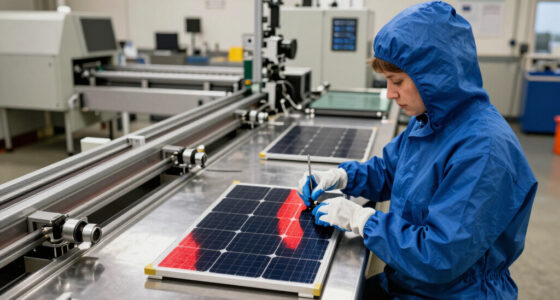
The recent efficiency improvement was achieved by Fraunhofer ISE through the implementation of shingle-matrix technology, which involves cutting triple-junction solar cells into narrow strips and arranging them in an overlapping pattern. This method, developed in collaboration with a mechanical engineering partner, reduces shading and eliminates the need for traditional soldered copper ribbons, thereby increasing the active area for light absorption.
The solar cells used are adapted from space-grade triple-junction cells supplied by Azur Space, optimized for the terrestrial solar spectrum. The module features anti-reflective front glass supplied by Temicon, further enhancing light capture. The previous efficiency record of 34.2% was also based on similar space-grade cells and achieved earlier this year on an 833 cm² module.
According to PV Magazine, this development builds on prior advances, including Fraunhofer ISE’s achievement of 40% efficiency for indoor III-V solar cells based on indium gallium phosphide in July 2025. The new record demonstrates ongoing progress in high-efficiency solar technology, with the shingle-matrix approach now transitioning into commercial module manufacturing.
Implications of the 34.4% Efficiency Record
This efficiency milestone signifies a notable advancement in solar cell technology, particularly for high-performance applications such as space, concentrated solar power, and future terrestrial deployments. Achieving 34.4% efficiency indicates that solar modules can convert more sunlight into electricity, potentially reducing costs and increasing power output for large-scale solar projects.
The adoption of shingle-matrix technology addresses longstanding challenges related to shading and interconnection losses, which are critical for scaling high-efficiency cells into commercial modules. This could accelerate the deployment of next-generation solar panels with higher energy yields, especially in areas with limited space or high energy demands.
Furthermore, the use of space-grade cells adapted for terrestrial use highlights the crossover potential of space technology into mainstream solar manufacturing, potentially paving the way for more robust, high-efficiency modules in the future.

SUNGOLDPOWER 590W Bifacial Solar Panel 6PCS,N-Type 16BB,High Efficiecy Up to 30% Extra Power,Vmp 44.4V/PCS,for 24V/48Vdc Home Backup,Energy Storage,On Grid/Off-Grid System UL61730 (6 * 590W Bifacial)
★【Lower Your Electric Bills】 : The SUNGOLDPOWER 590W bifacial solar panel uses advanced N-Type 16BB cells with up…
As an affiliate, we earn on qualifying purchases.
As an affiliate, we earn on qualifying purchases.
Advances in High-Efficiency Solar Cell Technologies
Fraunhofer ISE has been at the forefront of solar efficiency research, with previous milestones including a 40% efficiency for indoor III-V cells in July 2025. The recent record of 34.4% builds on earlier achievements using space-grade triple-junction cells, which are known for their high efficiency and durability.
The development of shingle-matrix technology by Fraunhofer ISE, in collaboration with mechanical engineering partners, represents a significant innovation in module interconnection methods. This approach reduces shading and metallic contact losses, which are common issues in traditional solar modules.
Earlier this year, the institute set a 34.2% efficiency record on a similar module, indicating ongoing progress in refining cell design, interconnection, and module assembly techniques. The focus has been on adapting space-grade cells for terrestrial environments, aiming to achieve higher efficiencies while maintaining manufacturability and cost-effectiveness.
“The shingle-matrix technology allows us to maximize active area utilization and reduce shading losses, which are critical for pushing efficiency boundaries.”
— an anonymous researcher at Fraunhofer ISE

SUNYIMA 10pcs Mini Monocrystalline Solar Cells Solar System Kit 50mm X 50mm/1.96" X 1.96" 2V 160MA for DIY Charge Solar Panels
【Accurate power】All data are actually measured under the condition that the solar light is sufficient. In full sunlight,…
As an affiliate, we earn on qualifying purchases.
As an affiliate, we earn on qualifying purchases.
Unanswered Questions About Commercial Scalability
It remains unclear how soon the shingle-matrix technology will be adopted at scale in commercial manufacturing, or what costs might be associated with this approach. Additionally, the long-term stability and durability of these modules in various environmental conditions are still under evaluation.
Further testing is needed to confirm whether the efficiency gains can be maintained over the lifespan of the modules and whether manufacturing processes can be optimized for mass production.

Concord Solar Panel Module
35w
As an affiliate, we earn on qualifying purchases.
As an affiliate, we earn on qualifying purchases.
Next Steps Toward Commercial Deployment
Fraunhofer ISE is expected to continue testing and refining the shingle-matrix modules, with potential pilot projects or collaborations with industry partners. The focus will be on assessing long-term performance, scalability, and cost-effectiveness.
Further research may also explore adapting this technology for larger modules and different applications, aiming to translate laboratory efficiency gains into commercial products in the coming years.

KESPEN Window Privacy Film One Way Daytime Privacy Static Cling Sun Blocking Anti UV Reflective Window Tint for Home and Office, Black-Silver, 17.5 Inch X 6.5 Feet
UV BLOCKING & GLARE CONTROL: KESPEN sun blocking window film can effectively block 82% of infrared rays and…
As an affiliate, we earn on qualifying purchases.
As an affiliate, we earn on qualifying purchases.
Key Questions
What is the significance of the 34.4% efficiency record?
This record represents a significant advancement in solar cell technology, indicating higher power output potential for modules and enabling more efficient use of space in solar installations.
How does shingle-matrix technology improve efficiency?
The shingle-matrix approach reduces shading and metallic contact losses by overlapping narrow strips of cells, increasing active area and enabling direct cell-to-cell contact.
Are these high-efficiency modules ready for commercial use?
While the technology shows promise, it is still in the developmental and testing phase. Further work is needed to confirm scalability, durability, and cost-effectiveness for commercial deployment.
What role do space-grade cells play in terrestrial solar modules?
Space-grade cells are known for their high efficiency and durability, and their adaptation for terrestrial use could lead to more robust, high-performance solar modules.
When can we expect to see this technology in the market?
It is uncertain; ongoing testing and development will determine the timeline for commercial adoption, which could still be several years away.
Source: PV Magazine