Choosing between voice control, app control, and fully automated systems depends on how you prefer to interact with your smart home. Voice control offers hands-free, natural commands, perfect when you’re busy or across the room. App control gives you precise management, ideal if you like visual access and customization. Fully automated systems handle routines automatically, creating a seamless experience. Understanding these options helps you find your perfect smart home style—learn more about each to make the best choice.
Key Takeaways
- Voice control offers hands-free, natural interaction but depends on speech clarity and background noise levels.
- App control provides detailed, customizable management with real-time visual feedback but requires proximity or internet access.
- Fully automated systems learn habits and adjust settings automatically, reducing manual effort but need initial setup and investment.
- Combining methods can optimize convenience, control, and automation based on your lifestyle and preferences.
- Choosing the right style depends on your routines, device preferences, and whether you prioritize ease, customization, or proactive automation.

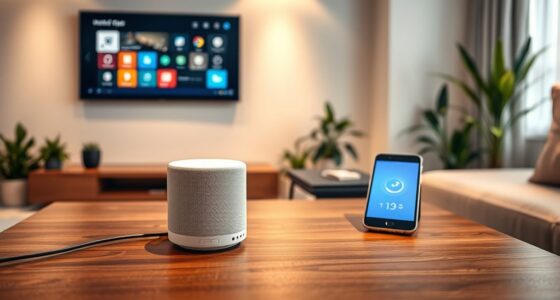
Smart home control options have revolutionized the way you manage your living space, offering convenience and efficiency at your fingertips. Whether you prefer speaking commands, tapping on an app, or letting your system run on autopilot, there’s a solution that fits your lifestyle. Each method has unique advantages, and understanding how they work can help you choose the best style for your daily routines. Voice control, for instance, allows you to manage your devices hands-free. Just say what you want—turn on the lights, adjust the thermostat, or play music—and your smart home responds instantly. This approach is especially handy when your hands are full or you’re across the room. Voice assistants like Alexa, Google Assistant, or Siri integrate seamlessly with a variety of devices, making your voice your primary remote. Plus, voice control can be intuitive and natural, giving you the feeling of interacting with your home in a conversational way. However, it relies on clear speech and a good microphone setup, so background noise or accents can sometimes cause issues.
Voice control offers hands-free convenience, making smart home management easy with natural, intuitive commands.
On the other hand, controlling your smart home via app gives you a high level of precision and control. With a few taps on your smartphone or tablet, you can manage multiple devices, set schedules, or monitor your home’s status from anywhere. Apps typically offer detailed customization options, allowing you to create complex routines or scene settings that activate multiple devices simultaneously. This method works well if you’re a visual person who prefers seeing controls and real-time status updates. It also provides a fallback if voice commands aren’t enough or aren’t working properly. The downside is that it requires you to be near your device or connected to the internet, which might limit immediate access in certain situations. Additionally, local automation can enhance privacy and reduce reliance on cloud services, providing faster response times and increased security.
Fully automated systems take control to the next level by learning your habits and adjusting your environment accordingly. With automation, you program routines or let the system adapt based on sensors and AI. For example, your lights might turn on gradually at sunset, your thermostat adjusts based on your daily schedule, and security cameras activate when you’re away. This style minimizes the need for manual inputs, creating a seamless living experience. It’s perfect if you want a truly hands-off home that responds proactively to your needs. The challenge lies in setting up these systems initially, which can be complex and sometimes costly. Still, once integrated, they can exceptionally enhance comfort, save energy, and provide peace of mind.
Ultimately, your smart home style depends on your preferences—whether you enjoy speaking commands, prefer managing everything through your app, or want a home that runs itself. Each approach offers distinct benefits, and many people find a combination of all three works best for them.
Frequently Asked Questions
Can I Combine Multiple Smart Home Control Methods Effectively?
Yes, you can combine multiple smart home control methods effectively. You might use voice commands for quick adjustments, an app for detailed settings, and automation for routines. This layered approach gives you flexibility, convenience, and control. Just guarantee all your devices are compatible and integrated through a central hub or platform. This way, you optimize your smart home experience and tailor it to your daily habits and preferences.
How Secure Are Voice-Controlled Smart Home Devices?
Voice-controlled smart home devices can be quite secure if you take proper precautions. You should use strong, unique passwords for your accounts and enable two-factor authentication whenever possible. Regularly update your device firmware to patch security vulnerabilities. Be cautious about sharing voice commands and avoid sensitive information spoken aloud. With these steps, you can enjoy the convenience of voice control while keeping your home protected from potential threats.
What Are the Costs Associated With Each Control Option?
You might worry about costs, but each control option varies. Voice control devices often have lower upfront costs, while apps are usually free or inexpensive, but setting up automation can add expenses. Fully automated systems tend to be pricier due to hardware and installation. Still, think about your budget and needs—small setups cost less, and investing upfront can save time and money long-term.
Do All Smart Home Devices Support App and Voice Control?
Not all smart home devices support app and voice control. Some are designed for specific functions and may only work with their proprietary apps or controllers. Before purchasing, check the device specifications to guarantee compatibility with your preferred app or voice assistant. If seamless control is important to you, look for devices labeled as compatible with popular platforms like Alexa, Google Assistant, or Apple HomeKit.
How Reliable Is Fully Automated Home Management?
Fully automated home management can be very reliable, like a well-trained orchestra, but it depends on your system’s quality. When properly set up, it adapts seamlessly to your routines, reducing manual effort. However, occasional glitches may occur due to connectivity issues or device incompatibilities. Regular updates and a strong internet connection help make certain your smart home runs smoothly, giving you peace of mind and effortless convenience.
Conclusion
Ultimately, choosing your smart home style boils down to what feels right for you. Whether you prefer voice commands, app control, or full automation, remember that variety is the spice of life. As the saying goes, “The best way to predict the future is to create it.” So, embrace the option that makes your life easier and more enjoyable, tailoring your smart home to fit your unique needs and lifestyle.