
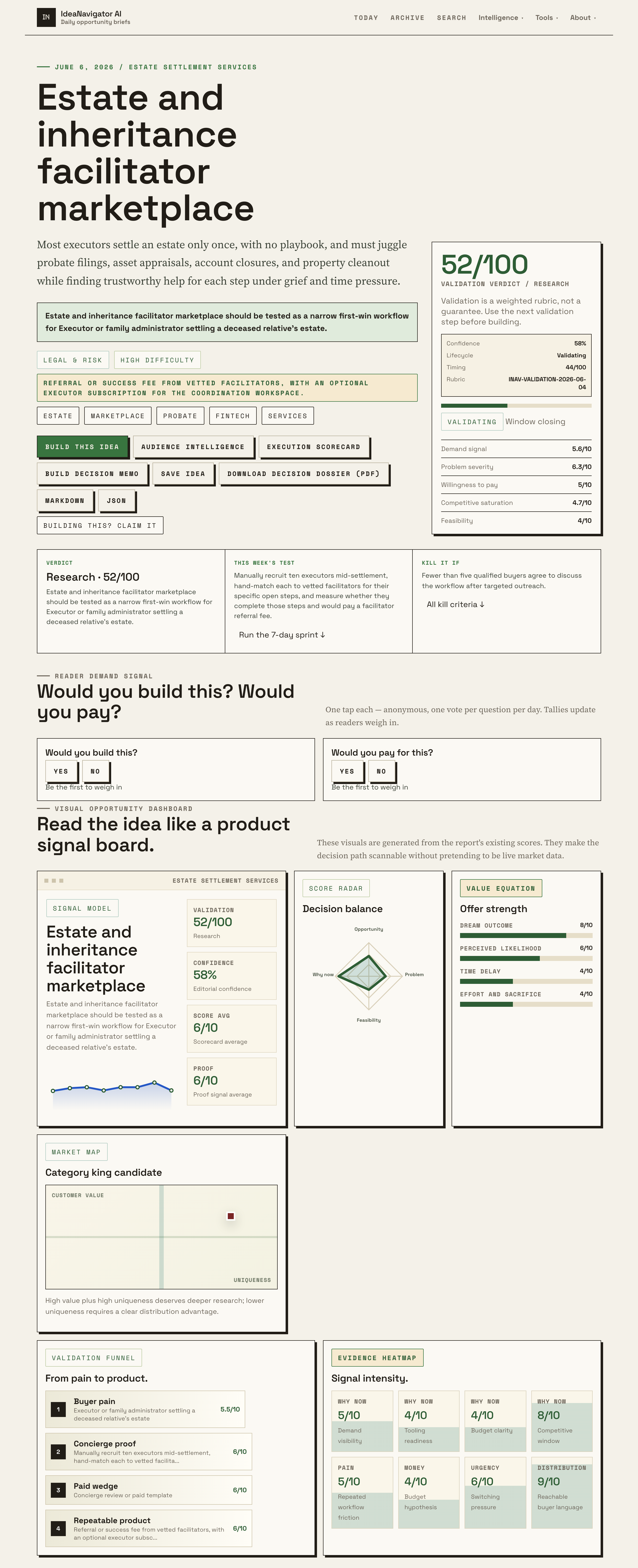
📊 Full opportunity report: Estate And Inheritance Facilitator Marketplace on IdeaNavigator AI — validation score, market gap, and execution plan.
TL;DR
A new estate and inheritance facilitator marketplace is in testing, aiming to streamline estate settlement for executors by providing guided workflows and trusted service matching. The initiative seeks to address current fragmentation in estate services amid rising wealth transfers.
A new estate and inheritance facilitator marketplace is in the pilot testing stage, focusing on guiding executors through the complex process of settling a deceased relative’s estate. This initiative aims to address the fragmented landscape of estate services and streamline the settlement process during a period of increasing wealth transfer and estate complexity.
The marketplace is designed to serve executors and family administrators who often face a one-time, high-pressure task of estate settlement without a clear playbook. The current process involves managing probate filings, asset appraisals, closing accounts, and property cleanouts, often under emotional distress and tight timelines.
According to sources involved in the pilot, the platform will initially offer a guided intake process that diagnoses the specific steps needed for each estate. It will then match each step with vetted facilitators—such as attorneys, appraisers, and estate cleanout services—and track the completion of each task. This concierge-style approach aims to simplify coordination before developing a broader self-serve marketplace.
The project is currently in the validation phase, where ten executors mid-settlement are being manually recruited. They are being paired with facilitators for their specific needs, and their progress and willingness to pay referral or success fees are being measured.
Potential Impact on Estate Settlement Efficiency
This initiative could significantly improve the estate settlement experience by reducing the time and stress involved for executors. It addresses a growing market need, as the largest generational wealth transfer in history is underway, with more estates spanning multiple states and digital accounts. By providing a coordinated, trusted service network, the platform could also improve transparency and trust in estate services, which are currently scattered and unorganized.
Successful validation could lead to a scalable model that transforms how estate settlement services are delivered, potentially reducing costs and increasing satisfaction for heirs and executors alike.
As an affiliate, we earn on qualifying purchases.
Growing Complexity of Estate Settlements Amid Wealth Transfer
The current estate settlement landscape is fragmented, with no centralized platform to guide executors through the process. Many estates involve multiple jurisdictions, digital assets, and a variety of service providers. The ongoing large-scale transfer of wealth from Baby Boomers to younger generations amplifies the need for more efficient, trustworthy facilitation solutions.
Existing services are often found through scattered directories, with no integrated workflow or coordination. The lack of a standardized process leaves many executors to navigate the settlement alone, risking delays, errors, or missed steps. The new marketplace aims to fill this gap by providing a guided, step-by-step approach.
This development aligns with broader trends toward digital transformation in legal and financial services, seeking to simplify complex tasks through technology-enabled workflows.
“The current estate settlement process is often overwhelming for executors, especially when they lack a clear roadmap or trusted service connections.”
— an anonymous researcher
As an affiliate, we earn on qualifying purchases.
Uncertainties Around Platform Adoption and Scalability
It is not yet clear how many executors will adopt the platform after the pilot, or whether facilitators will agree to pay referral or success fees at scale. The long-term viability and competitive positioning of this approach remain uncertain until broader testing and user feedback are available.
As an affiliate, we earn on qualifying purchases.
Next Steps in Validation and Market Expansion
The immediate next step is completing the pilot with the recruited executors, measuring task completion rates and willingness to pay. If successful, the platform plans to expand its network of vetted facilitators and refine its workflow. Further validation will determine whether the model can be scaled into a broader marketplace, potentially transforming estate settlement services.
As an affiliate, we earn on qualifying purchases.
Key Questions
How will the platform ensure the trustworthiness of facilitators?
The platform plans to vet facilitators through a screening process and track their performance during the pilot phase to ensure quality and reliability.
Will this service be available nationwide?
Initially, the focus is on testing the workflow with a limited number of executors. If successful, the goal is to expand the network and support more regions over time.
How does this differ from existing estate services?
Unlike scattered directories or ad hoc services, this platform offers a guided, coordinated workflow that directly matches estate steps with vetted service providers, reducing complexity for executors.
What are the potential costs for executors?
The model may include a subscription for the coordination workspace and referral or success fees paid to facilitators, but specific pricing details are still under development.
What challenges might the platform face in scaling?
Challenges include building a sufficiently large and trusted facilitator network, convincing executors to adopt the platform, and managing fee structures that satisfy all parties.
Source: IdeaNavigator AI