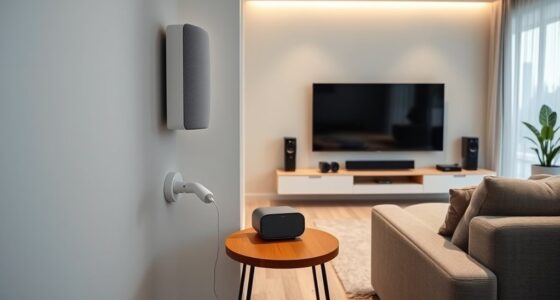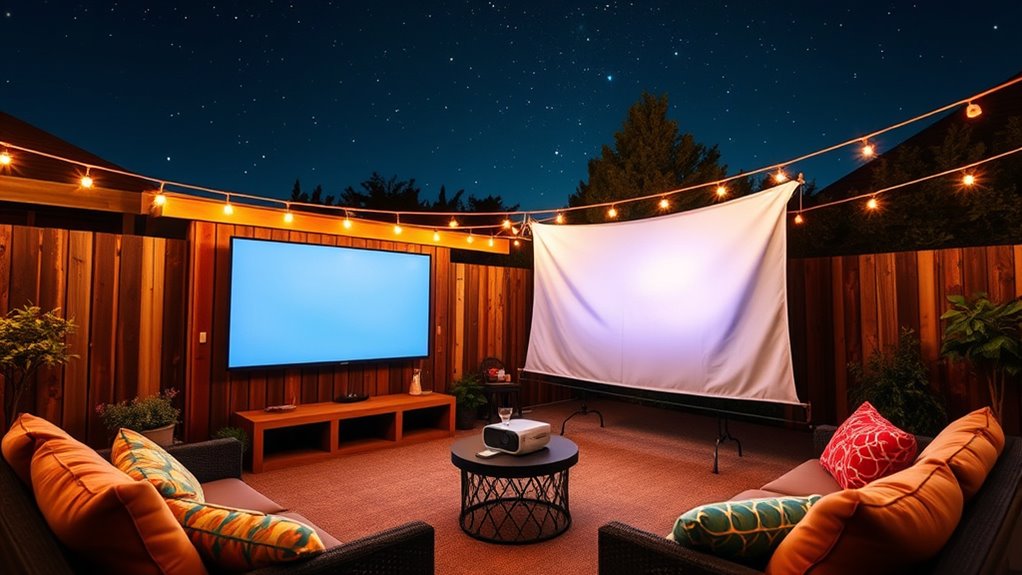

Choosing between a smart TV and a smart projector for outdoor movie nights depends on your space, budget, and how you want to enjoy your backyard theater. A smart TV offers bright, crisp images and simple setup, perfect for daytime viewing and small spaces. On the other hand, a projector provides a larger screen for a true outdoor theater experience, especially in darker environments. To find the best fit, explore more about their features and ideal environments.
Key Takeaways
- Smart TVs offer bright, crisp images suitable for daytime outdoor viewing, while projectors excel in large-screen experiences for darker environments.
- Projectors provide larger display sizes (up to 100 inches or more) and portability, ideal for flexible outdoor setups.
- Smart TVs are fixed installations with built-in speakers, whereas projectors often require external sound systems for optimal audio.
- Both devices support streaming and smart features; selection depends on space, ambient lighting, and preferred viewing size.
- Budget and usage frequency influence choice: TVs suit simple, permanent setups; projectors are better for occasional, immersive outdoor movie nights.

When it comes to enhancing your home entertainment setup, choosing between a smart TV and a smart projector can substantially impact your viewing experience. If you’re planning backyard movie nights, this decision becomes even more important. A smart TV offers a straightforward setup with crisp picture quality and easy access to streaming apps. You simply connect it to your Wi-Fi, turn it on, and start browsing your favorite content. The picture quality on modern smart TVs is impressive, with 4K resolution becoming standard, vibrant colors, and high contrast ratios. Plus, their compact design makes them easy to mount on a wall or place on a stand, blending seamlessly into your outdoor space. However, their size can be limiting for larger group viewing, and their fixed position means you need a dedicated space for ideal viewing.
On the other hand, a smart projector provides flexibility that can elevate your outdoor movie nights. With a projector, you can cast a huge image onto a blank wall, screen, or even a sheet, creating a true outdoor theater experience. Modern projectors are compact and portable, allowing you to set up and pack away easily. They often support wireless connections to stream content directly from your devices, and many come with smart features like built-in apps or compatibility with streaming dongles. The key advantage is size; you can project an image that’s 100 inches or more, making it perfect for larger groups or a more immersive experience. Yet, projectors generally require a darker environment to deliver the best picture, so you’ll want to plan your outdoor space accordingly, perhaps with some light control measures. Additionally, projectors often need a dedicated sound system, as their built-in speakers tend to be less powerful than those of a TV.
Both options have their merits, but your choice depends on your priorities. If simplicity, bright daytime viewing, and a clean aesthetic matter most, a smart TV might be your best bet. If you value size, portability, and creating a true outdoor theater ambiance, a smart projector can deliver that wow factor. Keep in mind that a smart projector might require a bit more setup and investment in sound equipment, but it can turn your backyard into a cinematic playground. Additionally, considering high refresh rates and low input lag can enhance your viewing and gaming experiences outdoors. Ultimately, consider your space, budget, and how often you plan to host outdoor movie nights to decide which option aligns best with your entertainment goals.

Core Innovations 43 Inch Outdoor Smart TV, 4K UHD HDR LED Weatherproof Television for Outside, webOS with Wi-Fi, 500-Nit Partial Sun Display, IP54 Rated, Includes Compatible Wall Mount
VIVID 4K HDR SMART OUTDOOR DISPLAY – Enjoy stunning visuals outdoors with a 4K UHD HDR display and…
As an affiliate, we earn on qualifying purchases.
As an affiliate, we earn on qualifying purchases.
Frequently Asked Questions
Which Device Offers Better Color Accuracy Outdoors?
A smart TV generally offers better color accuracy outdoors because it has a high-quality display with advanced image processing. You’ll notice vibrant, true-to-life colors even in bright conditions. Projectors, on the other hand, tend to lose color fidelity in sunlight unless you use a high-lumen model and a specialized screen. So, if color precision matters most, a smart TV is your best bet for outdoor movie nights.
How Do Ambient Light Conditions Affect Both Options?
Imagine a bright summer evening, and the sunlight’s fading. Ambient light can wash out images on both a smart TV and a projector, but projectors are especially vulnerable. Bright outdoor conditions, like direct sunlight or even a well-lit patio, diminish picture quality on projectors more than on TVs. For the best outdoor viewing, you’ll want a shaded spot or a high-lumen projector to combat ambient light and keep visuals sharp.
Can Smart Projectors Connect to Streaming Services?
Yes, smart projectors can connect to streaming services. You typically do this via built-in Wi-Fi or HDMI ports, allowing you to access platforms like Netflix, Hulu, or Disney+. Some projectors have dedicated apps, while others mirror your phone or tablet screen. Just make certain your projector has compatible apps or streaming device support, so you can easily enjoy your favorite shows and movies outdoors without needing extra equipment.
What Are the Power Consumption Differences?
You’ll find that smart projectors generally consume more power than smart TVs, mainly because they require brighter bulbs for outdoor use. A typical smart projector uses around 100-300 watts, depending on brightness and size, while a smart TV usually uses about 50-150 watts. So, if you plan outdoor movie nights often, consider the energy costs and how long you’ll run your device to manage power consumption effectively.
Which Device Is More Portable for Outdoor Use?
You’ll find that smart projectors are more portable for outdoor use, with many weighing under 5 pounds, making them easy to carry around. In comparison, smart TVs tend to be bulkier and heavier, often over 15 pounds. An interesting stat: portable projectors are now as compact as a small book, so you can effortlessly set up your outdoor movie nights anywhere. This makes projectors the clear choice for on-the-go entertainment.
![[Officially-Licensed App & Auto Focus]White Smart Mini Projector with WiFi and Bluetooth, XuanPad 4K Support Movie Projector, Portable Native 1080P Outdoor Projector with 360° Stand](https://m.media-amazon.com/images/I/51I8uy-U8bL._SL500_.jpg)
[Officially-Licensed App & Auto Focus]White Smart Mini Projector with WiFi and Bluetooth, XuanPad 4K Support Movie Projector, Portable Native 1080P Outdoor Projector with 360° Stand
Exciting Moments Begin – The XuanPad mini projector compatible with Netflix for the ultimate viewing experience.No extra devices…
As an affiliate, we earn on qualifying purchases.
As an affiliate, we earn on qualifying purchases.
Conclusion
Ultimately, choosing between a smart TV and a smart projector depends on your outdoor space and movie preferences. If you want a straightforward setup with a bright display, a smart TV is your go-to. But if you crave flexibility and a true backyard theater experience, a smart projector can turn any wall into a cinematic canvas. Remember, it’s all about finding what fits your needs—sometimes, you’ve got to think outside the box to get the best results.
[Officially-Licensed App & Auto Focus]White Smart Mini Projector with WiFi and Bluetooth, XuanPad 4K Support Movie Projector, Portable Native 1080P Outdoor Projector with 360° Stand
Exciting Moments Begin – The XuanPad mini projector compatible with Netflix for the ultimate viewing experience.No extra devices…
As an affiliate, we earn on qualifying purchases.
As an affiliate, we earn on qualifying purchases.

Assistrust Sound Bar for Smart TV, Soundbar with Bluetooth/ARC/Opt/AUX Connect, Auto Volume Boost, 3 Equalizer Modes, 2 in 1 Detachable Soundbar for TV/PC/Gaming/Projectors
【𝐈𝐦𝐩𝐚𝐜𝐭𝐟𝐮𝐥 𝐕𝐨𝐥𝐮𝐦𝐞 𝐁𝐨𝐨𝐬𝐭】: Elevate faint sounds to vibrant with automatic loudness boost. Experience immersive sound through 4 versatile…
As an affiliate, we earn on qualifying purchases.
As an affiliate, we earn on qualifying purchases.