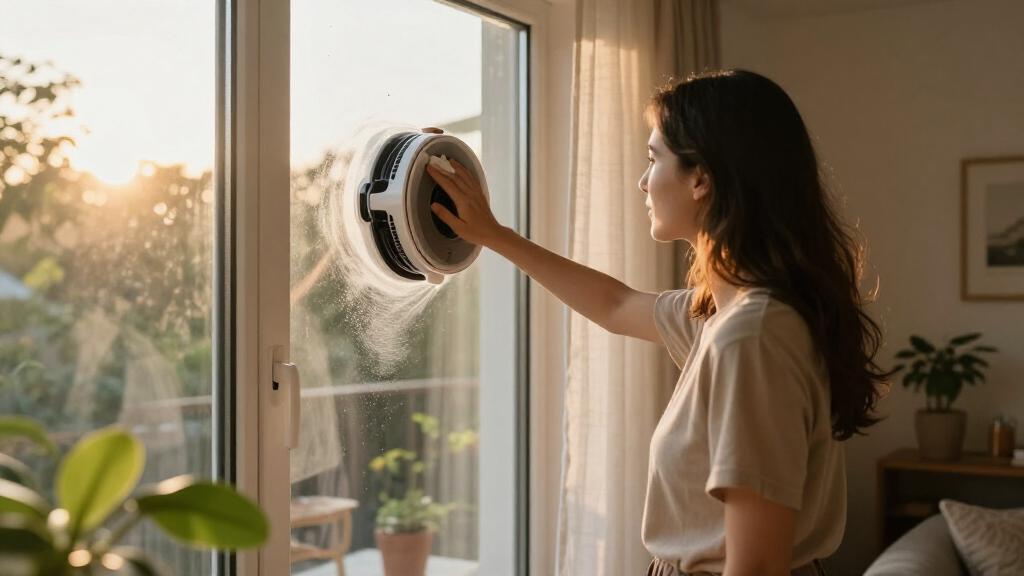
Robot window cleaners take one of the most dreaded household chores — balancing on a ladder with a squeegee — and hand it off to a suction-powered machine that crawls across the glass for you. After comparing 15 current models, the ECOVACS WINBOT W2 PRO Omni stands out as the best overall pick thanks to its multi-functional station that washes and dries the pads automatically, plus strong edge-to-edge coverage. The ECOVACS WINBOT W3 Omni is the premium step-up with a self-cleaning station, while the HIXZAP Z9Pro with four sprayers offers serious coverage for the money. The main tradeoff in this category is between convenience (stations that maintain the pads for you) and affordability (basic models that need manual pad rinsing between windows). Keep reading for the full ranked breakdown.

Get home appliances delivered free — and shop member deals
- Fast, free delivery on millions of items
- Access to Prime Big Deal Days deals on October 6–7
- Prime Video, Amazon Music and more included
Complete the kit


Key Takeaways
- Self-cleaning or multi-functional stations (W2 PRO Omni, W3 Omni) are the single biggest differentiator in 2026 — they eliminate the grimy-pad problem that plagues every budget robot in this lineup.
- Spray system design matters more than spray count: the Tosima X1’s ultrasonic atomization wastes far less water than the four-nozzle HIXZAP Z9Pro, making it better for small windows.
- Suction numbers (5600Pa to 6500Pa) matter less than the track system — HUTT‘s round-square design and ECOVACS‘s TruEdge both outperform higher-suction generic models on corners and frames.
- Compact models like the WINBOT Mini line trade cleaning speed for maneuverability on small or divided panes — a smart choice only if you don’t have large picture windows.
- Generic-brand units cluster around similar specs (dual spray, ~6000Pa); what separates them is water tank size, remote vs app control, and safety rope quality.
| HIXZAP Z9Pro Window Cleaning Robot with 4 Sprayers |  | Best Multi-Surface Flexibility | Sprayers: 4 | Suction power: 3200Pa | Emergency power backup: 20 minutes | VIEW LATEST PRICE | See Our Full Breakdown |
| Tosima X1 Window Cleaning Robot – Dual-Nozzle Ultrasonic Water Atomization |  | Best for Streak-Free Finish | Special features: Edge cleaning, low noise, wet/dry, portable | Capacity: 85 ml visible water tank | Cleaning path width: 8 inches | VIEW LATEST PRICE | See Our Full Breakdown |
| ECOVACS WINBOT Mini Window Cleaning Robot |  | Best for Beginners and Daily Maintenance | Surface recommendation: Glass | Controller type: App control | Dimensions: 8.46 x 8.46 x 2.17 inches | VIEW LATEST PRICE | See Our Full Breakdown |
| X6 Window Cleaning Robot with 6400Pa Suction |  | Best for High-Rise and Hard-to-Reach Glass | Suction power: 6400Pa variable | UPS backup duration: 30 minutes | Cleaning speed: 3.3㎡ per 7 minutes | VIEW LATEST PRICE | See Our Full Breakdown |
| Automatic Window Cleaning Robot with Water Spray and 5600 Pa Suction |  | Best Accessory Bundle Value | Suction power: 5600 Pa | Cleaning modes: 3 automatic modes; manual directional mode | Water spray: Automatic and manual | VIEW LATEST PRICE | See Our Full Breakdown |
| ECOVACS WINBOT MINI 2 Compact Window Cleaning Robot |  | Best for Small and Narrow Windows | Dimensions: 8.46 x 8.46 x 2.17 in | Suction: 8000 Pa | Edge coverage: Up to 90% | VIEW LATEST PRICE | See Our Full Breakdown |
| Automatic Window Cleaning Robot with Dual Spray |  | Best Budget Entry Point | Suction power: 3000 Pa | Water tank: 50 ml | Cleaning paths: 3 | VIEW LATEST PRICE | See Our Full Breakdown |
| ECOVACS WINBOT W2S Window Cleaning Robot with TruEdge Cleaning |  | Best Edge and Corner Coverage | Cleaning modes: 7 (Fast, Deep, Thorough, Edge, Spot, Zone, Heavy-Duty) | Navigation: WIN-SLAM 4.0 | Spray system: Three wide-angle nozzles | VIEW LATEST PRICE | See Our Full Breakdown |
| ECOVACS WINBOT W3 Omni Robot Window Cleaner with Self-Cleaning Station |  | Best Premium Setup | Navigation: Win-SLAM 5.0 with obstacle avoidance | Obstacle avoidance precision: 1 mm | Spray system: Triple-nozzle wide-angle | VIEW LATEST PRICE | See Our Full Breakdown |
| ECOVACS WINBOT W2 PRO Omni Window Cleaning Robot with Multi-Functional Station |  | Best Cordless Flexibility | Power modes: Battery and plugged-in | Battery life: Up to 110 minutes lithium-ion | Spray system: Three wide-angle nozzles | VIEW LATEST PRICE | See Our Full Breakdown |
| Tosima W5 Window Cleaning Robot |  | Best for Small Panes | Surface: Glass windows | Maximum suction: 6400 Pa | Cleaning path width: 6 inches | VIEW LATEST PRICE | See Our Full Breakdown |
| TOSIMA WA9C Pro Window Cleaning Robot with Dual Spray |  | Best Accessory Bundle | Suction force: 2600–3200 Pa | Cleaning modes: N-shape, Z-shape, manual | Cleaning path width: 8 inches | VIEW LATEST PRICE | See Our Full Breakdown |
| HUTT Round-Square Window Cleaning Robot |  | Best for Corners and Edges | Cleaning system: Round-square dual-stage | Maximum suction: 6500 Pa | Water tank: 80ml (up to 646 sq ft per refill) | VIEW LATEST PRICE | See Our Full Breakdown |
| Automatic Window Cleaning Robot with Double Helix Suction |  | Best Smart Dirt Response | Suction power: 4800–6400 Pa | Water tank: 85 ml | Spraying: Bidirectional ultrasonic atomization, twice per movement | VIEW LATEST PRICE | See Our Full Breakdown |
| BOJUK Window Cleaning Robot with 6500Pa Suction |  | Best for Routine Upkeep | Suction power: 6500 Pa | Cleaning modes: 3 (Top-Down, Left-Down, Right-Down) | Cleaning path width: 8 inches | VIEW LATEST PRICE | See Our Full Breakdown |
| robot window cleaner | Cleaning modes |
|---|---|
| HIXZAP Z9Pro Window Cleaning R | Z-shape and spot cleaning |
| Tosima X1 Window Cleaning Robo | — |
| ECOVACS WINBOT Mini Window Cle | 3 |
| X6 Window Cleaning Robot with | — |
| Automatic Window Cleaning Robo | 3 automatic modes; manual directional mode |
| ECOVACS WINBOT MINI 2 Compact | 5 (Fast, Thorough, Deep, Spot, Edge Clean) |
| Automatic Window Cleaning Robo | — |
| ECOVACS WINBOT W2S Window Clea | 7 (Fast, Deep, Thorough, Edge, Spot, Zone, Heavy-Duty) |
| ECOVACS WINBOT W3 Omni Robot W | 3 (Fast, Intensive, Zone) |
| ECOVACS WINBOT W2 PRO Omni Win | — |
| Tosima W5 Window Cleaning Robo | — |
| TOSIMA WA9C Pro Window Cleanin | N-shape, Z-shape, manual |
| HUTT Round-Square Window Clean | — |
| Automatic Window Cleaning Robo | — |
| BOJUK Window Cleaning Robot wi | 3 (Top-Down, Left-Down, Right-Down) |
More Details on Our Top Picks
HIXZAP Z9Pro Window Cleaning Robot with 4 Sprayers
Four independent sprayers are the Z9Pro’s defining advantage, and that matters if your glass varies from heavily smudged patio doors to lightly dusted mirrors. Where the Tosima X1 relies on a single 85 ml tank feeding two nozzles, the Z9Pro distributes water across a wider path, so you spend less time re-wetting large panes. The Z-shape and spot-cleaning modes let you target stubborn handprints rather than re-running a full pass, and the 20-minute emergency power backup plus safety tether put it in the same safety league as the X6 for second-story windows.
The tradeoffs are real, though. At 3200Pa, suction sits well below the X6’s 6400Pa, which may show on grimy exterior glass. And the listing’s data is sloppy — a 1 × 1 × 1 in dimension claim and a bamboo surface recommendation both suggest sloppy quality control on the listing side, which gives me pause about long-term support.
Pros:- Four-sprayer system covers large panes with fewer refill stops
- Spot-cleaning mode targets individual smudges efficiently
- Remote control works without needing a smartphone app
- Safety tether and 20-minute backup power for elevated windows
Cons:- 3200Pa suction is modest compared with the X6’s 6400Pa
- Listing data is inconsistent, raising questions about brand polish
- Tank and pad maintenance is fully manual
Best for: Households with a mix of glass doors, shower enclosures, and mirrors who want targeted spot cleaning without re-washing entire panes
Not ideal for: Anyone cleaning heavily soiled exterior windows — the 3200Pa suction is the weakest of the powered picks here and will likely need repeat passes
- Sprayers:4
- Suction power:3200Pa
- Emergency power backup:20 minutes
- Control method:Remote control
- Cleaning modes:Z-shape and spot cleaning
- Special feature:360-degree swivel
- Battery life:5 hours
Our verdict“A sensible pick for mixed indoor glass where versatility and spot cleaning matter more than raw suction power.”
Tosima X1 Window Cleaning Robot – Dual-Nozzle Ultrasonic Water Atomization
The X1’s ultrasonic water atomization is the feature that separates it from spray-based rivals like the Z9Pro. Instead of squirting droplets onto glass, it produces a fine mist that spreads evenly before the pad passes over it — that’s the mechanism behind genuinely streak-free results, and it’s the reason to choose this model if visible glass quality is your priority, say for living room picture windows or glass railings. The transparent 85 ml tank is a small but genuinely useful touch: you can see exactly when a refill is due instead of guessing.
Be realistic about scale, though. Eighty-five milliliters empties quickly on large window banks, and the roughly 25-minute corded runtime window means big jobs will need multiple sessions. Compared with the ECOVACS WINBOT Mini, you give up app control for a remote — fine for some, a dealbreaker for smart-home households. It’s also glass-only, so shower tile owners should look elsewhere.
Pros:- Ultrasonic atomization produces visibly streak-free glass
- Transparent tank makes refill timing obvious
- Backup battery keeps the unit attached during power loss
- S-shaped automatic path handles both large and small panes
Cons:- 85 ml tank limits continuous cleaning to short sessions
- Remote-only control lacks app integration
- Not suitable for non-glass surfaces
Best for: Detail-oriented owners of standard-sized glass windows who prioritize a polished, streak-free finish over speed
Not ideal for: Homes with expansive window walls or non-glass surfaces like tile — the small tank and glass-only design will frustrate both
- Special features:Edge cleaning, low noise, wet/dry, portable
- Capacity:85 ml visible water tank
- Cleaning path width:8 inches
- Controller type:Remote control
- Noise level:65 dB
- Power source:Corded electric
- Form factor:Compact
Our verdict“The pick when finish quality outranks coverage speed, provided your windows are a manageable size.”
ECOVACS WINBOT Mini Window Cleaning Robot
Of everything in this lineup, the WINBOT Mini is the one I’d hand to someone who has never owned a window robot. Setup logic is simple, operation is quiet enough for daily use, and app control — which the Tosima X1 and Z9Pro both lack — means you can start a cycle from the couch. The 9-stage protection system and washable filters round out a package built for frequent, low-effort upkeep rather than deep cleaning events.
Calibrate your expectations accordingly. ECOVACS positions this for routine dust, smudges, and light marks; heavy buildup from pollen season or months of neglect will require pad swaps and repeat cycles. Against the X6, it trades raw cleaning aggression for approachability, and against the Tosima X1 it skips atomization for dual ultrasonic nozzles in a gentler package. Owners of filthy exterior glass should step up to a higher-suction model instead.
Pros:- App control integrates with a smart-home routine
- Compact 8.46-inch frame is easy to position and store
- Quiet enough for everyday, in-room operation
- 9-stage protection system keeps the unit securely attached
Cons:- Struggles with heavy buildup without repeat cycles
- Cleaning scope limited to light dust and smudges
- Small size means more time on larger windows
Best for: First-time robot owners and tidy households wanting quiet, app-controlled touch-ups on indoor glass
Not ideal for: Anyone restoring neglected or exterior windows — heavy soil exceeds what this compact unit is designed to handle in one pass
- Surface recommendation:Glass
- Controller type:App control
- Dimensions:8.46 x 8.46 x 2.17 inches
- Cleaning modes:3
- Protection system:9-stage
- Spray system:Dual nozzles with ultrasonic spray
- Filter type:Washable
Our verdict“The easiest entry point into robot window cleaning for maintenance-level cleaning on modest glass.”
X6 Window Cleaning Robot with 6400Pa Suction
If your windows are the kind you’d rather not ladder up to, the X6 is the strongest argument in this batch. Its 6400Pa variable suction doubles the pulling power of the HIXZAP Z9Pro, which translates directly into firmer pad contact and better results on exterior grime. The safety story is the most complete here: a 30-minute UPS backup (versus 20 on the Z9Pro and 25 on the Tosima X1), a safety cable rated beyond 150 lbs, and anti-fall edge detection — all features that earn their keep on second-floor or skylight glass. AI-planned paths and a claimed 3.3㎡ in about 7 minutes make it efficient across multi-window runs.
It is not a hands-off appliance, however. You’ll swap pads mid-job, pre-spray very dirty glass, and expect two passes on worst-case panes. Treat it as a powered assistant rather than a set-and-forget device.
Pros:- Class-leading 6400Pa variable suction for exterior grime
- Longest backup power here at 30 minutes plus 150+ lb safety cable
- AI navigation covers window area without missed spots
- Works on mirrors, skylights, and tile walls, not just vertical windows
Cons:- Manual pad replacement interrupts larger cleaning jobs
- Heavily soiled glass needs two full passes
- Glass requires pre-spraying for best results
Best for: Owners of tall homes, skylights, or hard-to-reach exterior glass who need serious suction and redundant safety features
Not ideal for: Buyers wanting a fully automated, hands-off experience — pad swaps, pre-spraying, and repeat passes demand regular attention
- Suction power:6400Pa variable
- UPS backup duration:30 minutes
- Cleaning speed:3.3㎡ per 7 minutes
- Coverage:95% of window area
- Control:Remote
- Body shape:Round
- Warranty:1 year
Our verdict“The right tool for elevated or neglected glass where suction and safety redundancy justify the extra involvement.”
Automatic Window Cleaning Robot with Water Spray and 5600 Pa Suction
What sells this unnamed-but-capable robot isn’t headline specs — the 5600Pa suction lands between the Z9Pro and the X6, respectable without leading — but what’s in the box. Ten cleaning pads, four cleaning rings, a remote, adapter, safety rope, and water container arrive together, so you’re not shopping for consumables after week two. The dual spiral cleaning heads also agitate grime mechanically rather than relying purely on pad drag, which helps explain how it competes above its weight against pricier models.
The 300 lb-rated safety rope exceeds the X6’s cable rating, a genuine plus for upper-floor work. The compromises: it must stay tethered to the adapter, there’s no app, and it’s limited to glass and other smooth surfaces — textured tile owners should look at the X6 instead. Manual spray override at least lets you handle dry spots yourself.
Pros:- Ten pads and four cleaning rings included, minimizing add-on purchases
- 300 lb-rated safety rope exceeds most rivals’ cable ratings
- Dual spiral heads add mechanical scrubbing action
- Automatic and manual spray modes give control over wetness
Cons:- Corded adapter restricts mobility across distant windows
- No app or smart-home integration
- Limited to glass and smooth surfaces only
Best for: Budget-conscious buyers who want a complete out-of-the-box kit with plenty of consumables for regular cleaning
Not ideal for: Smart-home users wanting app control, or anyone with rough or textured surfaces beyond smooth glass
- Suction power:5600 Pa
- Cleaning modes:3 automatic modes; manual directional mode
- Water spray:Automatic and manual
- Safety rope capacity:300 lbs
- Cleaning heads:Dual spiral with microfiber pads
- Frame detection:Automatic window frame and obstacle detection
Our verdict“A practical, well-equipped middle-ground pick for buyers who value included consumables over brand polish or app features.”
ECOVACS WINBOT MINI 2 Compact Window Cleaning Robot
Size is the whole story here. At 8.46 inches square, the WINBOT MINI 2 fits panes that full-size machines like the WINBOT W2S simply can’t mount — the W2S demands a minimum glass area of 11.8 × 15.7 inches, while this one works down to 8.66 × 9.84 inches. That makes it the pick for divided-light windows, narrow sidelights, and small bathroom mirrors where rivals are physically too large.
The tradeoff is honest: ultrasonic mist and microfiber pads are built for routine maintenance of light dirt, so neglected glass will need repeat cycles. Edge brushes and the dedicated Edge Clean mode push coverage up to 90%, which cuts corner touch-ups, though some manual finishing remains.
Pros:- Compact footprint fits narrow panes other robots can’t mount
- Edge brushes and Edge Clean mode reduce corner touch-ups
- 8000 Pa suction plus rope and 30-minute backup attachment protection
- Five cleaning modes with app and Bluetooth directional control
Cons:- Light-duty cleaning power means heavily soiled glass needs multiple passes
- Still requires a minimum window size of 8.66 × 9.84 inches
Best for: Owners of older homes with small divided panes, sidelights, and mirrors who want regular upkeep without hand-wiping
Not ideal for: Homes with large picture windows caked in heavy grime — the cleaning pressure and mist system are tuned for light dirt
- Dimensions:8.46 x 8.46 x 2.17 in
- Suction:8000 Pa
- Edge coverage:Up to 90%
- Cleaning modes:5 (Fast, Thorough, Deep, Spot, Edge Clean)
- Navigation:WIN-SLAM 4.0
- Battery life:200 minutes lithium-ion
- Noise level:65 dB
Our verdict“Buy it if your windows are small or awkwardly shaped; skip it for big, dirty glass where a larger robot cleans faster and deeper.”
Automatic Window Cleaning Robot with Dual Spray
This unbranded dual-spray robot covers the fundamentals at the accessible end of the lineup. The dual water spray and three cleaning paths put it ahead of dry-pad-only budget machines, and its edge detection works even on frameless windows — something not every cheap robot can claim.
Compared with the TOSIMA WA9C Pro, the suction here is a modest 3000 Pa and the battery backup is shorter at 15–20 minutes, so it’s strictly a plugged-in tool. Set expectations accordingly: it’s a maintenance cleaner, not a restoration tool. Heavily stained panes need manual pre-cleaning first.
Pros:- Dual spray loosens dirt better than dry-pad budget robots
- Edge detection works on frameless glass
- Handles windows, doors, skylights, and mirrors
- Ten included microfiber cloths reduce refill purchases
Cons:- 3000 Pa suction is the weakest in this lineup
- Must stay plugged in; not cordless, and backup battery covers only 15–20 minutes
Best for: First-time buyers who want to try robotic window cleaning without a big commitment
Not ideal for: Anyone with curved glass, thick window trim, or off-grid/outlet-free setups — the cord and surface limits rule those out
- Suction power:3000 Pa
- Water tank:50 ml
- Cleaning paths:3
- Battery backup:15–20 minutes
- Power source:Corded electric
- Safety rope:4 m
- Control:Remote control
Our verdict“A sensible low-risk first robot for standard flat glass, as long as you accept pre-cleaning dirty panes by hand.”
ECOVACS WINBOT W2S Window Cleaning Robot with TruEdge Cleaning
If visible corner residue is your pet peeve, the W2S is built around solving it. TruEdge scrubbers reach roughly 1.1 mm from frame edges under lab conditions — noticeably closer than the WINBOT MINI 2’s 90% coverage — and the seven-mode menu includes a dedicated Heavy-Duty cycle the smaller robot lacks.
The three-nozzle spray system plus WIN-SLAM 4.0 path planning make it a genuinely capable daily driver too. Compared with the dual-spray budget robot above, you get smarter navigation and far more mode flexibility, but you give up nothing in cord dependence — the W2S also requires a live outlet. Deep window frames can still interrupt its route.
Pros:- TruEdge scrubbers clean closer to frames and corners than most rivals
- Seven modes including Heavy-Duty for tougher jobs
- Three wide-angle spray nozzles wet glass evenly
- Internal safety battery holds suction during power interruptions
Cons:- Corded only; cannot run on battery power
- Requires minimum 11.8 × 15.7 in flat glass, and frames may obstruct coverage
Best for: Detail-oriented owners frustrated by dirty corners and frame lines on standard flat windows
Not ideal for: Homes with outlets far from windows or textured/curved glass — the power cord and flat-glass-only requirement are hard limits
- Cleaning modes:7 (Fast, Deep, Thorough, Edge, Spot, Zone, Heavy-Duty)
- Navigation:WIN-SLAM 4.0
- Spray system:Three wide-angle nozzles
- Edge cleaning distance:Approx. 1.1 mm (lab conditions)
- Minimum glass size:11.8 × 15.7 in (30 × 40 cm)
- Compatible tilt angle:±45°
- App:ECOVACS HOME
Our verdict“The pick for people who judge a robot by how clean the edges look when it’s done.”
ECOVACS WINBOT W3 Omni Robot Window Cleaner with Self-Cleaning Station
The W3 Omni is the most hands-off package here. Its self-cleaning station washes the mop pads with 16 high-pressure nozzles in about a minute, which matters more than it sounds — pad maintenance is the hidden chore that makes most window robots feel less automated. The Win-SLAM 5.0 navigation with 1 mm obstacle avoidance also edges out the W2S’s 4.0 system, rerouting around latches and handles instead of stalling.
Its 200 RPM TruEdge scrubber targets the same corner problem as the W2S, but with only three cleaning modes versus seven, it trades flexibility for polish. And note that station functionality is optional — buyers who skip it lose the headline feature.
Pros:- Station automatically washes mop pads in about a minute
- Win-SLAM 5.0 obstacle avoidance with 1 mm precision
- 200 RPM TruEdge scrubber attacks corners directly
- Triple-nozzle wide-angle spray loosens dirt across the full pad width
Cons:- Self-cleaning station function is optional and not guaranteed in every configuration
- Only three cleaning modes limits customization compared to similarly priced rivals
Best for: Buyers who want maximum automation and hate rinsing dirty pads after every session
Not ideal for: Tinkerers who want granular mode control — three modes is thin next to the W2S’s seven
- Navigation:Win-SLAM 5.0 with obstacle avoidance
- Obstacle avoidance precision:1 mm
- Spray system:Triple-nozzle wide-angle
- Edge cleaning:TruEdge scrubber at 200 RPM
- Cleaning modes:3 (Fast, Intensive, Zone)
- Mop pad cleaning:Station with 16 high-pressure nozzles, ~1 minute
- Protection levels:12
Our verdict“The most automated window-cleaning system in this lineup, best for those who’d rather pay more than touch a dirty pad.”
ECOVACS WINBOT W2 PRO Omni Window Cleaning Robot with Multi-Functional Station
The W2 PRO Omni is the only robot in this batch that runs both ways: on battery or plugged in. That dual-mode design solves the W2S’s biggest weakness — being chained to an outlet — making it the strongest choice for hard-to-reach windows, upper floors, and outdoor glass where extension cords are a hassle. Up to 110 minutes of battery cleaning covers a respectable amount of glass per charge.
It shares the W2S’s three-nozzle spray and WIN-SLAM 4.0 planning, but unlike the W3 Omni’s pad-washing station, its station is multi-functional rather than purely self-cleaning. The ceiling is real, though: roughly 55 square meters per full charge, so very large glass-heavy homes will work in tethered mode anyway.
Pros:- Dual power modes: battery or continuous plugged-in operation
- 110 minutes of cordless runtime covers most residential sessions
- Three wide-angle spray nozzles with intelligent path planning
- 12-stage protection system with anti-fall safeguards
Cons:- Battery mode covers only about 55 square meters per charge
- Glass-only design; no versatility beyond smooth window surfaces
Best for: Owners of outlet-poor homes, tall windows, or outdoor glass who need true cordless operation
Not ideal for: Large properties with extensive glazing — battery coverage caps out around 55 square meters per charge
- Power modes:Battery and plugged-in
- Battery life:Up to 110 minutes lithium-ion
- Spray system:Three wide-angle nozzles
- Path planning:WIN-SLAM 4.0
- Protection:12-stage protection system
- Control:ECOVACS app
- Filter:Washable
Our verdict“The flexible pick for homes where the nearest outlet isn’t near the windows that need cleaning.”
Tosima W5 Window Cleaning Robot
The Tosima W5 earns its place as the pick for smaller windows and divided panes. While the BOJUK covers an 8-inch path for big glass, the W5’s narrower 6-inch footprint lets it work on glass the bigger machines can’t fit, and the 360-degree swivel helps it turn on tight panes without getting stuck. Its 6400 Pa adaptive suction matches the suction figures of pricier rivals like the HUTT, adjusting grip based on the surface rather than running flat-out.
The tradeoff is throughput: a 6-inch path means more passes on a large picture window, so anyone with floor-to-ceiling glass will finish faster elsewhere. The dual-spray system and spiral pads handle routine grime well, though like most budget robots, it still needs a wall outlet and a safety rope anchored overhead.
Pros:- Compact 6-inch path suits small and divided panes
- Adaptive suction up to 6400 Pa adjusts to the surface
- Dual-spray system wets as it cleans
- Safety rope rated to 220 kg plus backup battery
Cons:- Requires a wall outlet during normal operation
- Narrower path slows down large-window jobs
- Glass-only surface support
Best for: Apartment dwellers and anyone with divided window panes or narrow glass panels
Not ideal for: Owners of large picture windows — the 6-inch path makes big jobs slow compared to 8-inch rivals
- Surface:Glass windows
- Maximum suction:6400 Pa
- Cleaning path width:6 inches
- Backup battery:Up to 25 minutes
- Controls:Button and remote control
- Safety rope capacity:Up to 220 kg
Our verdict“If your home has lots of small or divided panes, this is the robot that will actually fit them.”
TOSIMA WA9C Pro Window Cleaning Robot with Dual Spray
What separates the WA9C Pro from the bare-bones competition is everything in the box. Compared with the Automatic Window Cleaning Robot with Double Helix Suction, which ships with minimal extras and thin documentation, this kit arrives with four cleaning mops, replacement nozzles, an unclogging needle kit, and a water bottle — the supplies you’d otherwise buy piecemeal after month one. Four spray nozzles also give it broader wetting coverage than the Tosima W5’s dual-spray setup.
The catch is raw grip: at 2600–3200 Pa, its suction sits well below the 6400–6500 Pa class of the HUTT and BOJUK. That’s usually fine on clean, smooth glass, but heavy hard-water staining is better tackled by a stronger-suction model. The N- and Z-shaped paths are efficient, and the 8-inch path covers real estate quickly when suction isn’t the limiting factor.
Pros:- Four nozzles spray across the full cleaning path
- Complete accessory kit including mops, nozzles, and maintenance tools
- N- and Z-shaped paths with an 8-inch coverage width
- Anti-fall sensors, safety rope, and 25-minute backup battery
Cons:- Suction of 2600–3200 Pa trails stronger rivals by nearly half
- Safety rope must be anchored for overhead use
- Still needs AC power for normal cleaning
Best for: First-time buyers who want a complete out-of-the-box kit with spares included
Not ideal for: Glass with heavy mineral buildup — the lower suction range may need repeat passes
- Suction force:2600–3200 Pa
- Cleaning modes:N-shape, Z-shape, manual
- Cleaning path width:8 inches
- Backup battery:Up to 25 minutes
- Control:Remote control
- Included accessories:Remote, 4 mops, nozzle kit, water bottle, AC adapter
Our verdict“The most supply-complete package here — a smart pick if you’d rather not shop for replacement pads and nozzles later.”
HUTT Round-Square Window Cleaning Robot
Most window robots are one shape, which means one blind spot: either corners or curves suffer. The HUTT’s round-square dual-stage system attacks both, pairing a square frame for corners with a round element for surface coverage — a genuine edge over single-form robots like the Tosima W5 on panes with visible frame borders. Add smart mapping and 14 sensors, and it plans routes more deliberately than the simpler remote-steered models in this lineup.
Its versatility also beats glass-only rivals: the 80ml tank and dual ultrasonic spray handle mirrors, shower doors, and sliding doors, not just windows. The compromises are maintenance-related — the tracks and pads need to stay clean and dry to avoid slipping, and the 80ml tank will need a refill mid-job on very large glass. At 1.3kg, it’s one of the lighter options here despite the hardware inside.
Pros:- Round-square hybrid system reaches corners single-shape robots miss
- Smart mapping with 14 sensors for route planning
- Works on mirrors, shower doors, and sliding doors
- Lightweight at 1.3kg with 30-minute backup adhesion
Cons:- Tracks and pads must be kept clean and dry to prevent slipping
- 80ml tank needs refilling on larger jobs
- Corded power limits where it can run
Best for: Detail-oriented owners who care about corner and edge coverage across multiple glass surfaces
Not ideal for: Set-and-forget users — pads and tracks demand regular cleaning to maintain grip
- Cleaning system:Round-square dual-stage
- Maximum suction:6500 Pa
- Water tank:80ml (up to 646 sq ft per refill)
- Sensors:14
- Backup adhesion:Up to 30 minutes
- Weight:1.3 kg
- Minimum glass size:30 × 30 cm
Our verdict“The most thorough edge-and-corner cleaner of the bunch, worth it if frame borders and bathroom glass are on your list.”
Automatic Window Cleaning Robot with Double Helix Suction
The standout idea here is variable-frequency suction from 4800 to 6400 Pa that responds to how dirty the glass is — cranking up grip and scrub on grimy sections, easing off on clean ones. Rivals like the Tosima W5 also advertise adaptive suction, but this model pairs it with bidirectional ultrasonic atomization that sprays twice per movement, wetting the pad more evenly than single-direction systems. Its 85ml tank is the largest in this batch, edging out the HUTT’s 80ml and the BOJUK’s 60ml.
Transparency is the problem. The listing says nothing about cleaning speed or backup battery life, so buyers can’t verify how it handles a power cut the way they can with the 25–30 minute backup claims elsewhere. That uncertainty matters for anyone cleaning high exterior windows, where a fall during an outage is the worst-case scenario. Strong concept, thin documentation.
Pros:- Variable-frequency suction adapts to dirt levels
- Bidirectional atomization sprays twice per pass for even wetting
- Largest water tank in this batch at 85 ml
- Air pressure sensor, anti-drop, and AI edge detection
Cons:- No published battery or backup runtime details
- Tank still requires refills on big jobs
- Less established brand support than TOSIMA or HUTT
Best for: Buyers with varied grime levels who want suction to scale with dirt instead of running constant
Not ideal for: Anyone cleaning high exterior glass — the missing battery-life spec makes power-cut safety a guess
- Suction power:4800–6400 Pa
- Water tank:85 ml
- Spraying:Bidirectional ultrasonic atomization, twice per movement
- Safety features:Air pressure sensor, anti-drop, AI edge detection
Our verdict“Clever adaptive cleaning at a budget price, but verify backup safety specs before trusting it up high.”
BOJUK Window Cleaning Robot with 6500Pa Suction
The BOJUK is built around a simple promise: keep already-decent glass decent, with minimal fuss. Its three directional cleaning paths — top-down, left-down, right-down — give you flexibility to attack streaks based on where they form, something the fixed N/Z paths of the TOSIMA WA9C Pro don’t offer. With 6500 Pa suction and an 8-inch path, it matches the HUTT on grip while covering ground faster than the 6-inch Tosima W5.
Where it’s honest about its limits is heavy soil: stubborn water stains and buildup may need pre-cleaning or extra cycles, so neglected glass is better served by the stronger-wetting HUTT first. Pad care is also a real chore — pads must be dampened before each run and washed after every cycle. For scheduled maintenance on windows, tiles, and glass doors, though, it’s a dependable workhorse with a 5-meter rope and 25-minute UPS backup for peace of mind.
Pros:- 6500 Pa suction with 8-inch coverage path
- Three cleaning paths for directional flexibility
- Dual spray nozzles with 5-meter safety rope and UPS backup
- Handles windows, tiles, and glass doors in hard-to-reach spots
Cons:- Heavy buildup requires pre-cleaning or repeat cycles
- Pads must be dampened before use and washed after each run
- Smallest tank here at 60 ml
Best for: Homeowners running a regular cleaning schedule on windows, glass doors, and tiles
Not ideal for: Restoring badly neglected or hard-water-stained glass — expect pre-cleaning by hand
- Suction power:6500 Pa
- Cleaning modes:3 (Top-Down, Left-Down, Right-Down)
- Cleaning path width:8 inches
- Water tank:60 ml
- Battery backup:25 minutes
- Safety rope:5 meters
- Surfaces:Windows, tiles, glass doors
Our verdict“A low-drama maintenance machine — ideal on a schedule, not the tool for a one-time deep restoration.”

How We Picked
I evaluated each robot window cleaner against the factors that actually determine satisfaction: cleaning performance on real glass (suction power, pad design, edge and corner coverage), water and spray systems (tank size, atomization quality, how often refills are needed), safety engineering (backup power, tether ropes, anti-fall sensors), and convenience features like self-cleaning stations, app control, and route planning. Because these robots work at height on expensive glass, I weighted reliability and safety redundancy more heavily than raw suction figures, which brands love to advertise but which rarely tell the whole story.
The ranking also reflects total ownership experience rather than the unboxing experience alone. Models with stations that wash pads automatically rank higher because pad maintenance is the chore people underestimate most. Budget-friendly generic units earned their spots by delivering core cleaning competence at accessible prices, but they rank lower where pad handling, app polish, or build quality lag behind. Every product below was placed through that same lens: who it serves best, and what it asks you to give up.
Factors to Consider When Choosing Robot Window Cleaners
Before picking a specific model, it helps to understand what actually separates a satisfying robot window cleaner from an expensive paperweight. These are the factors that shaped my rankings — and the ones most buyers get wrong.Suction vs. Track Design: What Actually Keeps It Stuck
Brands lead with suction numbers, but a robot’s ability to stay on the glass depends on the interaction between suction, seal quality, and drive system. A 6500Pa unit with a poorly engineered seal can be less secure than a 5000Pa unit with dual-fan redundancy and quality tracks. Look for models with backup battery or UPS protection that holds suction if power cuts mid-clean — this is the difference between a robot that pauses safely and one that slides down your window. Track shape also determines whether the machine can climb past window frames onto adjacent panes or needs to be relocated manually. Round-square designs like HUTT’s exist specifically to solve corner coverage that rectangular pads miss. My advice: treat suction specs as a baseline requirement, then compare safety systems and track geometry.
Spray Systems and Water Tanks
How a robot delivers cleaning fluid affects everything from streaking to how often you babysit the machine. Ultrasonic atomization (as on the Tosima X1) mists fluid finely, which reduces streaks and stretches a small tank across many windows. Multi-nozzle systems like the HIXZAP Z9Pro’s four sprayers cover wide glass faster but drain tanks quicker and can oversaturate pads on smaller panes. Tank size and visibility matter too — an 85ml visible tank lets you monitor fluid levels at a glance, while opaque tanks leave you guessing mid-session. Also check whether the unit sprays clean water only or accepts cleaning solution, since some manufacturers void warranties over third-party fluids. Match the spray system to your glass: big picture windows reward wide coverage; divided panes reward precision misting.
Stations: The Hidden Convenience Tax
The least understood decision in this category is whether to buy a robot with a docking station. Models like the ECOVACS W2 PRO Omni and W3 Omni include stations that wash and sometimes dry the cleaning pads between passes — without one, you’re rinsing dirty pads by hand every window or two, which is exactly the chore you bought the robot to escape. The catch is that stations add cost, counter space, and another component that can fail. If you clean windows weekly on a single-story home, a basic model with manual pad care may be perfectly reasonable. If you have a two-story house with many windows or cleaned rarely enough that grime builds heavily, the station pays for itself in saved effort and better results — dirty pads redistribute grit and scratch glass over time. This single feature drove more of my ranking decisions than any spec sheet number.
Window Type and Frame Navigation
Not every robot suits every window. Check the minimum and maximum glass size a unit supports — compact models excel on small and divided panes but crawl painfully slowly across a sliding door, while large-pad machines can’t maneuver tight grid windows at all. If your windows have deep frames or muntins between panes, look for frame-crossing capability; otherwise you’ll carry the robot between each pane, which halves the automation benefit. Heavily tinted, textured, or filmed glass can confuse sensors on cheaper units, causing them to skip zones or lose suction. Measure your largest and smallest windows before buying, and read the fine print on frame thickness compatibility. The most common buyer mistake in this category is assuming all robots handle all glass — they don’t.
Control Options and Route Planning
Entry-level robots clean in fixed Z-shaped or N-shaped patterns and rely on a remote; premium models add app control, path customization, and zone selection so you can target just the dirty half of a window. This sounds like a gimmick until you’re trying to clean a small smudge without running a full 15-minute cycle. App connectivity also unlocks firmware updates, which have meaningfully improved route logic on ECOVACS models over time. Remote-only units are simpler and fine for full-window maintenance cleans, but they frustrate anyone wanting spot cleaning. Voice assistant support is genuinely useful when your hands are wet with cleaning fluid. Consider who in the household will operate it — less tech-savvy users often prefer physical remotes and one-button auto modes.
Safety Engineering and Where to Skimp — or Not
Robot window cleaners work on second-story glass, so safety redundancy is the one area where I’d never recommend buying the cheapest option. Look for power-failure backup suction, safety tethers rated for the unit’s weight, and edge-detection sensors that stop the robot at frameless window borders. Generic units often include tethers that feel like afterthoughts — thin cords with weak anchors — while established brands engineer mounting points into the chassis. That said, there are smart places to save: if you live in a single-story home with low windows, you can reasonably prioritize cleaning performance over maximum safety engineering. For anything above head height or over hard surfaces, pay for the redundancy. Also factor in cord length and whether the power brick blocks adjacent outlets.
Frequently Asked Questions
Do robot window cleaners actually work on second-story windows?
Yes, but the safety margin depends heavily on the model. Quality units hold themselves to glass with 5000Pa-plus suction and include backup batteries that maintain suction for several minutes if power cuts, giving you time to intervene. The safety tether is your second line of defense — anchor it to a sturdy fixture, not the window frame itself, and always route it so a fall would land on nothing fragile. Models with edge detection also stop at frameless borders rather than driving off the edge. For second-story work, I’d stick with established brands like ECOVACS or HUTT over unproven generic units, simply because the failure modes are tested. Never operate one over a person, pet, or hard surface below.
Is a self-cleaning station worth the extra cost?
For most buyers with more than a handful of windows, yes — it’s the feature that separates a genuinely automated chore from a semi-manual one. Without a station, the pad saturates with dirt after one or two windows, and you end up rinsing it by hand repeatedly; worse, a dirty pad grinds grit across clean glass and leaves streaks. Stations on the W2 PRO Omni and W3 Omni wash (and in some cases dry) pads automatically between passes, keeping cleaning quality consistent across an entire house. The tradeoff is cost, counter space near a window, and one more component to maintain. If you only clean two or three ground-level windows occasionally, skip the station and budget for spare pads instead.
Can these robots clean window film, tinted glass, or textured glass?
This is where cheap units fail most often. Suction-based robots rely on a smooth, uniform surface to maintain their seal — textured glass, privacy film, or heavy tint can break that seal or confuse the sensors that map the surface. Most manufacturers explicitly exclude certain films and coatings from warranty coverage, so check compatibility before buying if your home has decorative or safety film. Standard tinted glass usually works fine, but heavily tinted glass can interfere with some optical sensors on budget models. If a large share of your windows are non-standard, the safer bet is a compact model with adjustable suction that you test on one window first. Frameless glass edges are a separate concern — verify the unit has edge detection before running it anywhere without a frame.
How often do pads and consumables need replacing?
Expect pad replacement every few months with regular use, sooner if your windows collect heavy grime or pollen. Most robots ship with two or three pads so one can dry while the other works, and spares are inexpensive — but availability varies wildly between established brands and generic imports, so confirm replacement pads are easy to order before committing to an off-brand unit. Cleaning solution is the other consumable: some brands require proprietary fluid, while others accept plain water or mild detergent. Proprietary fluid requirements can quietly add to long-term cost, and third-party solutions sometimes leave residue that clogs spray nozzles, especially on ultrasonic atomizers. Check consumable pricing and availability as part of your purchase decision, not after.
What’s the realistic cleaning time compared to doing it by hand?
A robot typically takes 10 to 20 minutes per large window, which is slower than a skilled person with a squeegee on a ground-floor pane. The value isn’t speed — it’s that the robot works unattended and safely at height, where hand cleaning means ladders, time, and risk. Realistically, plan a couple of hours for a full house of windows while you do other things, versus a full morning of manual labor. Robots also deliver more consistent results on high windows because they follow methodical paths instead of the rushed strokes most people use on a ladder. Where hand cleaning still wins: interior windows with blinds, shutters, or decor in the way, and spot-cleaning a single smudge unless your model supports app-based zone cleaning.
Conclusion
The right robot window cleaner depends less on specs and more on your windows and how much maintenance you’re willing to do. For most buyers, the ECOVACS WINBOT W2 PRO Omni is my best overall pick — its multi-functional station handles the pad-washing chore that sinks cheaper robots, and its cleaning performance and app control are polished end to end. The ECOVACS WINBOT W3 Omni is the best premium choice if you want the fullest self-cleaning experience for a large, multi-story home.
On value, the HIXZAP Z9Pro with four sprayers delivers wide coverage and a strong feature set without the station premium, while the Tosima X1 is the smarter value for smaller windows thanks to its efficient ultrasonic misting. For beginners, the ECOVACS WINBOT Mini keeps things simple and low-stakes on modest glass, and the HUTT round-square model is my pick for corner-critical, frame-heavy windows that defeat rectangular pads. Whatever you choose, prioritize safety redundancy and pad maintenance first — those two factors determine whether the robot becomes a habit or ends up in a closet.
Fall yard work Picks
leaf blowers
As an affiliate, we earn on qualifying purchases.