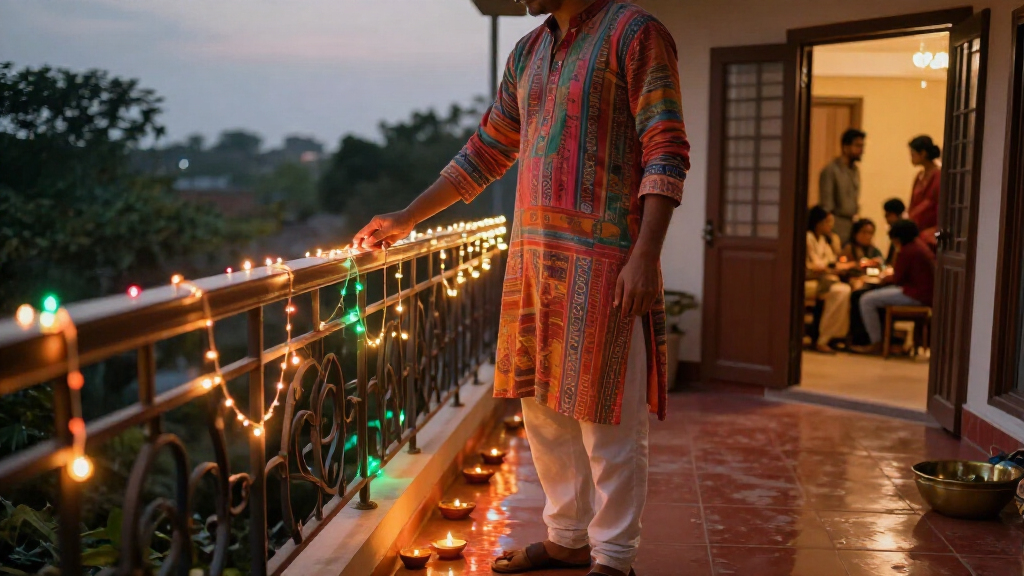
Choosing smart LED Diwali lights means deciding whether you want app-driven color and effects, or a simpler diya-style glow that suits traditional indoor decor. I rank the Philips Hue Festavia first for expansive, connected lighting with voice-assistant support; the OMIKA 100-foot string is a more accessible app-and-remote choice with music sync; and the DealBeta curtain lights are the pick for turning a wall or window into a custom pattern display. Each asks for a different compromise: Hue depends on its separately sold Bridge for several smart functions, OMIKA and DealBeta need corded or USB power, and the two diya strings trade smart-home connectivity for a warmer, more traditional look.

Get home appliances delivered free with Prime
- Fast, free delivery on millions of items
- Prime Video, Amazon Music and more included
- Member-only deals all year
My ranking favors useful control and a clear Diwali decorating role, not the highest feature count alone. If your priority is a classic amber diya effect, the alikiki USB diya string or the remote-controlled Lifnatty may suit your home better than a colorful smart string. Neither should be treated as an outdoor smart-light alternative, though: both are indoor products, and Lifnatty is explicitly not water resistant. I explain where each option fits, what it leaves out, and which buyer should choose something else.
Complete the kit


Key Takeaways
- Philips Hue Festavia offers the broadest connected-lighting setup and longest listed string, but a Hue Bridge is needed for automations, remote control, and music syncing.
- OMIKA pairs app and remote control with 100 feet of multicolor lights, music sync, group control, and timers; it suits broad, flexible decoration better than a minimal diya display.
- DealBeta curtain lights are the distinct choice for custom text and patterns across a 6.6-by-6.6-foot surface, not for wrapping a long balcony rail or tree.
- alikiki gives you a warm, flickering diya look with USB power and simple mounting, while its indoor-only design and lack of app control limit its smart-light credentials.
- Lifnatty is the easiest fit for remote-controlled indoor diya ambience, with eight modes and a repeating timer, but it is battery powered and not water resistant.


| smart LED Diwali light | Power | Usage | Light color | Length |
|---|---|---|---|---|
| Philips Hue Festavia 130-Foot | Corded electric | Indoor and outdoor | — | 130 feet |
| OMIKA 100 ft 300 LED Smart Fai | Corded electric | Indoor and outdoor | Multicolor | 100 feet |
| DealBeta Smart Curtain Lights | USB or included adapter plug | — | RGB color changing | — |
| Lifnatty Diwali Diya LED Strin | Battery powered | Indoor; not water resistant | Warm white | 11.8 feet |
| USB-Powered Diwali Diya LED St | USB | Indoor | Amber | — |
More Details on Our Top Picks
Philips Hue Festavia 130-Foot Indoor/Outdoor Smart String Lights, 500 LEDs
I put Philips Hue Festavia first because it combines the longest listed run here—130 feet—with 500 color-changing LEDs and several routes to control them. That makes it the strongest fit for a buyer who wants one connected lighting system to shape a broad Diwali display, rather than a small accent strand or a single patterned panel. Its white-and-color ambience also gives you more range than the fixed warm glow of alikiki or Lifnatty: you can choose a more traditional color mood or shift toward vivid festival colors.
The tradeoff is that Hue’s smart capabilities are not all available from the string alone. The listing says Bluetooth, Matter, Zigbee, and Wi-Fi connectivity, and control through the Hue app and compatible voice assistants, but a Hue Bridge is required for automations, remote control, and music syncing. That extra component makes this less straightforward than OMIKA’s app-and-remote arrangement. If you already use Hue, the Bridge requirement may fit your setup; if you are starting from scratch and only want lights for a few festival evenings, it is an added dependency to weigh.
Festavia is also better suited to long outdoor or indoor runs than DealBeta’s curtain format. DealBeta gives you a defined 6.6-by-6.6-foot area for text and patterns; Hue instead gives you a much longer string that can be arranged around a larger space. The stated IP54 water resistance supports indoor and outdoor use, but it is not a reason to leave the lights exposed beyond their stated protection. Apple HomeKit appears in the product title, while the supplied description does not detail that support, so I would verify compatibility rather than making it a deciding assumption.
I rank Hue above OMIKA for its longer run, higher LED count, broad connected ecosystem, and listed voice-assistant compatibility. OMIKA may be the simpler pick for buyers who value a remote in the box and want music sync without the listed Bridge requirement. Hue is the better match when connected controls and coverage matter most; it is not my pick for someone seeking a low-complexity, warm diya look or a smart setup with no hub dependency.
Pros:- 130-foot string with 500 color-changing LEDs for broad coverage
- App control and compatibility with Alexa and Google Assistant
- Indoor/outdoor use with a stated IP54 rating
- Hue Bridge can add automations, remote control, and music syncing
Cons:- A separately sold Hue Bridge is required for several key connected features
- Apple HomeKit support is not explained in the supplied product description
- Corded electric power can restrict placement
Best for: Buyers decorating a broad indoor or outdoor area who want color-changing lights, app control, and compatible voice-assistant options, especially if they already use Philips Hue.
Not ideal for: Anyone who wants music sync, automations, and remote access without buying or setting up a Hue Bridge, or who wants a small, warm diya-style accent.
- Length:130 feet
- LED count:500 mini LEDs
- Light colors:White and color ambience
- Usage:Indoor and outdoor
- Water resistance:IP54
- Connectivity:Bluetooth, Matter, Zigbee, and Wi-Fi
- Control:Philips Hue app and compatible voice assistants
- Power:Corded electric
Our verdict“I recommend Festavia for the broadest connected Diwali display, provided the Hue Bridge dependency fits your setup.”
OMIKA 100 ft 300 LED Smart Fairy Lights with App and Remote Control
OMIKA is my practical alternative to Hue for buyers who want a long, colorful string with direct everyday controls. Its 100-foot run and 300 multicolor LEDs give it plenty of reach for a festival display, while its app and included remote let you adjust brightness, color, and lighting modes. That pairing is useful when the person setting up the lights wants app features but guests or family members may prefer a physical remote. Compared with DealBeta, OMIKA is made for a long line of lights rather than a compact curtain of patterns.
The feature mix is unusually focused on atmosphere: there is a built-in microphone for music synchronization, plus group control and timers. In a room with several matching strings, group control and scheduling can reduce the work of switching displays on and off one strand at a time. The listing also describes the lights as suitable for indoor and outdoor use and waterproof, giving it a wider stated placement range than the indoor-only diya strings. The supplied details do not specify a formal ingress-protection rating, so I would not assume a particular exposure level from the word “waterproof” alone.
OMIKA ranks behind Hue because it has a shorter run and fewer LEDs, and its smart-home platform details are less expansive: no specific voice-assistant or broader ecosystem support is listed. Yet it can be a better fit if you do not need Hue’s connected ecosystem or Bridge-based features. Hue is the stronger choice for a buyer already invested in Hue and seeking a longer display; OMIKA is easier to justify for app-plus-remote flexibility and music-reactive decoration without the listed Bridge requirement.
It is not a traditional diya strand. The multicolor LEDs and changing modes prioritize customizable visual effects over the quiet amber flame style of alikiki or Lifnatty. Its corded power also means the display needs access to an outlet, which can complicate placement around a doorway or balcony. I would choose it for a broad, lively decoration plan, but skip it if the main goal is a simple warm accent or if a cable-free setup matters more than app control.
Pros:- 100-foot string with 300 adjustable multicolor LEDs
- App and remote control for flexible operation
- Built-in microphone enables music synchronization
- Group control and timers support coordinated displays
Cons:- Corded electric power limits placement flexibility
- No specific voice-assistant ecosystem is listed
- A formal water-resistance rating is not provided in the supplied specifications
Best for: Buyers who want a long multicolor string with app and remote control, music sync, timers, and group control for indoor or outdoor festival decorations.
Not ideal for: Shoppers seeking verified smart-home voice-assistant integration, a warm diya look, or a battery-powered display without a cord.
- Length:100 feet
- LED count:300
- Light color:Multicolor
- Controls:App and remote control
- Features:Color changing, music sync, group control, and timer
- Usage:Indoor and outdoor
- Power:Corded electric
- Warranty:180-day limited warranty
Our verdict“I would choose OMIKA over Hue when app-and-remote flexibility and music sync matter more than a larger connected ecosystem.”
DealBeta Smart Curtain Lights, 400 LEDs, 6.6 × 6.6 ft, with App and Remote Control
DealBeta’s curtain format solves a different decorating problem from Hue and OMIKA. Rather than supplying a long strand to trace along a railing, it creates a 6.6-by-6.6-foot lighted surface with 400 RGB LEDs. Its headline distinction is the ability to show preset or custom text and patterns, making it the most purpose-built option here for a window, wall, or backdrop where the shape of the display matters as much as the color. For a buyer who wants a focused visual feature, that can be more useful than simply adding another long string.
Control is handled by an app, remote, and listed voice control over Bluetooth, with music sync and color-changing effects as further options. The description does not explain how voice control is configured, so I would treat that as a feature to confirm rather than a guaranteed hands-free experience. Compared with OMIKA, DealBeta adds the custom-pattern format but gives up long-run coverage; OMIKA’s 100 feet is a better match for outlining a larger space, while DealBeta’s compact panel is better for a defined surface.
The stated IP67 waterproof rating and indoor/outdoor description make this more placement-flexible than the two diya strings, and its USB or included-adapter power choices can be convenient if a suitable source is nearby. Neither power route makes it wireless, though. The 9.8-foot lead wire gives some separation between the panel and its power source, but placement still depends on access to USB power or an outlet. The product description lists a 24-volt supply and 10-watt draw, useful details for planning a compatible setup.
I rank it third because it is a strong specialist pick, not the most versatile option for every Diwali display. Hue and OMIKA are better for long, sweeping arrangements; DealBeta is more compelling when text or patterns are the point. It also does not recreate the warm diya appearance offered by Lifnatty and alikiki. Choose it for a graphic window or wall feature, and skip it if you need a straightforward perimeter string or cannot confirm the voice-control setup you want.
Pros:- 400 LEDs across a defined 6.6-by-6.6-foot curtain
- Supports custom text and patterns as well as preset designs
- App and remote control with music-sync effects
- IP67 rating and USB or adapter power options
Cons:- USB or adapter power is still required
- Voice-control setup details are not provided
- A curtain panel covers a smaller defined area than the long Hue or OMIKA strings
Best for: Buyers who want a controllable light curtain for a window, wall, or backdrop, with custom text, patterns, and color effects.
Not ideal for: Anyone looking for a long wraparound string, a traditional diya glow, or voice control with clearly documented setup instructions.
- Model:DMO-410
- LED count:400
- Dimensions:6.6 × 6.6 feet
- Lead wire:9.8 feet
- Light color:RGB color changing
- Controls:App, remote, and listed voice control
- Connectivity:Bluetooth
- Power:USB or included adapter plug
Our verdict“I recommend DealBeta when custom text or patterns on a wall or window matter more than long-string coverage.”
Lifnatty Diwali Diya LED String Lights with Remote and Timer, 11.8 ft, 12 Lights
Lifnatty is the diya pick for buyers who want a traditional warm-white accent and convenient operation without an app. Its 12 lights run across 11.8 feet, and the remote gives access to eight lighting modes and two brightness levels. That is a more hands-off setup than alikiki, whose listed controls do not include a remote, and the six-hour-on, 18-hour-off timer can handle a repeating evening schedule without needing to switch the string off each night.
This is not a connected smart string in the same sense as Hue, OMIKA, or DealBeta. There is no app, voice assistant, or music sync listed; its appeal is a timed, remote-controlled glow, not broader home automation. Compared with the alikiki strand, Lifnatty offers more light points and explicit mode selection, while alikiki specifies softly flickering amber diyas, adhesive stickers, USB power, and the ability to connect one additional string. The two serve similar decor goals but favor different conveniences.
The most important placement restriction is clear: Lifnatty is indoor-only and not water resistant. Do not choose it for a balcony, exposed entrance, or any spot where moisture may reach the lights. Battery power avoids a cord running to an outlet, which can simplify indoor placement, but the product details provided do not specify battery type or runtime. I would plan around battery access rather than assume how long it can stay lit between replacements.
I place Lifnatty fourth because it offers a useful timer and remote for diya-style decor but lacks the app connectivity and broad placement options of the first three picks. For someone who wants a warm indoor accent with scheduled operation, those omissions may not matter. If you want a smart-home routine or an outdoor-rated display, Hue, OMIKA, or DealBeta are more suitable; if you want USB power and flickering amber flames, alikiki may fit better.
Pros:- Remote control with eight lighting modes
- Two brightness levels let you adjust the indoor glow
- Six-hour-on, 18-hour-off timer automates a daily schedule
- Battery power avoids a cord to a wall outlet
Cons:- Not water resistant and designed for indoor use only
- No app, voice-assistant, or music-sync control is listed
- Battery type and runtime are not specified in the supplied details
Best for: Buyers who want an indoor warm-white diya accent with remote operation, multiple modes, adjustable brightness, and a repeating timer.
Not ideal for: Anyone decorating outdoors, looking for app or voice control, or needing a water-resistant light string.
- Length:11.8 feet
- Number of lights:12
- Light color:Warm white
- Lighting modes:8
- Brightness levels:2
- Timer:6 hours on, 18 hours off
- Control:Remote control
- Power:Battery powered
- Usage:Indoor; not water resistant
Our verdict“I recommend Lifnatty for a scheduled indoor diya glow, not for connected smart-home control or outdoor decorating.”
USB-Powered Diwali Diya LED String Lights, 10 Count
The alikiki diya string is the simplest and most traditionally styled choice in this group. Ten amber LEDs with softly flickering flames create a diya-inspired accent over an 11.3-foot run, without open flames or dripping wax. It does not offer the app, music sync, timers, or extensive color changes found on the higher-ranked products. Its role is narrower: add a warm, festival-specific glow to an indoor setting with straightforward USB power.
Compared with Lifnatty, alikiki has fewer lights and does not list a remote, selectable modes, or an automatic schedule. In return, it provides USB power and five adhesive stickers for mounting on smooth surfaces, plus the ability to connect one additional string. Those details make it a practical option for a small shelf, wall, or other indoor accent near a USB source. Lifnatty is the better choice if remote adjustments and a timer matter more; alikiki is the better match if flickering amber diyas and simple mounting matter more.
It is important to read the connection limit as a real constraint. The product can connect up to two strings, and the description warns that connecting more than two can noticeably dim additional strings. That makes it less suitable for buyers hoping to build an extensive display by linking several packs. It also has no stated app or smart-home integration, so I would call it a convenient LED accent rather than a full smart-lighting system.
Its indoor-only use is another firm boundary. Hue, OMIKA, and DealBeta are the picks to compare for outdoor decoration; alikiki is not a substitute for them just because it uses LED bulbs. The 4.8-foot lead wire provides some distance to a USB power source, but cable placement still matters. I rank it fifth because its festival look is appealing yet its controls and use cases are intentionally limited. For a modest, flameless diya detail it can make sense; for automation, colorful effects, or weather exposure, choose a different product in this list.
Pros:- Warm amber LEDs create a diya-inspired flickering effect
- USB power works with common USB power sources
- Includes five adhesive stickers for smooth surfaces
- Can connect one additional string for a longer display
Cons:- Indoor use only
- No app, remote, timer, or smart-home features are listed
- Connecting more than two strings can noticeably dim additional strings
Best for: Buyers who want a modest indoor display of flickering amber diya lights, with USB power and adhesive mounting stickers.
Not ideal for: Anyone who needs outdoor-rated lights, app or remote control, a timer, or a long display made by linking several strings.
- String length:11.3 feet
- Light count:10
- Light color:Amber
- Color temperature:2700 K
- Lead wire:4.8 feet
- Power:USB
- Connectable strings:Up to 2
- Mounting accessories:5 clear adhesive stickers
- Usage:Indoor
Our verdict“I would choose alikiki for a simple indoor flickering diya accent, but not when smart control or outdoor placement is needed.”
How We Picked
I compared these five lights by how well they serve Diwali decorating needs, rather than treating every product with LEDs as an interchangeable smart-light kit. I gave more weight to controllability, the kind of display each product creates, useful coverage, and whether its stated indoor or outdoor rating matches a realistic festival setup. That is why a large, app-enabled outdoor string and a small warm diya strand have different roles in the ranking instead of being judged as though they solve the same problem.
Smart control matters, but the label alone is not enough. I looked at whether a light offers an app, remote, voice control, timers, or music sync, then noted what the setup depends on. The Hue Bridge requirement is a meaningful part of the Hue decision; the OMIKA offers an app and remote without that stated hub dependency; DealBeta lists voice control but does not explain its setup. For the diya options, remote modes and scheduling count as convenience, but I do not equate them with app-connected smart-home control.
I also weighed placement and power. Long strings can cover more architectural features, while curtain lights suit a defined wall or window. USB power can be convenient near a compatible source, but it still ties placement to power access. Battery operation avoids a cable run but brings a different routine. Outdoor suitability is judged from the supplied descriptions and specifications, not assumed from a festive appearance. I did not infer durability beyond the stated water-resistance information.
Finally, I treated omissions and restrictions as buying factors. A product can be a good fit for one kind of display and still rank below a more flexible option. Hue leads for connected coverage; OMIKA takes the practical app-and-remote position; DealBeta earns a specialist spot for patterned surfaces; Lifnatty and alikiki serve distinct diya-style preferences. I call out who should skip each one so the list helps narrow a decision rather than simply praise every entry.
| smart LED Diwali light | Usage | Power | Light color |
|---|---|---|---|
| Philips Hue Festavia 130-Foot | Indoor and outdoor | Corded electric | — |
| OMIKA 100 ft 300 LED Smart Fai | Indoor and outdoor | Corded electric | Multicolor |
| DealBeta Smart Curtain Lights | — | USB or included adapter plug | RGB color changing |
| Lifnatty Diwali Diya LED Strin | Indoor; not water resistant | Battery powered | Warm white |
| USB-Powered Diwali Diya LED St | Indoor | USB | Amber |
Factors to Consider When Choosing Smart LED Diwali Lights
I would start by deciding what the lights need to do in your home. These five products cover three different goals: connected color lighting, a graphic curtain display, and a warmer diya-inspired accent. Choosing the right format first prevents a common mismatch, such as buying a short indoor strand when the plan is to outline an outdoor space or expecting a simple diya string to respond to an app.
Choose the control style you will actually use
For app-based color and effects, compare Hue Festavia, OMIKA, and DealBeta. Hue has a broader listed ecosystem and compatible voice assistants, but a Bridge is needed for automations, remote access, and music syncing. OMIKA pairs an app with a physical remote and lists music sync, group control, and timers. DealBeta offers app and remote controls for its curtain format, with voice control listed but its setup left unclear. If your priority is just changing modes from across a room, Lifnatty’s remote may be enough; if you need app routines or voice-assistant control, it is not a substitute for the connected options.
Match the light format to the surface
A long string and a curtain are not interchangeable. Hue’s 130 feet and OMIKA’s 100 feet suit broader runs around a room or other features where a continuous line is useful. DealBeta’s 6.6-by-6.6-foot panel is better for a wall or window where custom text and patterns can be seen as a single design. The diya options cover less ground and are more suited to an accent than a whole-space lighting plan. I would measure the intended route or panel area before choosing based on LED count alone.
Decide whether you want festive color or diya warmth
Hue, OMIKA, and DealBeta are the flexible color choices. Their effects can create a bright, changing display, with music sync available on the listed models that support it. alikiki and Lifnatty favor a warm diya look, which can complement traditional decor without relying on multicolor effects. The difference is not simply brightness: it is whether the lights act as a colorful feature or a softer festival accent. If you want both styles, plan separate zones rather than assuming one product covers both moods.
Check power access before settling on a placement
Hue and OMIKA use corded electric power; DealBeta uses USB or its included adapter. These products can support larger displays, but their positions depend on a suitable power source. Alikiki also uses USB, while Lifnatty is battery powered and avoids a cable to an outlet. Battery operation is not the same as unlimited convenience: the supplied Lifnatty details do not say what battery type it takes or how long it runs. Leave room for cable routing or battery access in your setup plan.
Treat indoor and outdoor labels as a real boundary
Hue, OMIKA, and DealBeta are described for indoor and outdoor use, with Hue listing IP54 and DealBeta listing IP67. OMIKA is described as waterproof, but the supplied specifications do not give an IP rating. Alikiki and Lifnatty are indoor products; Lifnatty is expressly not water resistant. Do not place an indoor diya strand where it may get wet, and do not infer a stronger protection level than the product information states. For exposed locations, select a product with appropriate stated protection and follow its setup instructions.
Separate smart-home control from basic remote convenience
“Smart” can mean different things across this lineup. Hue, OMIKA, and DealBeta list app control, but their connections and setup details differ. Lifnatty’s timer and remote make regular operation easier without providing the app-connected features listed by the first three. Alikiki is simpler still. A timer is useful automation of a schedule, but it does not mean the lights can join a voice assistant or a broader smart-home routine. Choose based on the control you need, not the label you expect.
Plan for the full setup, not just the lights
Before ordering, check what the display requires beyond the strand: an outlet, a USB source, a Bridge, mounting points, or a clear surface. Hue’s Bridge is a separate requirement for several features; DealBeta includes an adapter, and alikiki includes mounting stickers for smooth surfaces. Setup dependencies can change which product is simplest even when its control options look attractive. If you want a display ready for a particular window, railing, or wall, confirm both the dimensions and the route to power first.
Frequently Asked Questions
Which of these smart LED Diwali lights is best for a large display?
I would start with Philips Hue Festavia if you want the longest listed string and a connected lighting ecosystem: it measures 130 feet and has 500 LEDs. OMIKA is a close alternative for a 100-foot run with app and remote controls, music sync, group control, and timers. Choose between them based on whether Hue’s broader platform and Bridge-dependent features suit your setup or OMIKA’s included remote and simpler stated control package fits better.
Which option gives me the most direct diya-style look?
alikiki and Lifnatty are the diya-inspired choices rather than color-changing smart strings. Alikiki specifies amber lights with softly flickering flames and USB power. Lifnatty uses warm-white lights and adds a remote, eight modes, two brightness settings, and a repeating timer. I would choose alikiki for its stated flicker effect and simple mounting, or Lifnatty when remote operation and scheduling matter more.
Do I need a Hue Bridge for Philips Hue Festavia?
The supplied product details say that a Hue Bridge is required for automations, remote control, and music syncing. Hue Festavia can also be controlled through the Hue app, and compatible voice assistants are listed, but buyers should check the specific feature and connection requirements for their intended setup. If you want app and remote control without the listed Bridge dependency, OMIKA may be a more direct alternative.
Can I use the diya lights outdoors?
I would not use either diya string outdoors based on the supplied specifications. alikiki is listed for indoor use, and Lifnatty is indoor-only and not water resistant. For outdoor decorating, the listings identify Hue, OMIKA, and DealBeta for indoor and outdoor use, with Hue specifying IP54 and DealBeta specifying IP67. Check the product instructions and the conditions at your mounting location before installing any lights outside.
Which product should I choose for a window or wall pattern?
DealBeta’s curtain lights are the clearest fit for a defined window or wall because the 6.6-by-6.6-foot panel supports preset and custom text and patterns. Hue and OMIKA provide longer strings, which are better for a line-based display around a space than a single graphic panel. If the surface is larger than DealBeta’s dimensions, check whether the panel will cover the intended area before buying.
Conclusion
For a broad, connected display, I would choose Philips Hue Festavia if its Bridge requirement works with my setup; it leads this list for listed length, LED count, and ecosystem options. I would pick OMIKA instead when app and remote control, music sync, group control, and timers matter more than joining the Hue ecosystem. For a window or wall that should show text or patterns, DealBeta has the most specific format for the job.
For a more traditional indoor accent, I would select Lifnatty when I want a remote and recurring timer, and alikiki when I want USB-powered amber flicker and simple mounting. Neither is the right pick for outdoor use, and neither provides the app-connected controls of the first three products. My final choice would come down to three practical questions: where the lights will go, what kind of glow I want, and which controls I will use. Answer those first, then select the product whose limitations fit the plan.