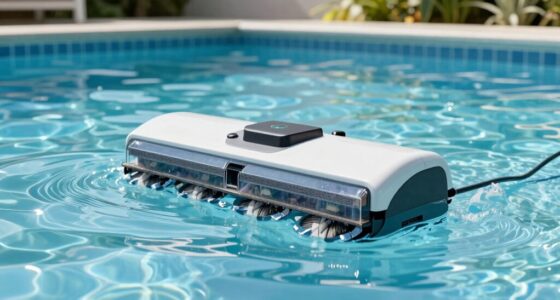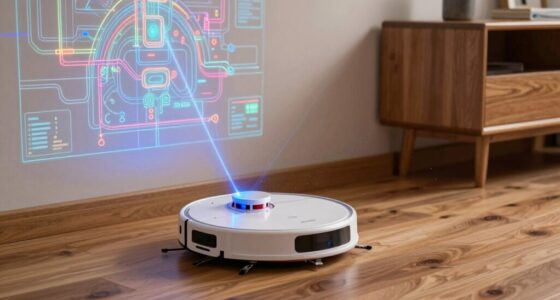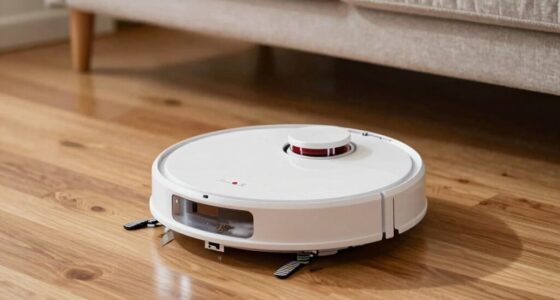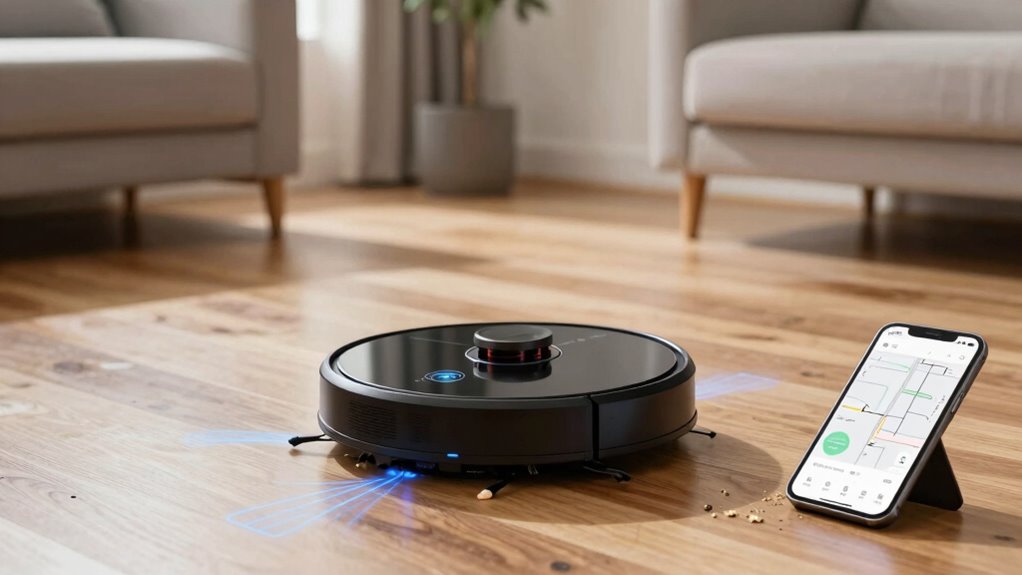

AI navigation helps guarantee your cleaning devices deliver consistent, thorough results by intelligently adapting to your environment in real time. It uses multiple sensors to map your space accurately, avoiding obstacles and missed spots. Advanced algorithms optimize cleaning routes, while continuous learning improves efficiency over time. This means your device consistently cleans effectively, even with layout changes or clutter. Keep exploring to discover how these smart systems make your cleaning easier and more reliable.
Key Takeaways
- AI navigation ensures consistent cleaning outcomes through precise environment mapping and systematic path planning.
- Advanced sensors detect obstacles and adapt routes in real-time, preventing missed spots and ensuring thorough coverage.
- Continuous learning and data collection enable devices to improve cleaning efficiency and accuracy over time.
- Adaptive algorithms adjust to different floor types and clutter, maintaining uniform results regardless of environment changes.
- Reliable obstacle avoidance and environmental adaptation ensure consistent cleaning performance in dynamic settings.
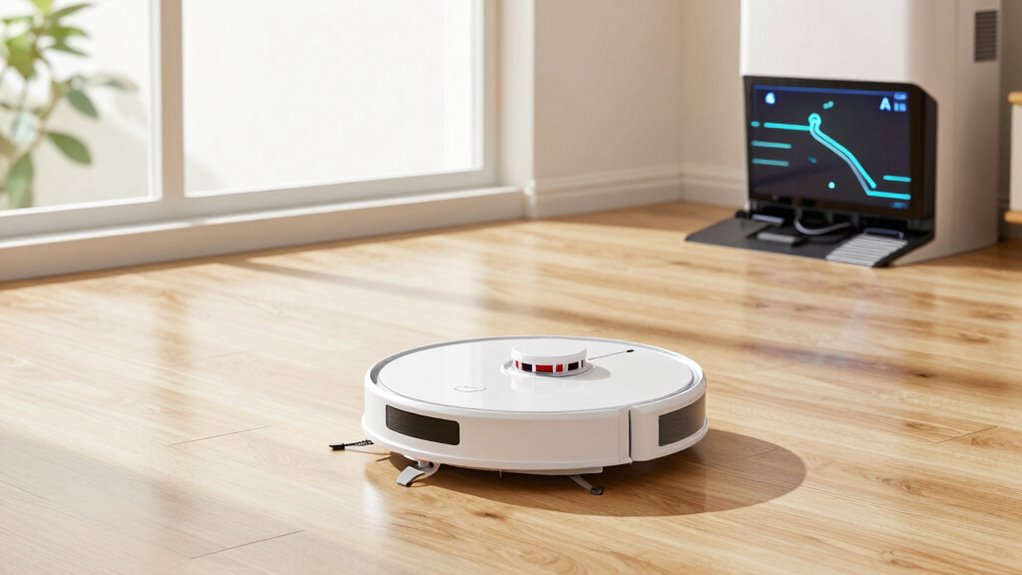
AI navigation systems are transforming cleaning processes by guaranteeing more consistent results. When you rely on these advanced systems, you notice a marked improvement in the quality and reliability of your cleaning routines. Unlike traditional methods, AI-powered devices can adapt to different environments, ensuring every nook and cranny gets the attention it needs. This consistency is largely driven by robotic efficiency, which allows these machines to operate smoothly and without unnecessary pauses or overlaps. As a result, you spend less time overseeing the cleaning process and more time enjoying a spotless space.
AI navigation ensures consistent, reliable cleaning with minimal oversight, adapting seamlessly to any environment for spotless results.
One of the key factors behind this improved consistency is sensor accuracy. Modern AI navigation systems use an array of sensors to map out your space precisely. These sensors gather real-time data, giving the device a detailed understanding of its surroundings. With high sensor accuracy, the robot can detect obstacles, avoid furniture, and navigate tight corners with ease. This prevents missed spots and reduces the chances of the machine getting stuck or repeating the same area multiple times. The more accurate the sensors, the better the device can plan its route and execute cleanings efficiently. Additionally, sensor calibration ensures that these sensors continue to provide precise data over time, maintaining optimal performance. Regular calibration also helps the system adapt to any changes in the environment, further boosting cleaning consistency. Furthermore, incorporating environmental adaptability allows these systems to handle different flooring types and clutter levels more effectively, enhancing their overall reliability. The integration of advanced mapping techniques further refines this process, making navigation even more precise.
Moreover, these systems leverage advanced algorithms that analyze sensor data to optimize cleaning paths. This means your device doesn’t just randomly wander around; instead, it methodically covers every section of your floor. This systematic approach ensures uniform cleaning, so you get consistent results every time. You’ll notice that the floors look equally clean regardless of whether you’re running the robot in the morning or evening. The ability to adapt to different layouts and clutter levels keeps the cleaning process dependable, even when your environment changes. Additionally, real-time data processing plays a critical role in enabling the device to respond swiftly to unexpected obstacles, further ensuring thorough cleaning.
Another benefit of AI navigation is its capacity to learn from past cleanings. As the device operates, it gathers data, fine-tuning its map and route planning for future sessions. This continuous learning process enhances robotic efficiency, reducing cleaning time and increasing thoroughness. You won’t have to worry about manually adjusting settings or shifting furniture—your AI-powered cleaner adjusts itself, maintaining high standards of cleanliness without constant oversight. This adaptive learning capability is a key advantage that continuously improves the system’s performance over time.

Shark AV2501S AI Ultra Robot Vacuum, with Matrix Clean, Home Mapping, 30-Day Capacity HEPA Bagless Self Empty Base, Perfect for Pet Hair, Wifi, Dark Grey
- Powerful Suction: Removes dirt from all floor types
- Matrix Clean Navigation: Ensures thorough, grid-based cleaning
- Self-Emptying Base: Holds 30 days of debris automatically
As an affiliate, we earn on qualifying purchases.
As an affiliate, we earn on qualifying purchases.
Frequently Asked Questions
How Does AI Navigation Adapt to Different Floor Types?
AI navigation adapts to different floor types through advanced floor detection and obstacle recognition. You’ll notice the cleaner senses whether it’s on hardwood, tile, or carpet, adjusting its suction and movement accordingly. It recognizes obstacles unique to each surface, like rugs or uneven flooring, and navigates smoothly around them. This adaptive technology guarantees your floors are cleaned thoroughly and consistently, regardless of the surface type.
What Safety Features Are Integrated With AI Navigation Systems?
You benefit from safety features like advanced sensor accuracy and obstacle detection in AI navigation systems. These sensors precisely identify objects and potential hazards, ensuring your device avoids collisions. The obstacle detection technology instantly reacts to changes in the environment, stopping or rerouting as needed. Together, these safety features keep your cleaning device operating smoothly, protect your furniture, and reduce the risk of accidents, making your cleaning routine safer and more reliable.
Can AI Navigation Identify and Avoid Delicate or Fragile Items?
Yes, AI navigation can identify and avoid fragile items through advanced fragile detection systems. When your cleaning device encounters delicate objects, it automatically recognizes them and adjusts its path to prevent accidents. These systems use sensors and cameras to detect fragile items, ensuring safe item avoidance. This technology helps maintain the integrity of your belongings while providing consistent, thorough cleaning, so you don’t have to worry about accidental damage during routine chores.
How Does AI Learning Improve Over Time in Cleaning Routines?
You’re right on the money—AI learns and improves over time. Its learning algorithms analyze your cleaning patterns and adapt strategies to suit your space better. As it gains experience, it becomes more efficient and precise, kind of like hitting two birds with one stone. This ongoing learning process guarantees your cleaning routines become more effective, consistent, and personalized, making your home shine brighter with each visit.
Is AI Navigation Compatible With Smart Home Integration?
Yes, AI navigation is compatible with smart home integration. You can control your cleaning device through voice commands, making it easy to start, stop, or schedule cleaning sessions. Most systems are designed with hardware compatibility in mind, ensuring seamless communication between your smart home devices and the robot. This integration allows you to optimize your cleaning routines effortlessly, bringing convenience and efficiency to your daily chores.

Laser Sensor LDS Unit FM1828, Compatible with DEEBOT N8 Pro / T9 / T8 Robot Vacuum Cleaner Spare Parts
- Broad Compatibility: Fits DEEBOT N8 Pro, T9, T8 models
- Accurate Environment Recognition: Uses ToF laser for precise mapping
- Easy Installation: Simple replacement without tools
As an affiliate, we earn on qualifying purchases.
As an affiliate, we earn on qualifying purchases.
Conclusion
With AI navigation guiding your cleaning device, you’ll find your routines become smoother than ever, like a well-conducted symphony. It guarantees every corner gets the attention it deserves, eliminating missed spots and uneven coverage. As technology advances, your cleaning experience transforms into a seamless dance—efficient, reliable, and effortless. Embrace AI-powered navigation, and watch your cleaning become as consistent as the sunrise, leaving your home spotless and your day a little easier.
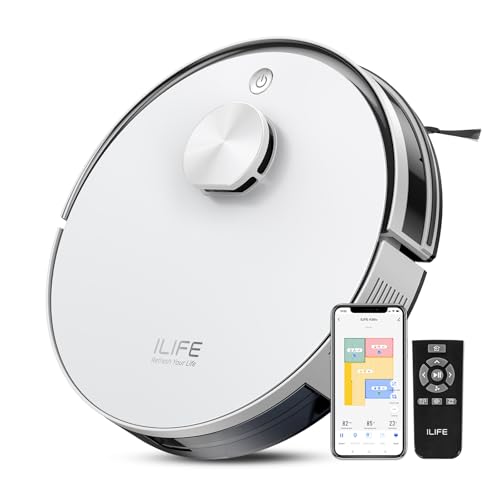
ILIFE A30s Robot Vacuum, 10000Pa Max Suction
- Max Suction Power: Up to 10,000Pa for deep cleaning
- Smart Mapping & Navigation: LiDAR and SLAM for efficient coverage
- Pet Hair Cleaning: Dual anti-tangle brush for pet households
As an affiliate, we earn on qualifying purchases.
As an affiliate, we earn on qualifying purchases.

T30+ Robot Vacuum and Mop Combo with Self-Emptying Station, 12000Pa Robotic Vacuums Cleaner, No-Collision Obstacle Avoidance, Carpet Detection, Anti-Tangle Brush, 240Min Run, for Hair, Floors, Carpets
- Powerful Suction: 12000Pa for deep cleaning on carpets and floors
- Long Runtime: Up to 240 minutes per charge
- Self-Emptying Dustbin: 75-day capacity with 3.5L dust bag
As an affiliate, we earn on qualifying purchases.
As an affiliate, we earn on qualifying purchases.