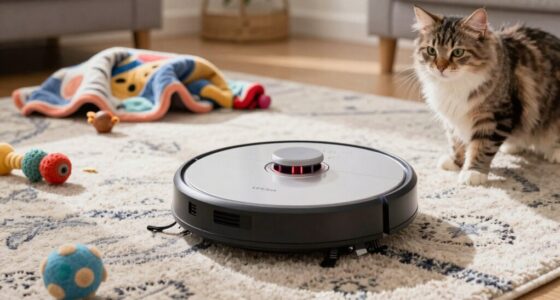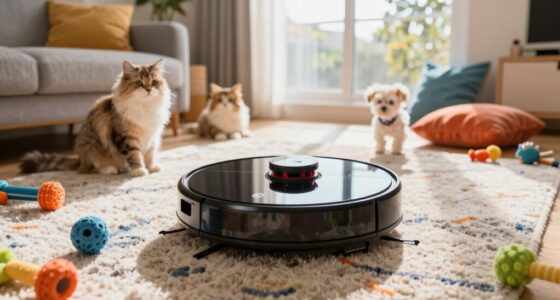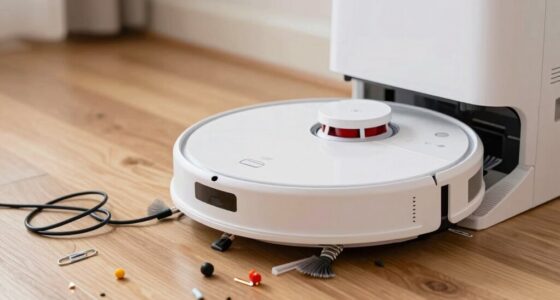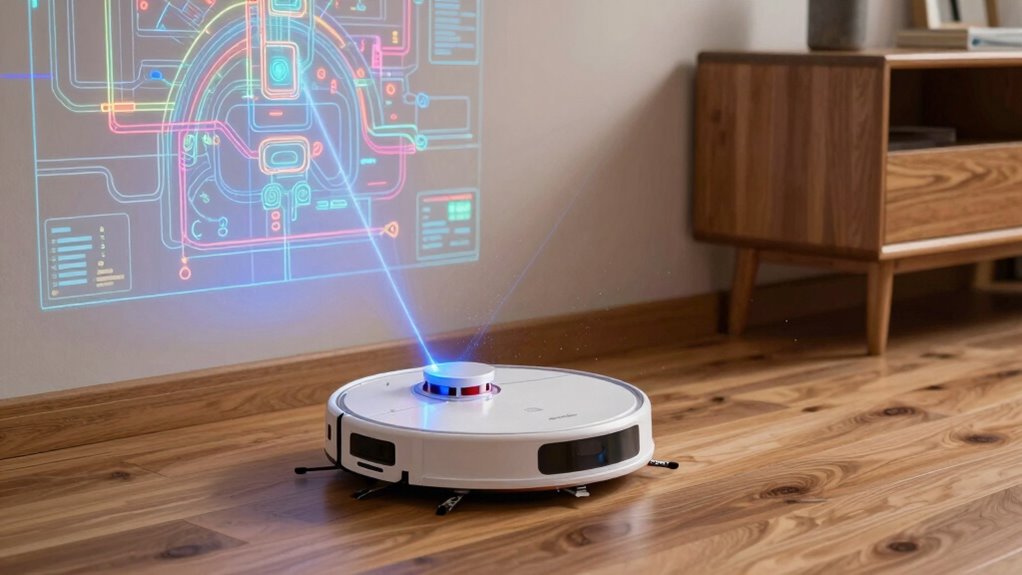
Robot vacuums build a map of your home by using advanced sensors like LiDAR or cameras to detect obstacles, walls, and furniture. They actively scan your space, gathering real-time data to create detailed, accurate maps. These maps help the vacuum plan efficient cleaning paths and avoid obstacles like stairs. As they move, they update their maps continuously to adapt to changes. If you want to understand how this all works, keep exploring this smart technology.

Get home appliances delivered free with Prime
- Fast, free delivery on millions of items
- Prime Video, Amazon Music and more included
- Member-only deals all year
Key Takeaways
- Robot vacuums use sensors like LiDAR and cameras to scan and interpret their environment.
- They emit laser beams or visual data to measure distances and recognize features.
- Continuous feedback updates the map as the robot moves through different areas.
- Mapping enables navigation around obstacles and prevents falls or collisions.
- Detailed maps allow for efficient cleaning routes and room-specific control.
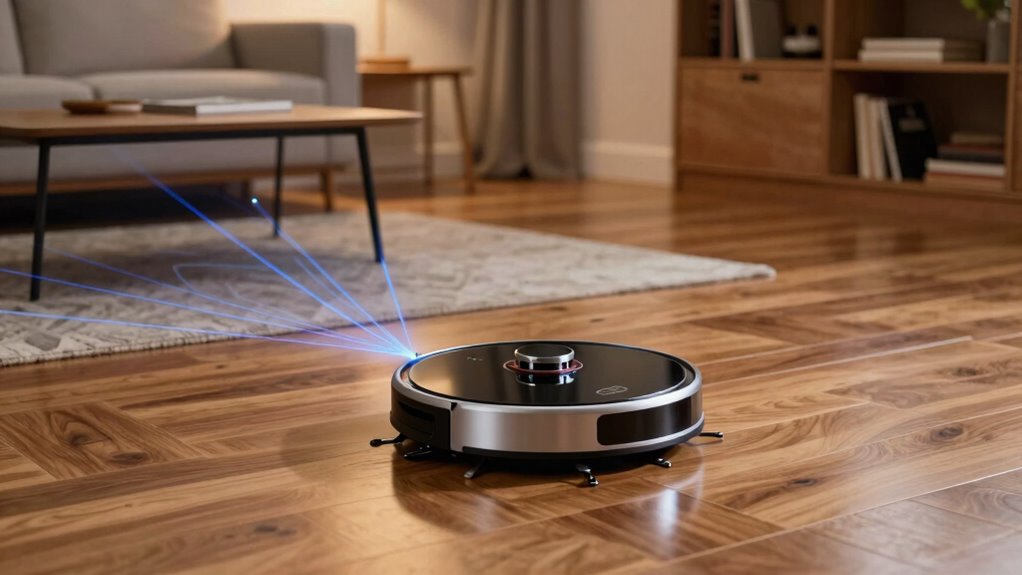
Robot vacuums have revolutionized home cleaning by using advanced mapping technology to navigate efficiently. When you turn yours on, it doesn’t just roam randomly; it systematically scans your space to create a detailed map of your home. This process hinges on navigation accuracy, which is made possible through sophisticated sensor technology. These sensors act like your robot’s eyes and ears, providing real-time data about your environment. They detect obstacles, walls, furniture, and even changes in floor surfaces, guaranteeing the robot can adapt its route as needed.
Robot vacuums use advanced sensors to create detailed maps, ensuring efficient, adaptive cleaning throughout your home.
The core of building a map lies in how well the robot can interpret the data from its sensors. Laser-based sensors, like LiDAR, are common in high-end models. They emit laser beams that bounce back from nearby objects, helping the robot calculate precise distances. With this information, the robot can draw a highly accurate layout of your home. On the other hand, some models use camera-based sensors, which rely on visual data to recognize features and landmarks within your space. These cameras, combined with advanced image processing, allow for detailed mapping and better obstacle avoidance.
What makes these sensors so effective is their ability to provide continuous feedback. As the robot moves, it constantly updates its map, refining its understanding of the environment. This real-time data ensures that the robot can navigate complex areas, avoid falling down stairs, and maneuver around furniture without getting stuck. The better the sensor technology, the higher the navigation accuracy, leading to more efficient cleaning paths and less missed spots.
Once the map is built, your robot uses it to plan superior cleaning routes. Instead of zigzagging aimlessly, it follows a logical pattern, covering every inch of your floors with minimal overlap. This not only saves time but also enhances cleaning performance. Plus, with a detailed map, you can usually specify no-go zones or designate specific rooms for cleaning, giving you greater control over the process.
In essence, the combination of advanced sensor technology and high navigation accuracy enables your robot vacuum to understand your home’s layout thoroughly. It’s this understanding that allows it to clean more intelligently, avoid obstacles confidently, and operate with a level of precision that was once unimaginable. So, the next time you see your robot smoothly gliding around furniture, remember that behind that efficiency is a sophisticated system of sensors working tirelessly to map and master your home. Understanding sensor technology is key to appreciating how these devices achieve such remarkable performance.
As an affiliate, we earn on qualifying purchases.
Frequently Asked Questions
How Accurate Are Robot Vacuum Maps Over Time?
Robot vacuum maps are generally quite accurate over time, especially when sensor calibration stays up-to-date. Regularly calibrating sensors guarantees mapping accuracy remains high, even as your home changes. Factors like furniture movement or new obstacles can slightly affect precision, but most modern vacuums adapt well. With proper maintenance, you can trust your robot’s map for efficient cleaning, knowing it’ll stay accurate for months or even years.
Can Robot Vacuums Recognize Specific Rooms?
Yes, robot vacuums can recognize specific rooms through advanced mapping technology and room recognition features. You can customize your vacuum’s cleaning schedule based on different rooms, making your cleaning more efficient. By using mapping customization, you tell your robot to focus on particular areas or avoid others. This room recognition capability helps your vacuum navigate accurately, ensuring thorough cleaning while respecting your preferences and room boundaries.
Do Maps Update Automatically After Furniture Changes?
Most robot vacuums update their maps automatically, but only about 60% do so reliably after furniture changes. You might notice mapping accuracy decline if furniture moves aren’t recognized quickly. To maintain peak cleaning performance, confirm your vacuum’s app is updated and encourage it to re-scan your space periodically. This way, your map stays current, and cleaning remains efficient despite furniture updates.
How Is Privacy Maintained When Mapping?
Privacy concerns are addressed by most robot vacuum brands through data encryption, ensuring your mapping data stays secure. When your vacuum creates a map, it typically doesn’t share or store images externally unless you enable specific features. You can also usually access and delete your data through app settings. To protect your privacy, always review your device’s privacy policy and turn off features that might transmit data to third parties.
Can Multiple Robot Vacuums Share the Same Map?
Think of multiple robot vacuums sharing a map like a team of explorers passing a shared treasure map. With advanced mapping algorithms and sensor integration, they can work together seamlessly, updating and referencing the same digital blueprint. This collaboration guarantees efficient cleaning without overlaps. So, yes, your vacuums can share the same map, working in harmony like a well-oiled machine, thanks to smart technology and communication protocols.
camera-based robot vacuum cleaner
As an affiliate, we earn on qualifying purchases.
As an affiliate, we earn on qualifying purchases.
Conclusion
So, next time your robot vacuum avidly maps your home, remember it’s secretly becoming the ultimate snoop. It’s funny how something that’s supposed to clean can also be a tiny spy, knowing every nook and cranny. You might think you’re in control, but really, your smart little cleaner is just building a digital diary of your messy life. Who knew that the future of cleaning also comes with a side of creeping curiosity?
As an affiliate, we earn on qualifying purchases.
As an affiliate, we earn on qualifying purchases.
Cold & flu season Picks
humidifiers
As an affiliate, we earn on qualifying purchases.