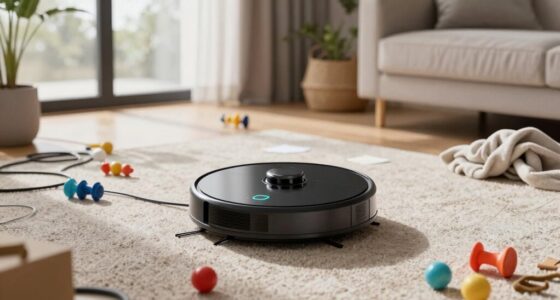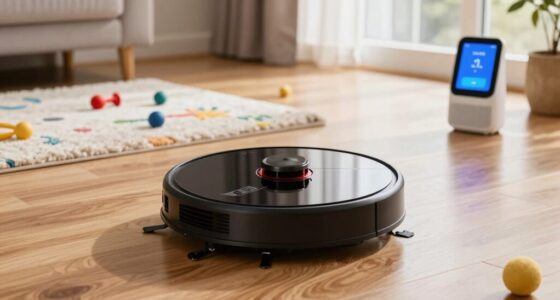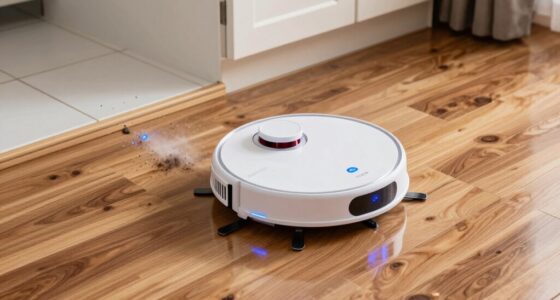
AI helps robot vacuums avoid cords and small objects by using advanced sensors like infrared, laser, or ultrasonic technology to detect obstacles early. These vacuums actively map your space and learn from their environment to recognize hazards, such as cords or jewelry, more accurately over time. Their machine learning algorithms adapt, improving obstacle avoidance and navigation strategies. Keep exploring how these smart features make your vacuum operate more efficiently and safely around everyday objects.

Get home appliances delivered free with Prime
- Fast, free delivery on millions of items
- Prime Video, Amazon Music and more included
- Member-only deals all year
Key Takeaways
- AI enables robot vacuums to recognize and differentiate small objects and cords through advanced sensor calibration and object detection.
- Machine learning allows vacuums to adapt to specific home environments, improving obstacle recognition over time.
- Real-time AI processing detects hazards instantly, preventing collisions with cords, jewelry, or small toys.
- AI-driven navigation algorithms plan routes that avoid obstacles, optimizing cleaning efficiency while preventing entanglements.
- Continuous AI updates refine obstacle detection accuracy, ensuring reliable avoidance of cords and tiny objects during cleaning.

Have you ever wondered how modern robot vacuums seamlessly clean your home with minimal effort? The secret lies in their advanced AI systems that help them navigate efficiently, avoiding cords and small objects without you having to lift a finger. These vacuums use a combination of sensor calibration and smart algorithms to detect obstacles early and adapt their paths accordingly. When you set your robot to clean, it doesn’t just wander randomly; it actively maps out your space, recognizing potential hazards before they become problems. This process hinges on precise sensor calibration, which ensures that the vacuum accurately perceives its surroundings. Over time, manufacturers optimize these sensors to improve obstacle detection, making the vacuum more reliable at identifying cords, toys, or even tiny objects like jewelry. Additionally, the integration of machine learning techniques allows the vacuum to adapt to your environment more effectively, enhancing obstacle avoidance over time. Regular software updates also contribute to refining these capabilities, ensuring the vacuum stays ahead of new challenges. Battery optimization plays a crucial role in this process too. As the vacuum learns your home’s layout, it manages its power consumption more efficiently. It plans routes that minimize unnecessary travel, conserving battery life so it can clean longer without needing to recharge. When the battery level drops, AI algorithms help the vacuum return to its charging dock intelligently, avoiding obstacles along the way. This ensures you get maximum cleaning coverage with minimal interruptions, and it reduces the chances of the vacuum bumping into cords or small objects that could cause malfunctions or entanglements.
Sensor calibration is a continuous process. Modern robot vacuums use infrared, laser, or ultrasonic sensors, which are fine-tuned regularly through software updates to improve detection accuracy. This calibration allows the vacuum to distinguish between different objects and surfaces, so it can identify a thin cord lying on the floor or a small toy in its path. Some vacuums even employ machine learning techniques that help them adapt to your environment over time, recognizing patterns and adjusting their navigation strategies. As a result, they become increasingly adept at avoiding obstacles, saving you from the frustration of tangled cords or missed spots. The integration of advanced sensors and AI-driven learning ensures these devices remain increasingly effective and reliable in home environments. This ongoing improvement is partly driven by sensor calibration, which is essential for maintaining accuracy as the device encounters various objects and surfaces. Additionally, real-time obstacle detection enables the vacuum to respond instantly to unexpected hazards, further improving its navigation precision.
Together, battery optimization and sensor calibration enable AI-driven robot vacuums to clean more intelligently and safely. They move smoothly around furniture, sidestep tiny objects, and avoid hazards with minimal input from you. When you trust your vacuum’s AI capabilities, you can rest assured it’s working diligently behind the scenes—efficiently avoiding cords and small objects while preserving battery life. It’s this combination of smart navigation and ongoing calibration that makes modern robot vacuums a reliable and convenient cleaning solution.
AI robot vacuum with obstacle avoidance
As an affiliate, we earn on qualifying purchases.
As an affiliate, we earn on qualifying purchases.
Frequently Asked Questions
How Long Does the Ai-Powered Navigation System Typically Last?
AI-powered navigation systems usually last around 3 to 5 years, depending on usage and maintenance. Your robot vacuum’s battery longevity and sensor calibration play key roles in this lifespan. Properly calibrating sensors ensures accurate navigation, while maintaining the battery helps it run efficiently. Over time, sensors may need recalibration, and batteries might require replacement to keep the system functioning effectively and extend its overall lifespan.
Can Robot Vacuums Differentiate Between Fragile and Sturdy Objects?
Yes, robot vacuums can differentiate between fragile and sturdy objects through advanced object recognition and fragile detection features. You’ll notice the vacuum slowing down or changing direction when it detects delicate items like glass or electronics, helping prevent damage. This intelligent detection allows the vacuum to treat fragile objects more carefully, ensuring your belongings stay safe while it efficiently cleans your floors.
Do AI Algorithms Improve Over Time With More Cleaning Sessions?
Yes, AI algorithms in robot vacuums improve over time through machine learning. As you use your vacuum more, it gathers data from each cleaning session, allowing adaptive algorithms to optimize navigation and obstacle avoidance. This means your vacuum becomes smarter, better at avoiding cords and small objects, and more efficient with each use. Over time, your device learns your home’s layout, making cleaning sessions more thorough and tailored to your environment.
Are There Privacy Concerns With AI Mapping My Home?
Yes, there are privacy concerns with AI mapping your home. Your robot vacuum collects data to optimize cleaning, but this raises questions about home privacy and data security. You should check the manufacturer’s privacy policy to understand what information is stored and how it’s protected. To safeguard your home privacy, make certain your device has strong security features, and regularly update its firmware to prevent unauthorized access.
How Do Robot Vacuums Handle Unexpected Obstacles or Emergencies?
Imagine your robot vacuum as a vigilant guardian, ready for surprises. When unexpected obstacles appear, it uses obstacle detection sensors to recognize them instantly, like a guardian spotting danger. If an emergency arises, such as a spill or a fall, the AI responds swiftly to pause or reroute, ensuring safety and efficiency. Its quick obstacle detection and emergency response keep your home clean and protected, even in unforeseen situations.
laser sensor robot vacuum cleaner
As an affiliate, we earn on qualifying purchases.
As an affiliate, we earn on qualifying purchases.
Conclusion
Thanks to AI, your robot vacuum now skillfully dodges cords and tiny objects, making cleaning smoother than ever. Imagine it effortlessly avoiding over 1,000 obstacles in a single cleaning session, saving you time and frustration. With these smart features, you can relax knowing your vacuum is smarter and safer, keeping your home spotless without constant supervision. AI truly transforms your cleaning routine into a quiet, efficient, and worry-free experience.
As an affiliate, we earn on qualifying purchases.
robot vacuum for pet hair and small objects
As an affiliate, we earn on qualifying purchases.
As an affiliate, we earn on qualifying purchases.
NFL season / tailgating Picks
team gear
As an affiliate, we earn on qualifying purchases.