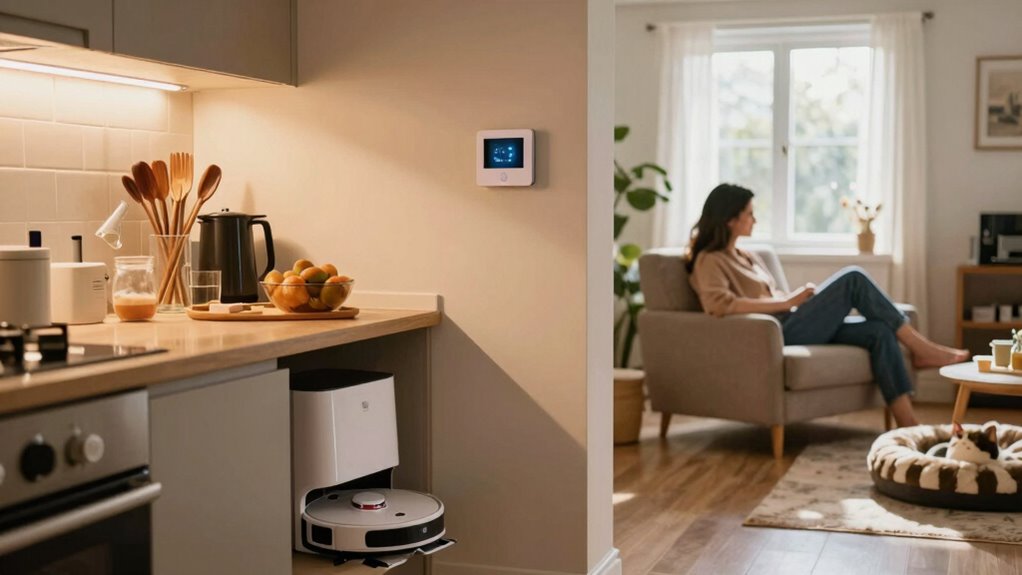

In a busy household, AI learns your comfort patterns by constantly observing your routines, like wake-up times and dinner schedules, as well as emotional cues from voice, facial expressions, and sensors. It adapts dynamically, adjusting lighting, climate, and sounds to suit your changing needs. Over time, it builds a personalized environment that feels effortless and supportive. Keep exploring to discover how these intelligent systems can truly transform your daily life.

Get home appliances delivered free — and shop member deals
- Fast, free delivery on millions of items
- Access to Prime Big Deal Days deals on October 6–7
- Prime Video, Amazon Music and more included
Key Takeaways
- AI observes daily routines and habits to build personalized profiles for seamless automation.
- Sensors detect environmental and emotional cues, enabling real-time adjustments to comfort settings.
- Continuous data collection refines AI responses, adapting to routine changes and emotional states.
- Advanced algorithms analyze behavioral and emotional patterns to update environmental preferences.
- The system responds empathetically, creating an intuitive, supportive living environment in a busy household.

Have you ever wondered how AI systems in smart homes adapt to your daily routines? It’s like having a personal assistant who learns your preferences and adjusts itself to make your life easier. This is made possible through smart home integration, where various devices and sensors work together seamlessly. As you go about your day, the AI observes your habits—when you wake up, your preferred temperature, or the times you usually cook dinner. Over time, it builds a detailed profile of your routines, allowing the system to anticipate your needs before you even voice them. For example, if you typically turn on the lights at a certain time, the AI can automatically adjust lighting without you asking. This continuous learning creates a comfortable, intuitive environment that feels personalized and effortless.
But it’s not just about recognizing routines; emotional recognition plays a vital role in how AI adapts to you. Advanced smart home systems are now capable of interpreting your emotional cues through voice tone, facial expressions, or even physiological signals. When you seem stressed, the AI might lower the lighting, play calming music, or adjust the climate to help you relax. If you’re happy and energetic, it could brighten the room or turn on upbeat music to match your mood. This emotional recognition helps the system respond more empathetically, transforming your home into a space that supports your well-being. You don’t have to tell the AI what to do; instead, it observes and reacts based on your emotional state, creating a more responsive environment. Additionally, the integration of smart sensors enhances the AI’s ability to detect subtle changes in your environment and emotional cues. These sensors gather data that allows the AI to better understand and adapt to your emotional cues, ensuring a truly personalized experience. For example, the system might recognize changes in voice tone or facial expressions and adjust its responses accordingly. Understanding the importance of data collection helps explain how the AI continuously refines its responses. Furthermore, the use of machine learning algorithms enables the AI to improve its accuracy in predicting your needs over time, making the environment even more intuitive.
The AI’s ability to learn comfort patterns isn’t static—it constantly updates itself as your habits evolve. Maybe you start working from home more often or change your sleep schedule; the system adjusts, ensuring your comfort remains a priority. It’s like having a home that evolves with you, understanding your preferences and emotional needs without constant input. This dynamic learning process relies on sophisticated algorithms that analyze data from your daily interactions and emotional cues, making your household smarter and more attuned to your life. Ultimately, this integration of routine recognition and emotional awareness creates a living space that’s not just automated but genuinely responsive to your unique comfort patterns, making your busy household feel more harmonious and personalized every day.
As an affiliate, we earn on qualifying purchases.
Frequently Asked Questions
How Does AI Differentiate Between Similar Comfort Behaviors?
AI differentiates between similar comfort behaviors through behavior recognition and pattern differentiation. It analyzes subtle cues like timing, context, and sensor data to identify unique patterns. You’ll notice it learns to distinguish, for example, when you’re relaxing on the couch versus lying down to sleep, even if behaviors seem alike. By continuously updating its algorithms, AI becomes better at recognizing these nuances, ensuring it responds appropriately to your comfort needs.
Can AI Adapt to Changing Household Routines Over Time?
Imagine your household as a flowing river, constantly shifting with new currents and twists. Your AI observes these household dynamics, adjusting its responses like a skilled sailor steering through changing waters. Over time, it learns behavioral adaptation, recognizing subtle changes in routines and preferences. Yes, your AI can adapt to evolving patterns, ensuring it stays in tune with your household’s rhythm, making daily life smoother and more personalized.
What Privacy Measures Are Taken With Household Data?
You should know that household data is protected through robust privacy measures. Data anonymization removes personal identifiers, ensuring your privacy. Encryption protocols securely scramble your information during transmission and storage, preventing unauthorized access. These practices help maintain your privacy while AI learns comfort patterns, giving you peace of mind that your household data remains confidential and protected against potential breaches.
How Quickly Can AI Learn New Comfort Patterns?
AI learns new comfort patterns as swiftly as a sprinter, often within hours or days. By integrating sensors throughout your home, it continuously gathers real-time data. Your user feedback further accelerates this process, helping the AI fine-tune its understanding of your preferences. The more you interact, the faster it adapts, ensuring your environment feels just right—promptly responding to your changing routines and comfort needs.
Is AI Able to Recognize Individual Family Members?
Yes, AI can recognize individual family members using household sensors and user identification. When sensors detect specific behaviors, voices, or device usage patterns, the AI learns to distinguish each person. This allows your smart home to personalize comfort settings, such as adjusting lighting or temperature based on who’s present. Over time, the AI becomes more accurate, ensuring everyone feels comfortable and understood in your busy household.
emotional recognition smart thermostat
As an affiliate, we earn on qualifying purchases.
As an affiliate, we earn on qualifying purchases.
Conclusion
You now see how AI adapts to your busy household by learning comfort patterns. It recognizes when you prefer the lights dimmed or the thermostat adjusted, making life easier. Did you know that households with smart AI systems experience a 20% boost in energy efficiency? As AI continues to learn and personalize your environment, you’ll enjoy even more convenience and savings. Embrace this technology—it’s shaping a smarter, more comfortable home just for you.
sensor-based home climate control
As an affiliate, we earn on qualifying purchases.
As an affiliate, we earn on qualifying purchases.
personalized home automation devices
As an affiliate, we earn on qualifying purchases.
As an affiliate, we earn on qualifying purchases.
NFL season / tailgating Picks
team gear
As an affiliate, we earn on qualifying purchases.