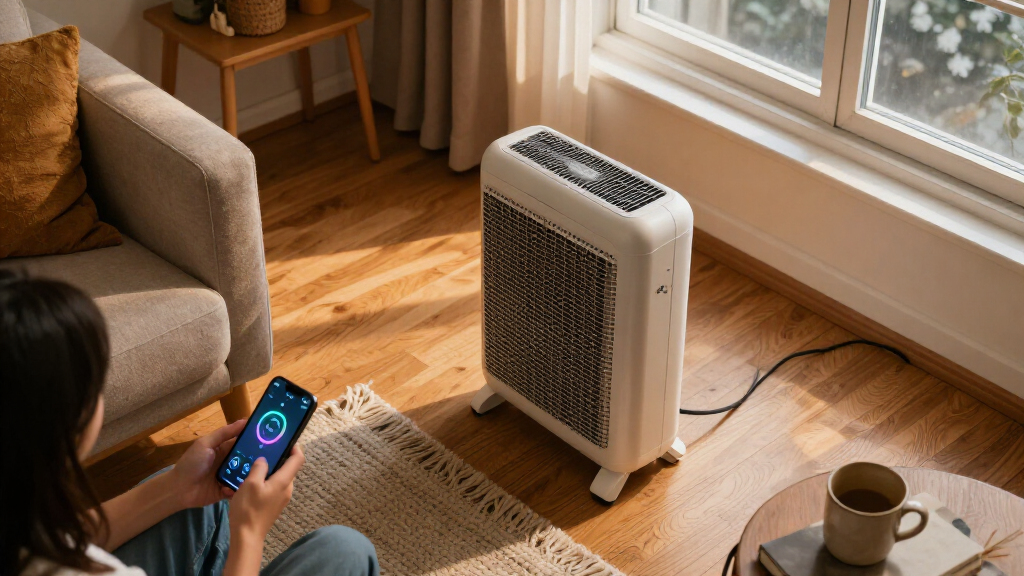

Smart space heaters promise more control over room heating, but the label covers two different priorities. Wi-Fi app-controlled heaters let you change settings from a phone, set schedules, and sometimes connect to voice assistants. Thermostat-smart heaters focus on holding a target temperature, often with simpler controls and fewer connected features. The real choice is whether you want to manage heating remotely or have the heater respond automatically as the room warms and cools. Choose Wi-Fi if remote access and detailed scheduling matter; choose thermostat-smart if steady comfort and straightforward operation are your priorities. Either type still needs suitable safety features and careful placement, and neither should be treated as a replacement for a home’s primary heating system.

Get home appliances delivered free with Prime
- Fast, free delivery on millions of items
- Prime Video, Amazon Music and more included
- Member-only deals all year

FLANUR Smart Space Heater for Indoor Use – Large Room, 1500W
- ✔ Power: 1500 W
- ✔ Coverage: Up to 300 sq ft
- ✔ Controls: Wi-Fi app, Alexa, Google Assistant

FLANUR 1500W Smart Space Heater – Black
- ✔ Power: 1500 W
- ✔ Voltage and current: 120 V; 12.5 A
- ✔ Coverage: 160–200 sq ft

Nutromo Space Heater with WiFi/App – Portable Electric Heater for Office
- ✔ Power: 1500 W
- ✔ Heating method: Forced air
- ✔ Oscillation: 90 degrees
At a Glance
| Criteria | Wi-Fi app-controlled space heaters | Thermostat-smart space heaters | Winner |
|---|---|---|---|
| Remote control | Usually controlled through a phone app, sometimes with voice assistant support | Usually controlled at the unit; some models add an app or remote | A |
| Temperature management | Settings vary by model; remote adjustment is convenient, but temperature hold may be limited | Designed to maintain a selected temperature with less manual adjustment | B |
| Scheduling and automation | Often offers app schedules, timers, or routines | May offer a timer or basic schedule; automation varies | A |
| Setup and everyday use | Requires Wi-Fi and app setup; offers more control once configured | Typically simpler to set up and operate, especially without an app | B |
| Safety features | Depends on the individual heater; smart connectivity does not itself make a heater safer | Depends on the individual heater; check for tip-over and overheat protection | Tie |
| Price and value | Often costs more than basic heaters; added value depends on whether remote features are used | Can be a lower-cost way to get automatic temperature control, though premium models may cost more | Depends |
FLANUR Smart Space Heater for Indoor Use – Large Room, 1500W
The FLANUR Large Room Tower is the most versatile match for buyers who want smart controls to serve a main living area, larger bedroom, or home office. Its stated coverage reaches up to 300 square feet, more than the 160–200 square feet listed for the FLANUR Black. That coverage claim makes it the clearest choice of the three when one heater needs to circulate warmth across a broader room, though actual comfort will depend on insulation, ceiling height, and outdoor conditions.Its app, Alexa, and Google Assistant support gives us several ways to adjust heat without walking over to the unit. The heater lists three heat levels alongside ECO and fan-only modes, plus a 12-hour programmable timer. Compared with the Black FLANUR, that gives this tower a more specific scheduling feature; compared with Nutromo, it has a stated coverage figure and a stated 23 dB lowest-mode noise level. A low noise claim is especially relevant in rooms where conversation, reading, or sleep matters, but it should not be read as a promise that every mode is silent.There are practical limits. A 1500-watt, 12.5-amp draw can be demanding on a shared circuit, and the 29-inch tower with a 200-by-200-millimeter footprint may feel oversized in a tight room. Wi-Fi setup requires 2.4 GHz, and remote control is useful only if the app and network suit your setup. We would choose it over the other two for broader stated coverage and quiet low operation, but skip it if compact dimensions or a more modest room-heating target matter more.
Pros:
- Stated coverage up to 300 square feet is the broadest in this comparison.
- App, Alexa, and Google Assistant controls pair with three heat levels, ECO, and fan-only modes.
- Lists a 23 dB lowest-mode noise figure and 70-degree oscillation.
- Includes tip-over and overheat protection, child lock, and automatic shut-off.
Cons:
- Its 29-inch tower form may be bulky in compact rooms.
- The 1500-watt, 12.5-amp maximum draw can be a concern on a shared circuit.
- Wi-Fi connectivity is specified for 2.4 GHz networks.
Best for: People who want app or voice control and a tower heater with a stated coverage rating for a larger indoor room.
Not ideal for: Small-room users with limited floor space, or households without an appropriate circuit and compatible 2.4 GHz Wi-Fi.
Bottom line: We rank the Large Room Tower first for its combination of broad stated coverage, smart controls, and a quiet low-mode claim, provided its size and electrical draw suit the room.
“We rank the Large Room Tower first for its combination of broad stated coverage, smart controls, and a quiet low-mode claim, provided its size and electrical draw suit the room.”
FLANUR 1500W Smart Space Heater – Black
The FLANUR Black makes more sense when our priority is controlled supplemental warmth in a modest room rather than the broadest coverage. Its stated 160–200-square-foot range is lower than the Large Room Tower’s claim, but that can be a more appropriate match for a bedroom, office, or smaller living space. Both FLANUR models provide 70-degree oscillation and app or voice control, so the Black’s case rests on its room-size fit and clearly detailed safety package rather than a more expansive feature list.Its 1500-watt PTC ceramic element offers high, low, ECO, and fan-only modes, and the temperature range is listed as 41–95°F. The manufacturer also gives a 36 dB noise figure. That is higher than the Large Room Tower’s lowest-mode claim of 23 dB, making the larger FLANUR the more compelling pick for buyers especially sensitive to operating noise. In return, this model offers a practical set of protections: tip-over shut-off, overheat protection, dual fuses, a child lock, and a 24-hour auto shut-off. Those safeguards do not remove the need for careful placement and attentive use.One notable omission is a physical remote, so adjustments rely on the unit itself or the connected app and voice assistant. The heater requires 2.4 GHz Wi-Fi, and its instructions caution against soft carpets and bathroom use. Compared with Nutromo, it has more specific safety and coverage information; compared with the Large Room Tower, it is better suited to a smaller footprint in use but offers less stated reach and a higher listed noise level. Choose it for a smaller room and its safety details, not as a substitute for whole-home heating.
Pros:
- Stated 160–200-square-foot coverage suits smaller rooms better than the larger FLANUR tower’s target.
- Works with an app, Alexa, and Google Assistant.
- Lists overheat protection, tip-over shut-off, child lock, dual fuses, and 24-hour auto shut-off.
- Offers high, low, ECO, and fan-only modes with 70-degree oscillation.
Cons:
- No physical remote is included.
- Its listed 36 dB noise level is higher than the Large Room Tower’s lowest-mode claim.
- Requires 2.4 GHz Wi-Fi and is not recommended for soft carpets or bathrooms.
Best for: Buyers seeking smart supplemental heat for a smaller bedroom or office who value a child lock and multiple listed safety protections.
Not ideal for: People who need broad room coverage, a physical remote, a particularly quiet low mode, or a heater for bathroom use or soft-carpet placement.
Bottom line: We recommend the Black FLANUR for smaller rooms where app control and a detailed set of safety features matter more than maximum coverage or the quietest listed operation.
“We recommend the Black FLANUR for smaller rooms where app control and a detailed set of safety features matter more than maximum coverage or the quietest listed operation.”
Nutromo Space Heater with WiFi/App – Portable Electric Heater for Office
Nutromo is the most distinctive choice if we care about how broadly a heater sweeps air across a room. Its 90-degree oscillation is wider than the 70 degrees listed for either FLANUR, which may help distribute forced air across a wider viewing or seating area. That does not establish that it heats a larger room: unlike both FLANUR products, Nutromo provides no square-foot coverage figure in the supplied specifications. We would therefore choose it for its airflow pattern, not on an assumption that it outcovers the Large Room Tower.Smart Wi-Fi app control and Alexa or Google Assistant integration make it comparable on connected convenience. Nutromo also lists an ECO mode that adjusts output and a built-in fan for cooling, giving it more explicit year-round utility than the FLANUR Black, whose fan-only mode is described without a cooling-season emphasis. The temperature range is 41–95°F. As with any 1500-watt heater, ECO operation is a mode rather than a guarantee of a particular energy saving; results depend on settings and conditions.The tradeoff is less complete buying information. The supplied details do not state a coverage area, noise figure, Wi-Fi band, timer, or specific safety protections, so buyers cannot compare those points as confidently as they can with the FLANUR heaters. The tower form may also take up more space than a compact heater, and the fan can be noticeable at higher speeds. Compared with the Large Room Tower, Nutromo offers wider oscillation and a stated cooling fan but gives up the clearer coverage and noise claims. Compared with the Black FLANUR, it is more compelling for broad airflow and warm-weather fan use, but less clearly documented for safety and room fit.
Pros:
- 90-degree oscillation is the widest listed in this group.
- Supports Wi-Fi app control, Alexa, and Google Assistant.
- ECO mode adjusts output according to the product description.
- Built-in fan provides an additional non-heating use.
Cons:
- No heating coverage figure is supplied, making room matching less certain.
- The tower may be bulky for compact spaces.
- Higher-speed fan operation can generate noticeable noise.
- Specific timer, Wi-Fi band, and safety-protection details are not provided.
Best for: People who want a smart tower heater with wider oscillation and a fan mode they can use beyond the heating season.
Not ideal for: Buyers who need a stated room-coverage figure, a specified noise level, or clearly itemized safety protections before choosing.
Bottom line: Nutromo is the alternative for buyers who prioritize 90-degree airflow and a cooling fan, but we would choose a FLANUR instead when documented coverage, noise, or safety details are decisive.
“Nutromo is the alternative for buyers who prioritize 90-degree airflow and a cooling fan, but we would choose a FLANUR instead when documented coverage, noise, or safety details are decisive.”
As an Amazon Associate we earn from qualifying purchases.
Key Differences
The clearest distinction is how much attention you want to give the heater. A Wi-Fi model makes it easier to check or change settings while away from the room, and its schedules can match a changing routine. That flexibility pays off when you regularly adjust heating around work hours, sleep, or rooms used at different times. It brings more setup and app dependence, though, and remote control is only useful if you actually use it.
A thermostat-smart model puts more weight on maintaining a comfortable temperature with less intervention. That can be a better everyday experience for someone who wants to set a target and leave the heater alone. The tradeoff is less remote flexibility on many models, although product features vary and some thermostat heaters also connect to apps. In either category, safety protections and the heater’s suitability for the room matter more than the word “smart.”
Detailed Comparison
Remote control (Wi-Fi app-controlled space heaters wins — moderate)
Wi-Fi app-controlled heaters win by a moderate margin when you need to adjust heat from another room or while away. Thermostat-smart models often rely on controls on the unit, though some add an app or remote. If you rarely change settings remotely, that difference may be minor in daily use.
Temperature management (Thermostat-smart space heaters wins — moderate)
Thermostat-smart heaters win by a moderate margin for users who want a steady target temperature. Their central job is to respond as the room changes, while an app-controlled heater may chiefly make manual adjustments more convenient. Check the specific model: Wi-Fi features and thermostat performance can overlap.
Scheduling and automation (Wi-Fi app-controlled space heaters wins — moderate)
Wi-Fi models generally win by a moderate margin because apps often provide more scheduling choices and routines. This is useful when your hours change or you want heating to follow a particular pattern. If a simple timer meets your needs, the extra automation may not justify the additional setup.
Setup and everyday use (Thermostat-smart space heaters wins — minor)
Thermostat-smart heaters usually win by a minor margin for ease of use: selecting a temperature at the unit can be simpler than connecting an app and Wi-Fi. App-controlled models can feel more convenient after setup, especially across several rooms or schedules. The practical winner depends on whether you prefer direct controls or phone-based management.
Safety features (major difference)
There is no category-wide winner. Both types can include tip-over shutoff and overheat protection, but connected features do not guarantee those safeguards. Compare the specific heater’s safety provisions and follow its placement and operating instructions; those details matter more than app support.
Price and value (moderate difference)
The value winner depends on which features you will use. A thermostat-focused model can deliver automatic temperature control without charging for a rich app experience. A Wi-Fi heater may earn its premium for someone who regularly uses remote adjustments and schedules. Compare actual model prices and features rather than assuming every connected heater costs more.
Wi-Fi app-controlled space heaters: Pros and Cons
Pros:
- Remote changes through an app on many models
- Scheduling can match varied routines
- May support voice assistants or other smart-home features
Cons:
- App and Wi-Fi setup add steps
- Remote features offer little value if rarely used
- Connectivity alone does not improve safety
Thermostat-smart space heaters: Pros and Cons
Pros:
- Automatic temperature holding suits steady comfort
- Often simpler to operate directly on the unit
- Can provide useful temperature control without extensive app features
Cons:
- Remote adjustment may be absent
- Scheduling can be more limited
- Thermostat behavior and accuracy vary by model
Who Should Choose What
Choose Wi-Fi app-controlled space heaters if:
- You want to switch or adjust heat while away from the room.
- Your schedule changes and you will use app routines or timers.
- You already use a compatible smart-home or voice assistant setup.
Choose Thermostat-smart space heaters if:
- You want a heater to maintain a chosen room temperature with little adjustment.
- You prefer direct controls and want to avoid relying on Wi-Fi or an app.
- Remote access and elaborate schedules would not affect your choice.
Skip both if: Skip both if you need a primary heating system for a whole home, or if neither model provides the safety features, room suitability, and operating guidance you need.
Value for Money
Paying more for Wi-Fi is worthwhile when remote control and flexible schedules solve a real routine problem. If you heat one room at predictable times, a thermostat-smart heater may offer better value by focusing on temperature control without features you will leave unused. Prices and capabilities vary by model, so compare the specific safety features, controls, and thermostat behavior before paying a premium.
Final Verdict
Choose a Wi-Fi app-controlled heater if remote adjustments and detailed schedules are your main reasons for buying smart. Choose a thermostat-smart heater if you want a room to stay near a chosen temperature with minimal effort. For most people who simply want comfortable supplemental heat, prioritize a dependable thermostat and suitable safety features over app extras. The deciding factor is whether you will regularly control the heater from elsewhere: if yes, pay for Wi-Fi; if not, keep the choice simpler.
Frequently Asked Questions
Are Wi-Fi space heaters better than thermostat-smart heaters?
Neither type is better for everyone. Wi-Fi models suit remote control and scheduling, while thermostat-smart models suit automatic temperature management. Some products offer both, so compare features at the model level.
Is a smart space heater worth paying more for?
It can be if app access or automatic temperature control makes heating a room easier for you. Paying extra for features you will not use adds little practical value.
Do smart space heaters use less electricity?
Smart controls can help you schedule operation or avoid heating an empty room, but they do not make the heater itself inherently more efficient. Electricity use depends on the heater’s power, how long it runs, and how you use it.
What safety features should I check?
Check the product details for protections such as tip-over shutoff and overheat protection, and follow the maker’s placement and use instructions. App connectivity is not a substitute for those safeguards.