
TL;DR

Get home appliances delivered free — and shop member deals
- Fast, free delivery on millions of items
- Access to Prime Big Deal Days deals on October 6–7
- Prime Video, Amazon Music and more included
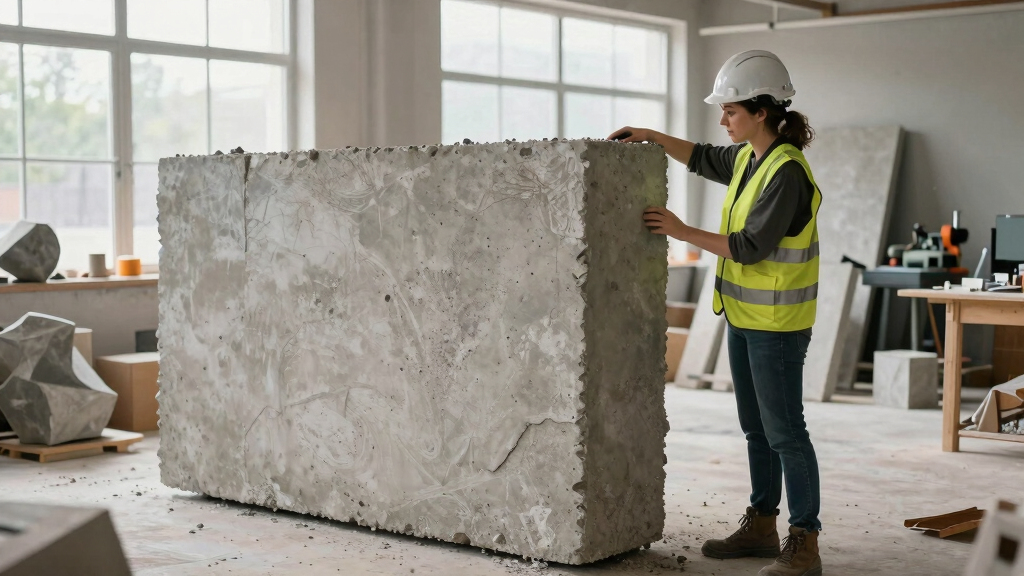
Urbi et Orbi has developed a process to repurpose industrial rubble into modern concrete monoliths. This innovative approach integrates recycled materials, advancing circular economy principles in design and architecture.
Urbi et Orbi has announced its new initiative to create contemporary concrete monoliths by upcycling industrial rubble, emphasizing sustainability and circularity in design. This development marks a significant step in transforming waste materials into high-value architectural objects, highlighting the studio’s commitment to environmental innovation.
Founded in 2012, Urbi et Orbi collaborates closely with artisans and designers to explore concrete’s organic and cultural potential. Their latest project involves a circular approach, where heavy industrial waste—such as crushed concrete rubble and airborne dust residues—is incorporated into new concrete mixes. This process results in objects with textures and appearances that reflect their recycled origins, ranging from 20% to 80% recycled content.
The studio’s Zero Waste Project, launched in 2020, intercepts 100% of internal industrial waste from their workshops. Crushed rubble replaces traditional gravel, and dust collected from sawing and grinding is used as fine filler, creating a mechanical loop that minimizes waste and maximizes material reuse. These efforts have produced a series of contemporary objects, including monolithic tables and sculptures that embody both cultural references and innovative materiality.
Designers working with Urbi et Orbi incorporate local materials such as mineral scraps from marble and ceramic workshops, embedding these fragments into concrete to produce raw, terrazzo-like surfaces. Their pieces often reference Mediterranean architectural forms, utilizing earth tones and integrated terrazzo accents to blend historic inspiration with modern circular design principles.
Environmental Impact of Recycled Concrete Monoliths
This development demonstrates a practical application of circular economy principles in architecture and design, reducing reliance on virgin materials and diverting industrial waste from landfills. It highlights how creative experimentation with recycled content can produce durable, aesthetically compelling objects that challenge traditional notions of concrete as a rigid industrial material. For the design industry and environmental advocates, Urbi et Orbi’s approach offers a scalable model for sustainable material innovation, potentially influencing broader practices in construction and decor.
As an affiliate, we earn on qualifying purchases.
Innovative Use of Industrial Waste in Concrete Design
Urbi et Orbi’s work is rooted in a Mediterranean cultural context that values craftsmanship and local materials. Since 2020, the studio has been pioneering a closed-loop system that intercepts all waste generated during production, transforming it into new building and decor elements. Their experimental approach aligns with global trends toward sustainability in architecture, emphasizing the reuse of industrial by-products to create high-quality, contemporary objects. This approach also responds to increasing regulatory and market pressures to reduce environmental footprints in construction materials.
“Urbi et Orbi’s process exemplifies how industrial waste can be integrated into high-end design, turning environmental challenges into creative opportunities.”
— an anonymous researcher
industrial rubble concrete table
As an affiliate, we earn on qualifying purchases.
As an affiliate, we earn on qualifying purchases.
Remaining Questions on Durability and Scale
It is not yet clear how these recycled concrete monoliths perform over long-term use, particularly regarding structural integrity and weather resistance. The scalability of this process for large construction projects or mass production remains to be demonstrated, and industry standards for recycled concrete objects are still evolving.
As an affiliate, we earn on qualifying purchases.
Upcoming Projects and Industry Adoption
Urbi et Orbi plans to showcase new designs incorporating higher percentages of recycled content in upcoming exhibitions. The studio is also engaging with industry partners to explore scaling their process for larger architectural applications, potentially influencing sustainable building practices. Monitoring these developments will reveal how recycled concrete can become a mainstream material in architecture and design.
As an affiliate, we earn on qualifying purchases.
Key Questions
How does Urbi et Orbi ensure the quality of recycled concrete?
They use a controlled process that combines crushed industrial rubble and fine dust with new cement mixes, adhering to environmental and safety standards, though full long-term durability data is still forthcoming.
Can recycled concrete match the strength of traditional concrete?
Preliminary tests suggest that with proper formulation, recycled concrete can achieve comparable strength, but further research is ongoing to confirm performance in various structural applications.
Are these recycled concrete objects suitable for outdoor use?
Some objects are designed for indoor or sheltered environments; their weather resistance is still being evaluated, and additional protective finishes may be necessary for outdoor exposure.
What are the environmental benefits of this approach?
It reduces industrial waste sent to landfills, decreases the demand for virgin raw materials, and promotes circular economy principles within the building and design sectors.
Will this process be adopted widely in the construction industry?
While promising, widespread adoption depends on further validation of durability, cost-effectiveness, and regulatory acceptance, which are currently in development stages.
Source: designboom
NFL season / tailgating Picks
team gear
As an affiliate, we earn on qualifying purchases.