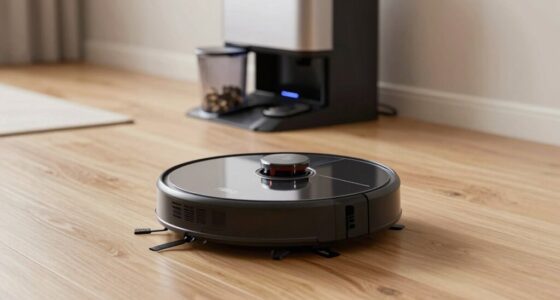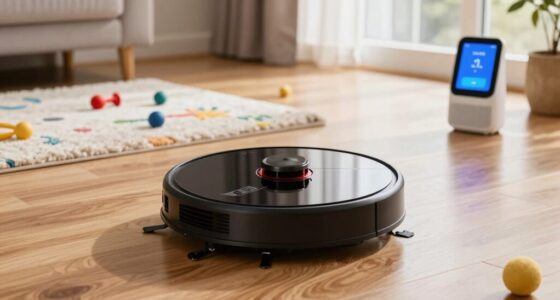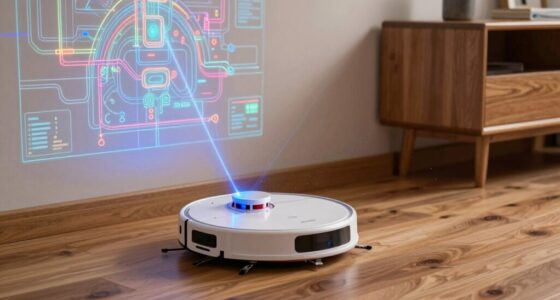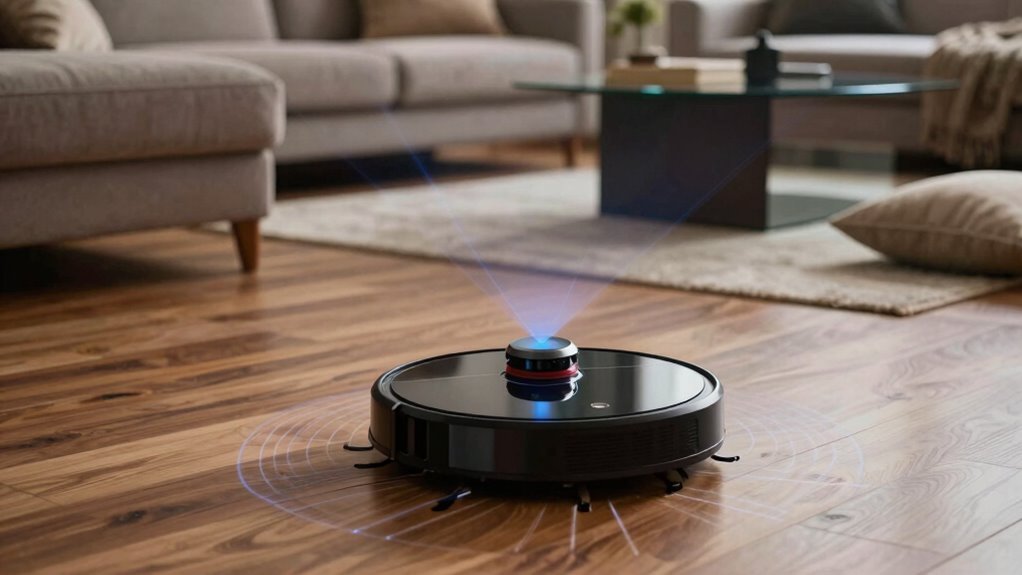

Lidar mapping in a robot vacuum helps it create a detailed, real-time 3D map of your home by using laser sensors to detect walls, furniture, and objects. It quickly sends laser pulses that bounce back, allowing the vacuum to understand its surroundings and plan efficient routes. This technology enables the vacuum to avoid obstacles, adapt to changes, and clean more thoroughly. Keep exploring to discover how it makes your cleaning smarter and more effective.

Get home appliances delivered free with Prime
- Fast, free delivery on millions of items
- Prime Video, Amazon Music and more included
- Member-only deals all year
Key Takeaways
- Creates detailed 3D maps of home environments for precise navigation.
- Detects obstacles like furniture and small objects to avoid collisions.
- Enables efficient, systematic cleaning routes by analyzing environmental features.
- Continuously updates maps to adapt to environmental changes over time.
- Supports intelligent decision-making for optimized cleaning and user customization.
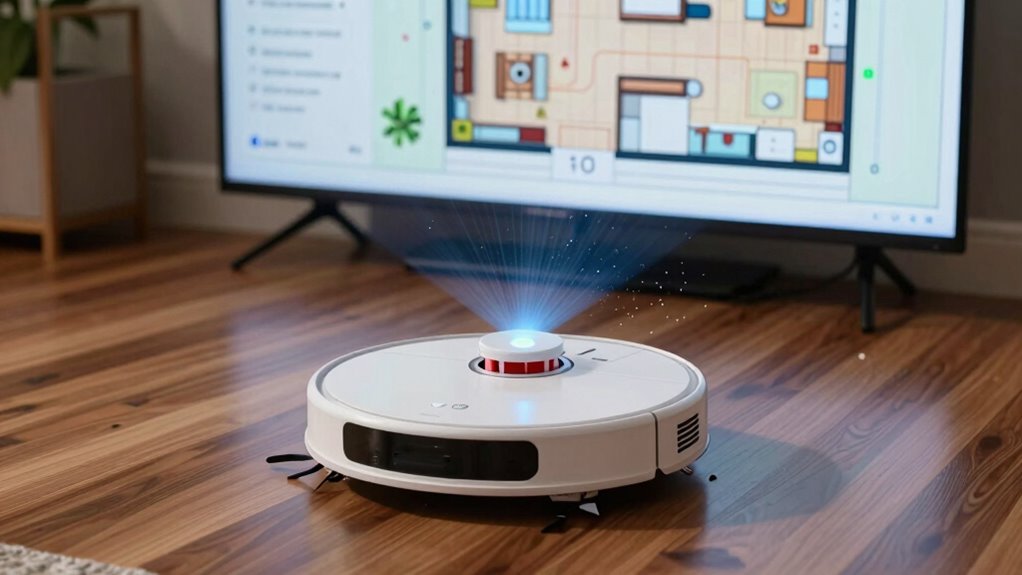
Lidar mapping has revolutionized how robot vacuums navigate and clean your home. By using laser sensors to create a detailed map of your environment, these vacuums can move efficiently and avoid obstacles with impressive accuracy. At the core of this technology is sensor integration, which allows the vacuum to gather real-time data about its surroundings. The laser sensors emit quick pulses of light that bounce back when they hit objects, helping the vacuum build a precise 3D map of your space. This sensor data is vital because it feeds directly into the navigation algorithms that determine how the vacuum moves.
Lidar mapping uses laser sensors to create detailed, accurate home maps for efficient robot vacuum navigation and obstacle avoidance.
Navigation algorithms process the information collected through sensor integration to chart the most efficient cleaning routes. They analyze the map to identify open areas, tight corners, and obstacles like furniture or pet toys. The algorithms continuously update as the vacuum moves, adjusting its path to avoid new obstacles or to cover missed spots. This dynamic decision-making process guarantees thorough cleaning without wasting time or energy. Unlike older models that relied on random bouncing, modern robot vacuums with lidar can plan systematic routes, guaranteeing every inch of your home gets cleaned.
The combination of sensor integration and smart navigation algorithms means your vacuum can do more than just move randomly around your rooms. It can recognize walls, furniture, and even small objects, allowing it to make intelligent decisions about where to go next. This precision reduces the chances of bumping into things or missing areas, which results in a more efficient cleaning session. Plus, with accurate mapping, you can often control the vacuum through a mobile app, setting specific cleaning zones or scheduling routines based on the map it creates.
Furthermore, these advanced systems enable your robot vacuum to learn your home’s layout over time. As it navigates repeatedly, it refines its map, becoming faster and more effective. Sensor integration ensures that the vacuum can detect changes—like a new piece of furniture or a moved object—and update its map accordingly. The navigation algorithms then adapt to these changes, helping your vacuum avoid obstacles and optimize cleaning paths on subsequent runs. This constant learning process enhances cleaning quality and makes the device more autonomous, reducing your need to supervise. A key factor behind this capability is the environmental mapping that these sensors enable, allowing the vacuum to understand and adapt to its surroundings constantly. Additionally, this environmental mapping relies heavily on sensor integration, which is crucial for creating accurate and comprehensive maps.
By combining these technologies, robot vacuums are becoming increasingly intelligent and capable of delivering consistent, high-quality cleaning results. The ongoing development of sensor technology continues to push the boundaries of what these devices can achieve, making them more reliable and efficient over time.
As an affiliate, we earn on qualifying purchases.
Frequently Asked Questions
How Does Lidar Mapping Improve a Robot Vacuum’s Cleaning Efficiency?
Lidar mapping boosts your robot vacuum’s cleaning efficiency by improving mapping accuracy and obstacle detection. It creates a precise, real-time map of your space, allowing the vacuum to navigate efficiently without missing spots or bumping into furniture. With better obstacle detection, it avoids obstacles smoothly, reducing collisions and ensuring thorough cleaning. This smart navigation helps your vacuum cover more area faster, making your cleaning routine more effective and less time-consuming.
Can Lidar Mapping Detect Small Objects or Obstacles?
Think of lidar mapping as your robot vacuum’s vigilant eye, capable of detecting small objects and obstacles with impressive precision. It uses advanced object detection to spot tiny items that might otherwise escape notice. This technology enables obstacle avoidance, helping your vacuum maneuver seamlessly around fragile objects or clutter, preventing accidents. While it’s highly effective, extremely minuscule objects might sometimes slip through, but overall, lidar guarantees your cleaning path stays clear and safe.
How Does Lidar Mapping Work in Low-Light or Dark Environments?
Lidar mapping works well in low-light or dark environments because it uses laser pulses rather than relying solely on visible light. It often combines Infrared sensing and Ultrasonic detection to enhance obstacle detection. Infrared sensors detect obstacles in dark areas, while Ultrasonic detection measures distance to nearby objects. Together, these technologies enable your robot vacuum to navigate efficiently, even in poorly lit spaces, ensuring thorough cleaning without bumping into furniture or walls.
What Maintenance Is Required for Lidar Sensors?
You need to regularly clean your lidar sensors to prevent dust buildup, which can impair their accuracy. Calibration is crucial, so check and adjust the sensors as recommended by the manufacturer. Coincidentally, keeping the sensors dust-free and properly calibrated ensures your robot vacuum maps efficiently, navigates smoothly, and maintains peak performance. Regular maintenance like this helps avoid navigation errors, prolongs sensor life, and keeps your cleaning device functioning at its best.
Is Lidar Mapping Affected by Pet Hair or Dust Buildup?
Pet hair and dust buildup can affect lidar mapping, causing the sensor to misread its surroundings. When pet hair accumulates on the lidar sensor, it can obstruct the laser beams, leading to less accurate navigation and mapping. Dust buildup similarly interferes with sensor performance. Regularly cleaning the lidar sensor with a soft cloth helps maintain best possible mapping accuracy, ensuring your robot vacuum navigates efficiently and avoids obstacles.
robot vacuum obstacle avoidance sensors
As an affiliate, we earn on qualifying purchases.
As an affiliate, we earn on qualifying purchases.
Conclusion
So, with lidar mapping, your robot vacuum becomes an unstoppable cleaning beast, transforming your home into a perfectly mapped kingdom. It’s like having a tiny, super-smart explorer dodging furniture and conquering every corner with laser precision. No dust bunny stands a chance against this high-tech marvel, turning your cleaning chores into a breeze. Say goodbye to missed spots and hello to a spotless, effortlessly maintained home—your new robotic guardian is here to rule the mess!
As an affiliate, we earn on qualifying purchases.
robot vacuum with real-time mapping
As an affiliate, we earn on qualifying purchases.
As an affiliate, we earn on qualifying purchases.
Halloween Picks
halloween
As an affiliate, we earn on qualifying purchases.