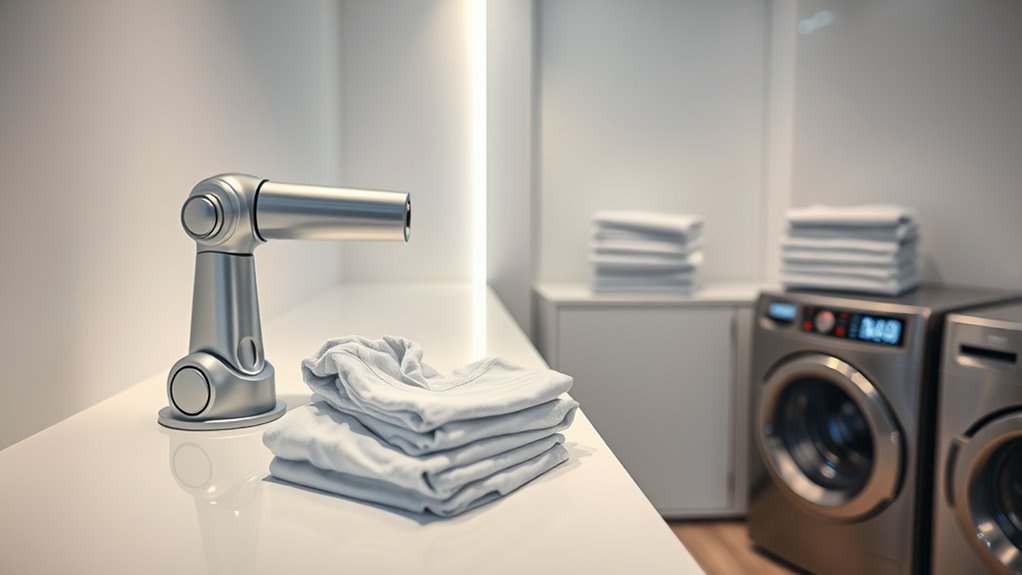

Automated laundry is increasingly becoming a reality, thanks to advanced laundry folding robots that can handle everyday clothes efficiently. These robots mimic human movements, use visual recognition, and adapt to different fabrics and sizes, making laundry tasks easier and faster for you. While they excel at standard clothing items, some complex items still challenge them. As technology improves, you’ll see these robots become more versatile and affordable, transforming how you manage laundry. Keep exploring to learn more.
Key Takeaways
- Laundry folding robots are commercially available, demonstrating that automated laundry is now a practical reality.
- These robots use sensors, visual recognition, and advanced algorithms to fold various clothing items efficiently.
- They excel at standard laundry tasks but still face challenges with complex items like fitted sheets.
- Ongoing improvements are making these robots faster, more affordable, and capable of handling more laundry tasks.
- Automated laundry solutions are transforming laundry routines, reducing effort and time for households.

Folding laundry can be a tedious chore, but advances in robotics are changing that. Today, you can find robots specifically designed to handle this mundane task, promising to save you time and effort. These machines are no longer just prototypes; many are available on the market, offering a glimpse into a future where laundry day might require just a press of a button. Companies have developed robots equipped with sensors and advanced algorithms that can identify, pick up, and fold clothes with impressive accuracy. The idea is to automate a process that typically takes up a considerable chunk of your weekend, freeing you to focus on other activities or simply relax.
Robotic laundry folders are transforming chores into effortless tasks.
When you look at these laundry folding robots, you’ll notice they are built to mimic human movements but with greater efficiency. They use a combination of visual recognition and precision manipulation to handle a variety of fabrics, sizes, and shapes. This means you don’t have to worry about sorting clothes into delicate or heavy categories—these robots adapt quickly, providing versatile solutions for households of all sizes. The process usually begins with the robot scanning your laundry, identifying items, and then methodically folding each piece. Some models even stack or organize clothes into neat piles, which can make your closet or drawer look much more orderly. Additionally, many of these robots incorporate smart-home integrations to streamline the entire laundry management process.
You might be wondering if these robots are truly reliable. The truth is, many have made remarkable progress, but they’re not perfect yet. They excel at standard clothing like T-shirts, towels, and jeans, but might struggle with more complex items like fitted sheets or irregularly shaped garments. Still, ongoing improvements are rapidly increasing their capabilities. As you consider investing in one, you’ll find that many models are designed for easy setup and user-friendly operation. Once you load your laundry into the robot’s designated area, it takes over, allowing you to multitask or take a break. This automation can be especially beneficial if you have mobility issues or a busy schedule that makes traditional folding a chore you’d prefer to avoid.
In essence, the laundry folding robot is becoming a practical reality rather than just a concept. While it might not completely replace the human touch for all types of laundry yet, it’s notably reducing the time and effort involved in folding clothes. As technology advances, you can expect these robots to become more affordable, faster, and more adaptable. Soon, you might find yourself just loading laundry into a machine and letting it handle the rest, transforming a once monotonous task into a quick, effortless process.

United Office Products F100 Automatic Paper Folding Machine, 200-Sheet Capacity, Folds Letter and Legal Size Paper, High-Speed Letter Folding Machine for Offices, Schools and Churches
FAST & RELIABLE FOLDING: Save time and eliminate the hassle of manual folding. This high-speed automatic letter folder…
As an affiliate, we earn on qualifying purchases.
As an affiliate, we earn on qualifying purchases.
Frequently Asked Questions
How Much Does a Laundry Folding Robot Typically Cost?
A laundry folding robot typically costs between $500 and $2,500, depending on the brand and features. You might find more affordable models with basic functions, while premium options offer advanced folding capabilities and smart integration. Keep in mind that prices can vary based on sales, discounts, and updates in technology. Investing in one could save you time, but be sure to weigh your specific needs and budget before buying.
Can the Robot Handle Delicate or Special Fabrics?
Yes, your laundry folding robot can handle delicate or special fabrics, but with some limitations. While it’s designed to be gentle, you should always check the fabric type and use the recommended settings. Think of the robot as a skilled assistant—careful but not infallible. For truly delicate items like silk or lace, hand washing and traditional folding might still be your best bet.
What Is the Average Speed of Folding per Load?
You can expect the laundry folding robot to handle about 20 to 30 loads per hour, depending on the size and complexity of each load. It moves quickly and efficiently, folding clothes in just a few seconds per item. Keep in mind, some models might be slightly slower or faster based on their design. Overall, it’s a time-saving device that streamlines your laundry routine profoundly.
How Much Space Does the Robot Require?
The laundry folding robot typically requires about the size of a small table, roughly 3 to 4 feet wide and 2 to 3 feet deep. You’ll need enough space for the robot to operate smoothly without obstruction, including room for loading and unloading clothes. Make certain there’s a flat, stable surface nearby, and consider leaving extra space for maintenance or adjustments. Properly positioning it ensures efficient folding and easy access.
Is the Robot Compatible With Existing Laundry Systems?
Like a modern-day Robin Hood wielding high-tech tools, this robot is designed to be compatible with most existing laundry systems. You won’t need to overhaul your setup; it seamlessly integrates with your current washer and dryer. Just connect, and it takes care of the folding. Its adaptable design makes it a smart choice for anyone looking to automate laundry without the hassle of replacing their existing appliances.

Semi-Automatic Folding and Packaging Machine Clothes Folding and Stacking/Bagging Machine
Efficient and Precise Folding: The Automatic Clothes Folding Machine-51A folds various types of garments, including t-shirts, sweatshirts, and…
As an affiliate, we earn on qualifying purchases.
As an affiliate, we earn on qualifying purchases.
Conclusion
Imagine a future where laundry folding is fully automated, saving you time and effort. Currently, robots can fold a t-shirt in under 10 seconds—an impressive feat that shows how close we are to making this a reality. With technology advancing rapidly, automated laundry could become a common household helper soon. So, next time you dread folding clothes, remember that a robot might be doing it for you before long, making laundry day a breeze.

BoxLegend V3 Shirt Folder Board Tshirt Clothes Folder Folding Board Durable Laundry Sorter Helper Liner, Black
A Laundry Game Changer – Had a hard time folding shirts? This folding board will up your laundry…
As an affiliate, we earn on qualifying purchases.
As an affiliate, we earn on qualifying purchases.

Portable Clothes Dryer, 8H Timer, w/Remote Control & Dry Bag, Mini Compact Foldable Fast Electric Dryer Machine for Laundry, Travel, Apartment, RV, Dorm, Quiet 45dB, Energy Save, 600W
【Compact, Convenient and Easy to Store】This product is compact and convenient to carry, product size: 9.69×6.97×4.49 in, weight:…
As an affiliate, we earn on qualifying purchases.
As an affiliate, we earn on qualifying purchases.