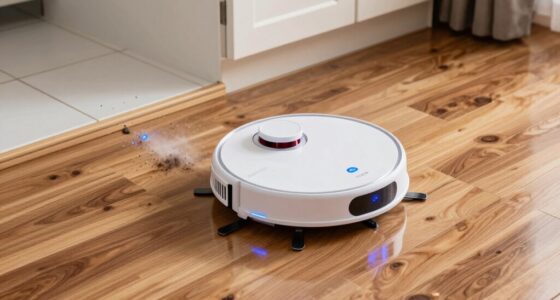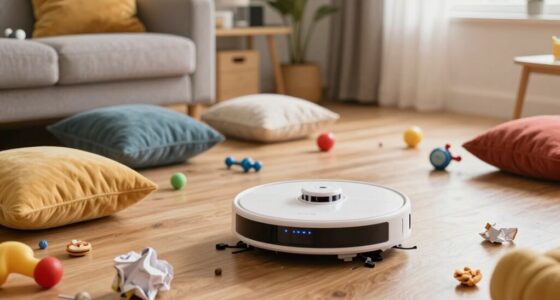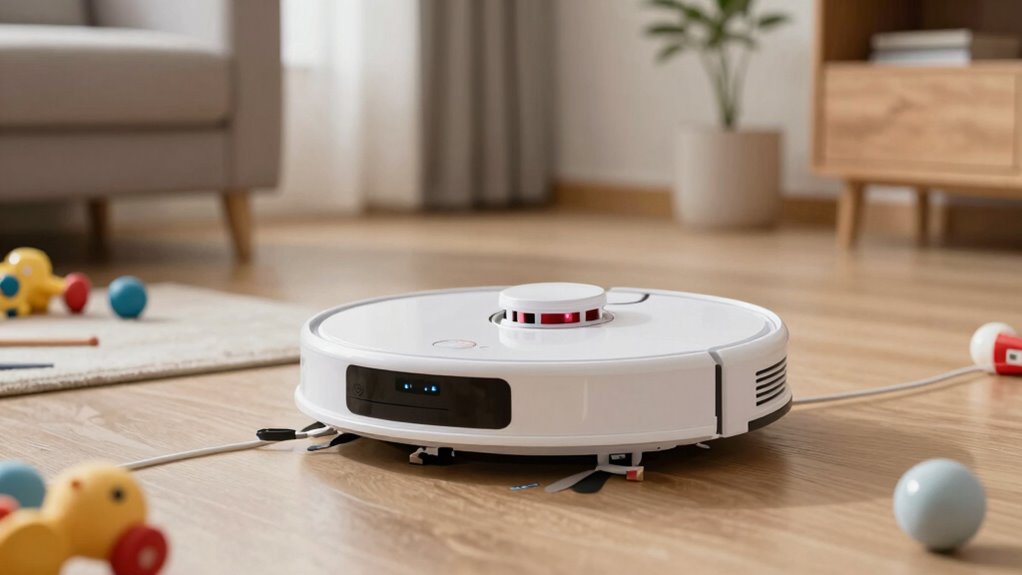

Obstacle avoidance has transformed your robot vacuum by making it smarter, safer, and more efficient. Advanced sensors and navigation algorithms now let it detect and avoid obstacles in real time, ensuring thorough cleaning without getting stuck. This technology also allows for detailed mapping and customized cleaning zones, boosting overall performance. As these innovations keep evolving, you’ll see even better accuracy and autonomy. Stay with us to discover how these changes continue shaping the future of robotic cleaning.

Get home appliances delivered free with Prime
- Fast, free delivery on millions of items
- Prime Video, Amazon Music and more included
- Member-only deals all year
Key Takeaways
- It enabled precise navigation, allowing robot vacuums to clean more efficiently and cover entire homes autonomously.
- Advanced obstacle detection reduced getting stuck, increasing reliability and user trust in autonomous cleaning.
- Integration of sensor fusion and AI improved obstacle recognition, making robots smarter and adaptable to complex environments.
- Custom features like zone cleaning and no-go areas became possible, enhancing user control and cleaning customization.
- Continuous technological innovations raised industry standards, driving competition and accelerating market growth.
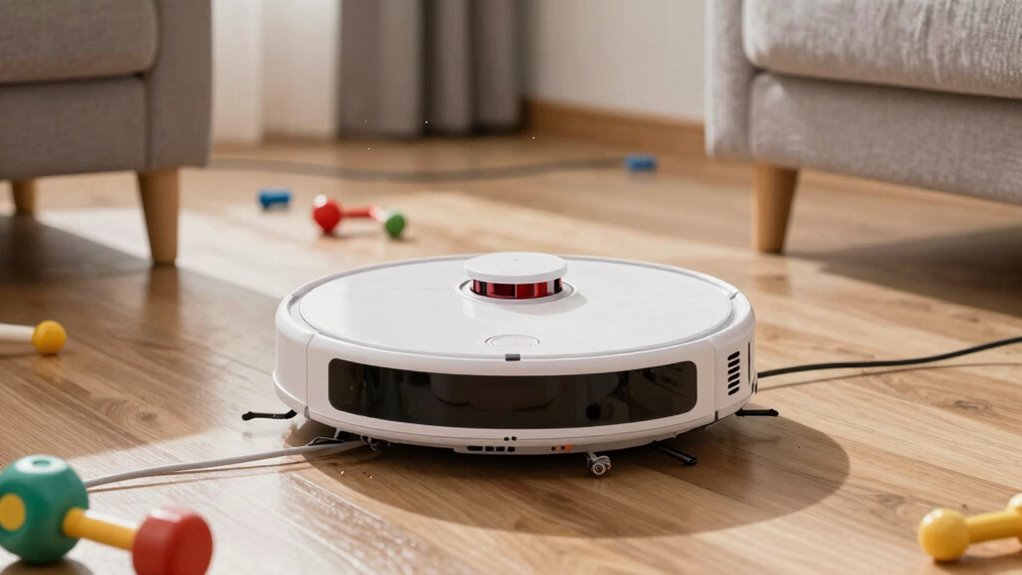
Obstacle avoidance technology has become a key factor driving innovation and competition in the robot vacuum market. When you look at how these devices operate, it’s clear that navigation algorithms and sensor technologies are at the core of their ability to clean efficiently without colliding with furniture or falling down stairs. Manufacturers have realized that sophisticated navigation algorithms enable robots to map your home accurately, plot ideal cleaning paths, and adapt to changes in the environment. Paired with advanced sensor technologies—like infrared, ultrasonic, and lidar sensors—these algorithms empower the vacuum to detect obstacles in real-time and respond swiftly. This combination transforms what used to be simple bump sensors into intelligent systems capable of understanding complex home layouts.
You’ll notice that modern robot vacuums navigate more intelligently than ever before. Instead of blindly bumping into objects or randomly wandering, they create detailed maps of your space, allowing them to plan efficient routes. This is made possible by the continuous improvement in sensor technologies, which give the vacuum a 360-degree awareness of its surroundings. Infrared sensors detect nearby objects, ultrasonic sensors measure distances, and lidar sensors generate precise 3D maps. When obstacles appear or furniture shifts, the robot’s navigation algorithms interpret sensor data instantaneously, adjusting its path to avoid collisions. This seamless interaction between sensors and algorithms ensures your device cleans thoroughly without getting stuck or causing damage. Additionally, the integration of advanced sensor technologies has significantly enhanced obstacle detection accuracy, making navigation even more reliable. The ongoing development of sensor fusion techniques further improves obstacle recognition by combining data from multiple sensors for more accurate detection.
The evolution of obstacle avoidance has also led to smarter features like zone cleaning, no-go areas, and multi-room navigation. You might not realize it, but every time your robot adapts to new obstacles or changes in your home, it’s executing complex decision-making processes powered by these technologies. As these systems continue to advance, manufacturers are exploring ways to incorporate machine learning to improve obstacle detection and navigation capabilities further. The integration of automated mapping enhances the robot’s ability to remember and adapt to your home layout over time. As a result, your vacuum becomes more autonomous and reliable, reducing the need for manual intervention. This progress in navigation algorithms and sensor tech has elevated user expectations, prompting manufacturers to innovate further. They now focus on improving obstacle detection accuracy, battery efficiency, and mapping speed, which all hinge on advancements in these core technologies.
In essence, obstacle avoidance has revolutionized the robot vacuum industry by making these devices smarter, safer, and more efficient. It’s a direct consequence of integrating advanced navigation algorithms with cutting-edge sensor technologies, allowing your vacuum to adapt to your home’s unique environment. This synergy not only enhances cleaning performance but also sets new standards for what you can expect from an intelligent cleaning companion. The future of robot vacuums will continue to depend heavily on these innovations, shaping a smarter, more intuitive cleaning experience for you.
robot vacuum with obstacle avoidance
As an affiliate, we earn on qualifying purchases.
As an affiliate, we earn on qualifying purchases.
Frequently Asked Questions
How Does Obstacle Avoidance Impact Battery Life in Robot Vacuums?
Obstacle avoidance can slightly decrease your robot vacuum’s battery life because it increases power consumption due to additional sensors and processing. However, it helps with battery optimization by preventing the vacuum from wasting energy on repeated or unnecessary cleaning in cluttered areas. Overall, the benefits of avoiding obstacles often outweigh the small impact on battery life, leading to more efficient cleaning sessions and longer-lasting batteries in the long run.
Are Obstacle Avoidance Systems Costly to Upgrade in Existing Vacuum Models?
Upgrading obstacle avoidance systems can be costly, often ranging from a few hundred to over a thousand dollars, depending on the model. You might find that these upgrades involve complex feature integration, which increases expenses. While some manufacturers offer affordable retrofit kits, in many cases, the cost of installing advanced sensors and software makes the upgrade less accessible for existing vacuum models. Consider these factors before deciding on a costly upgrade.
What Sensors Are Primarily Used for Obstacle Detection in Robot Vacuums?
You’ll find that ultrasonic sensors, infrared sensors, and cameras are primarily used for obstacle detection in robot vacuums. These sensors are strategically placed around the device to optimize obstacle recognition, ensuring the vacuum can identify and navigate around furniture, walls, and other objects. Proper sensor placement is vital for accurate obstacle detection, allowing your robot to clean efficiently without collisions or missed spots.
How Do Obstacle Avoidance Features Affect Cleaning Efficiency?
Obstacle avoidance acts like a vigilant guide, boosting your robot vacuum’s cleaning efficiency. Navigation algorithms and obstacle mapping help it dodge obstacles smoothly, covering more ground without getting stuck or missing spots. This accuracy ensures every corner sparkles, saving time and energy. With smarter navigation, your vacuum not only cleans better but also preserves its battery life, making your cleaning routine effortless and more effective.
Can Obstacle Avoidance Technology Be Integrated Into Future Robot Vacuum Designs?
Yes, obstacle avoidance technology can definitely be integrated into future robot vacuum designs. You’ll see advancements through improved navigation algorithms that enable smarter path planning, and more precise sensor calibration that enhances obstacle detection. These innovations will make vacuums more efficient and adaptable, allowing them to navigate complex environments seamlessly. As technology progresses, expect future models to be even better at avoiding obstacles, reducing accidents, and cleaning more thoroughly.
As an affiliate, we earn on qualifying purchases.
Conclusion
Obstacle avoidance has transformed the robot vacuum landscape, turning a simple chore into a dance of precision and intelligence. As these devices glide seamlessly around furniture and navigate tricky corners, they paint a picture of technological artistry, making cleaning feel effortless. With smarter sensors leading the charge, your home becomes a stage for innovation. Embrace this evolution, and watch your cleaning routine become a smooth, choreographed performance—where obstacles are no longer barriers, but part of the graceful journey.
smart robot vacuum zone cleaning
As an affiliate, we earn on qualifying purchases.
As an affiliate, we earn on qualifying purchases.
robot vacuum with mapping and navigation
As an affiliate, we earn on qualifying purchases.
As an affiliate, we earn on qualifying purchases.
NFL season / tailgating Picks
team gear
As an affiliate, we earn on qualifying purchases.