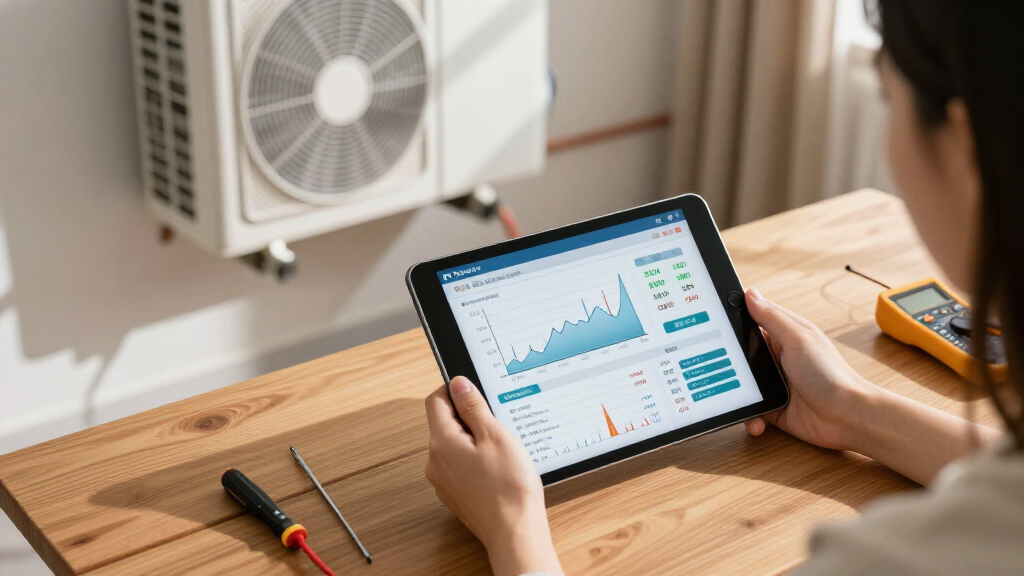

A heat pump can be the most efficient appliance in your home and still quietly waste money if nobody is watching how it runs. That’s the problem a good heat pump monitoring system solves: it tells you whether your unit is cycling properly, how much energy it’s actually drawing, and when something has drifted out of tune. But the three products I compare here approach that job from completely different angles, and picking the wrong angle is the most common mistake buyers make.

Get home appliances delivered free — and shop member deals
- Fast, free delivery on millions of items
- Access to Prime Big Deal Days deals on October 6–7
- Prime Video, Amazon Music and more included
If your goal is everyday whole-home visibility, the Emporia Vue 3 is my top overall pick because it watches your heat pump’s circuit alongside everything else in the house, with solar and net-metering tracking thrown in. If you’re a homeowner who just wants a low-cost, focused look at the heat pump circuit itself — plus a remote shutoff — the WiFi Home Energy Monitor with Three 80A CT Clamps is the budget-friendly choice. And if you’re a technician or a serious DIYer who needs to diagnose how well the refrigeration circuit is performing, not just how much power it draws, the Testo 550i Digital Manifold Kit is in a class of its own — though it won’t tell you anything about your electric bill.
The core tradeoff in this category is breadth versus depth. Whole-panel energy monitors show you cost and consumption trends but can’t see refrigerant pressures or superheat. A digital manifold reads the thermodynamic health of the system with precision but only during service calls. Understanding which question you’re trying to answer — “how much?” or “how well?” — is what this guide is designed to settle.
Complete the kit


![[Genuine] Waterdrop PF-01A Water Filter Replacement for W...](https://m.media-amazon.com/images/I/41+5tl9EiKL._SX342_SY445_QL70_FMwebp_.jpg)
Key Takeaways
- The Emporia Vue 3 wins overall because it monitors sixteen circuits at ±2% accuracy, letting you isolate your heat pump’s consumption from the rest of the house over the long term.
- The Nestool PW03 is the value pick: three CT clamps and a 15A remote relay cover a heat pump circuit and one switched device, at a fraction of a whole-panel system’s complexity.
- The Testo 550i measures system health, not energy use — pressure, evaporation, and condensation temperatures — making it a diagnostic tool rather than a monitoring dashboard.
- All three wireless options here depend on either 2.4 GHz Wi-Fi or Bluetooth, so your network setup should drive your choice as much as the hardware does.
- Only the Emporia keeps data indefinitely (hourly); the PW03 offers app history, while the Testo documents readings per job — a big difference if you want years of trend data.
| Emporia Vue 3 Home Energy Monitor |  | Best Overall | Installation: Circuit panel with clamp-on sensors | Included sensors: Sixteen 50A branch sensors | Supported systems: Single phase, single-split phase, 2-wire, 3-wire, and 3-phase 4-wire Wye with earthed neutral (some configurations require an additional sensor) | VIEW LATEST PRICE | See Our Full Breakdown |
| Testo 550i App-Controlled Digital Manifold Kit with Two 115i Pipe Clamp Thermometers |  | Best for System Diagnostics | Brand: Testo | Model: 550i | Pressure measuring range: −15 to 870 psi (−1 to 60 bar) | VIEW LATEST PRICE | See Our Full Breakdown |
| WiFi Home Energy Monitor with Three 80A CT Clamps |  | Best Value | Manufacturer: Nestool | Model: PW03 | Input voltage: AC 100–240V | VIEW LATEST PRICE | See Our Full Breakdown |
| heat pump monitoring system | Connectivity | Warranty | Model |
|---|---|---|---|
| Emporia Vue 3 Home Energy Moni | 2.4 GHz Wi-Fi and internet connection required | 1 year | — |
| Testo 550i App-Controlled Digi | — | 2 years | 550i |
| WiFi Home Energy Monitor with | 2.4 GHz Wi-Fi | — | PW03 |
More Details on Our Top Picks
Emporia Vue 3 Home Energy Monitor
The Emporia Vue 3 earns the top spot because it answers the question most heat pump owners actually have: what is this thing costing me, hour by hour, season by season? With sixteen 50A branch sensors clamped into your circuit panel, you can dedicate one sensor to the heat pump, another to the air handler, and still have plenty left over to see how your heating load stacks up against water heating, EV charging, and everything else. That whole-panel context is what separates it from the Nestool PW03, which watches three circuits and stops there — fine for a single-focus setup, but you lose the ability to compare your heat pump against the rest of your consumption.
The ±2% accuracy rating and UL/CE listings put this in legitimate energy-meter territory rather than hobbyist gadget territory. For heat pump owners specifically, the real value emerges over months: you learn your baseline seasonal draw, and any anomaly — short cycling, failed aux heat, a compressor drawing harder than usual — shows up as a visible deviation long before it shows up as a comfort complaint. The solar production and net-metering tracking is another differentiator; if your heat pump is paired with rooftop solar, the Vue 3 shows generation and consumption in one view, something neither alternative here can do at all.
The tradeoffs are real, though. It requires 2.4 GHz Wi-Fi and a continuous internet connection — no cloud, no data. One-second resolution only streams live while the app is open and is retained for just three hours, and one-minute data disappears after seven days, so long-term analysis relies on hourly figures. Also note that some three-phase and split configurations need an additional sensor sold separately, which is an easy detail to miss before ordering. Compared with the Testo 550i, the Vue 3 can’t see refrigerant pressures or line temperatures at all — but it runs 24/7 unattended, which the manifold never will.
Pros:- Monitors sixteen individual circuits, so the heat pump can be tracked separately from the rest of the house
- Real-time solar production and net-metering tracking in one app
- ±2% accuracy with UL and CE listings, plus energy automation and data export
- Hourly data retained indefinitely for long-term seasonal trend analysis
Cons:- Requires 2.4 GHz Wi-Fi and a constant internet connection to function
- Some electrical configurations require an additional sensor sold separately
- One-second data only streams live and is retained for just three hours; one-minute data lasts seven days
Best for: Homeowners who want continuous, whole-home energy visibility with their heat pump tracked as a dedicated circuit, especially homes with solar.
Not ideal for: Anyone who needs offline operation, three-phase systems unwilling to buy extra sensors, or buyers diagnosing refrigerant-side performance problems.
- Installation:Circuit panel with clamp-on sensors
- Included sensors:Sixteen 50A branch sensors
- Supported systems:Single phase, single-split phase, 2-wire, 3-wire, and 3-phase 4-wire Wye with earthed neutral (some configurations require an additional sensor)
- Connectivity:2.4 GHz Wi-Fi and internet connection required
- Accuracy:±2%
- Data retention:1-second data 3 hours; 1-minute data 7 days; 1-hour data indefinitely
- Certifications:UL Listed and CE Listed
- Warranty:1 year
Our verdict“The most complete way to watch a heat pump’s energy behavior over time, as long as your home has reliable 2.4 GHz Wi-Fi.”
Testo 550i App-Controlled Digital Manifold Kit with Two 115i Pipe Clamp Thermometers
The Testo 550i plays a completely different game from the other two picks, and that’s exactly why it belongs in this lineup. Energy monitors tell you how much electricity your heat pump consumes; the 550i tells you how well the refrigeration circuit is converting that electricity into heat. It measures high and low side pressure across a −15 to 870 psi range at ±0.5% full-scale accuracy, and the two included 115i wireless pipe clamp thermometers capture suction and liquid line temperatures simultaneously — the raw ingredients for subcooling and superheat calculations. Without both pressures and line temperatures, you’re guessing at heat pump health; the Vue 3 and PW03 simply cannot see any of this.
What makes this kit genuinely practical rather than just accurate is the workflow. Operation happens through the app over Bluetooth, so you can watch live readings from the indoor unit while the manifold stays connected outside — a real convenience during a cold-weather commissioning check when you’re moving between air handler and condenser. Every measurement can be documented and exported as a report, which matters if you’re a technician who needs records per job, or a homeowner verifying that an installer actually balanced the system correctly. The 150-hour battery life on the pipe clamps and the rugged IP54 housing mean the kit survives the reality of van transport and rooftop work, and the included protective case and calibration protocols round out a professional package.
The limitations are inherent to what it is. It’s a snapshot tool, not a monitoring platform — it only sees the system while physically connected, so it will never alert you to a compressor failure that happens three weeks later, which the Vue 3 would catch through consumption anomalies. It also requires a mobile device with Bluetooth 4.0 or newer, and the pipe clamps have a stated grip limit of 1.5 inches, which rules out some larger insulated lines. But if your question is performance rather than cost, nothing else here comes close.
Pros:- Measures system performance directly: pressures, evaporation and condensation temperature, plus pipe temperatures from two wireless clamps
- App-based Bluetooth operation with remote reading and documented measurement reports
- IP54 rugged housing built for job-site conditions, with a protective case and calibration protocols included
- Long 150-hour battery life on each pipe clamp thermometer
Cons:- Only monitors while physically connected — no continuous or historical energy tracking
- Requires a compatible mobile device with Bluetooth 4.0 or newer
- Pipe clamp thermometers grip pipes up to 1.5 inches only
Best for: HVAC technicians, commissioning-focused installers, and hands-on homeowners who want to verify refrigerant-side performance and document it.
Not ideal for: Anyone wanting continuous unattended monitoring of energy use, or users without a compatible Bluetooth mobile device.
- Brand:Testo
- Model:550i
- Pressure measuring range:−15 to 870 psi (−1 to 60 bar)
- Pressure accuracy:±0.5% of full-scale value
- Temperature range:−58° to +302°F (−50° to +150°C)
- Temperature accuracy:±0.9°F (±0.5°C)
- 115i battery life:150 hours (3 x AAA)
- “:”Connectivity:Bluetooth; iOS 7.1+ and Android 4.3+
- Warranty:2 years
Our verdict“The only option here that measures whether your heat pump is running correctly rather than how much it costs to run — a diagnostic instrument, not a dashboard.”
WiFi Home Energy Monitor with Three 80A CT Clamps
The Nestool PW03 takes the value slot by refusing to do more than the job requires. Where the Vue 3 instruments an entire panel with sixteen sensors, the PW03 gives you three 80A CT clamps — enough for a heat pump’s compressor circuit, the air handler, and one more load of your choosing. For a homeowner whose entire question is “how much electricity is my heat pump using, and can I see the history?”, this covers the bases without paying for capability you’ll never wire up. Through the Smart Life or Tuya app over 2.4 GHz Wi-Fi, it tracks voltage, current, power, and cumulative energy, with historical graphs to spot seasonal trends.
Two features lift it above a plain energy meter. The built-in temperature sensor with alerts above 50°C is a genuinely useful safety layer for a heat pump install — a failing contactor or a panel running hot will trigger a notification before it becomes a fire risk, something neither the Vue 3 nor the Testo offers in this form. And the remote on/off relay for one circuit up to 15A lets you switch a connected device from your phone, which works for ancillary equipment like a circulation pump or a small resistive heater, though 15A is far below what a heat pump compressor circuit draws, so don’t buy this imagining you’ll remotely shut down the heat pump itself.
The honest tradeoffs: installation means wiring inside the electrical panel, and the manufacturer recommends a qualified electrician, so budget for that if you’re not comfortable around live panels. There’s no published accuracy figure comparable to the Vue 3’s ±2%, and the ecosystem is a generic Tuya device rather than a polished energy platform — fine for graphs and alerts, less strong for export and automation. And unlike the Testo 550i, it sees nothing about refrigerant performance. As a focused, affordable circuit monitor with a safety alert and a relay, though, it does exactly what it promises.
Pros:- Monitors up to three selected circuits simultaneously with voltage, current, power, and energy tracking
- Historical usage data available through the Smart Life or Tuya app
- Built-in temperature sensor with alerts above 50°C for panel safety
- Remote on/off relay control for one circuit up to 15A
Cons:- Installation requires electrical panel wiring — an electrician is recommended
- Remote relay limited to a single circuit and 15A, well below compressor loads
- No stated measurement accuracy spec and a smaller ecosystem than dedicated energy platforms
Best for: Budget-minded homeowners who want to monitor the heat pump circuit plus a couple more loads, with high-temperature alerts and basic remote switching.
Not ideal for: Whole-home energy analysis, monitoring large compressor circuits remotely, or anyone unwilling to open the electrical panel (or hire an electrician).
- Manufacturer:Nestool
- Model:PW03
- Input voltage:AC 100–240V
- CT clamps included:3 (80A)
- Connectivity:2.4 GHz Wi-Fi
- App compatibility:Smart Life, Tuya
- Temperature alert:Above 50°C
- Remote relay control:Up to 15A for one circuit
- Dimensions:4.2 x 2.5 x 1.2 in
Our verdict“A straightforward, budget-friendly way to watch a heat pump circuit with history and safety alerts — as long as you accept its three-circuit ceiling.”

How We Picked
Because “heat pump monitoring” spans two very different product categories, I judged each option against what a buyer realistically needs from a monitoring system: visibility, accuracy, longevity of data, and installation burden. For the whole-home energy monitors, I weighted sensor count, measurement accuracy, app quality, and how long historical data survives. A system that only holds one-second data for three hours is a very different product from one that keeps hourly data forever, and I treated that distinction seriously.
For the professional-grade option, I focused on measurement range, durability, and documentation workflow. A manifold used on service calls lives in a van and gets dropped, so the IP54 housing and included calibration protocols mattered as much as raw specs. The two wireless pipe clamp thermometers also earn their place here: without simultaneous liquid-line and suction-line temperatures, a manifold alone can’t compute the performance numbers that matter for heat pumps.
Finally, I favored products with honest limitations I could verify from the manufacturer’s own documentation. Every option here has real drawbacks — extra sensors needed for some panel types, grip limits on pipe clamps, electrician-required wiring — and I’ve kept those front and center rather than buried, because they’re usually what determines whether a product actually works in your situation.
Factors to Consider When Choosing Best Heat Pump Monitoring Systems
Choosing between these three systems comes down to one question: are you monitoring energy consumption, or system performance? Everything else — sensor count, connectivity, installation — flows from that split. Here’s how I’d work through the decision.Energy monitoring vs. performance diagnostics
The Emporia Vue 3 and Nestool PW03 are electrical monitoring systems: they read current at the panel and translate it into consumption data. They can tell you your heat pump used 38 kWh yesterday and that usage spiked at 2 a.m., but they can’t tell you whether your refrigerant charge is low. The Testo 550i is a performance diagnostic instrument: it reads pressures and line temperatures to reveal subcooling, superheat, and efficiency, but only while physically connected to the system. Most homeowners need the first category; the second belongs to service work and commissioning checks.
Sensor count and what you’ll actually monitor
Think in circuits, not products. A typical heat pump needs at least two monitored circuits — the outdoor compressor and the indoor air handler — plus possibly aux heat strips. The Vue 3’s sixteen sensors leave room for the whole house; the PW03’s three clamps cover a heat pump-focused setup with little spare. Count your loads before choosing, including any solar production you want tracked, which only the Vue 3 supports.
Connectivity and data retention
All three options are wireless, but differently. The Vue 3 and PW03 need 2.4 GHz Wi-Fi and continuous internet; if your router only broadcasts 5 GHz or your connection drops often, expect gaps. The Testo 550i uses Bluetooth to a phone and works entirely locally, but only at the job site. Data longevity also varies sharply: the Vue 3 keeps hourly data indefinitely, the PW03 offers app-based history with no stated retention guarantee, and the Testo documents per-measurement reports. If multi-year trend analysis is your goal, retention policy should drive your pick.
Installation and safety
Every option here involves the electrical panel except the Testo, which connects to refrigerant lines instead. The Vue 3 uses clamp-on sensors inside the panel; the PW03 requires direct wiring, and the manufacturer recommends a qualified electrician. If you’re not experienced with panel work, factor an electrician’s visit into the total cost of either energy monitor. The PW03’s 50°C temperature alert adds a safety margin the others don’t offer, but it’s a supplement to proper installation, not a substitute.
Frequently Asked Questions
Can a whole-home energy monitor actually tell me if my heat pump has a problem?
Indirectly, yes — and that indirect signal is more useful than most people expect. A heat pump that’s low on refrigerant, short cycling, or running with failed aux heat strips shows a characteristic change in its electrical signature: longer run times, higher draw per degree of heating, or sudden spikes when backup heat kicks in. The Emporia Vue 3, with a dedicated sensor on the heat pump circuit and indefinitely retained hourly data, is the best of these three for catching that kind of drift, because you can compare this January against last January. What it can’t do is tell you why the system changed — for that you need a diagnostic instrument like the Testo 550i to check pressures and line temperatures. Think of energy monitoring as the smoke alarm and the manifold as the investigation that follows.
Do I need an electrician to install these monitoring systems?
For the two energy monitors, the honest answer is probably yes for most homeowners. Both the Emporia Vue 3 and the Nestool PW03 require opening your circuit panel and working near energized bus bars — the Vue 3 clamps sensors onto conductors, while the PW03 involves direct wiring into the panel. The PW03’s manufacturer explicitly recommends a qualified electrician, and I’d apply the same standard to the Vue 3 unless you’re comfortable and competent with panel work. The Testo 550i is the exception: it connects to refrigerant lines and pressure ports rather than the electrical panel, so an electrician isn’t involved at all — though connecting to refrigerant circuits has its own safety considerations and typically requires an HVAC technician.
Why does everything require 2.4 GHz Wi-Fi instead of 5 GHz?
It’s a range and power decision, not a cost shortcut. The 2.4 GHz band carries farther and penetrates walls better than 5 GHz, and since a monitoring device usually lives in a basement, garage, or outdoor-adjacent panel location, that reach matters more than raw speed — an energy meter sends tiny packets of data, so bandwidth is never the bottleneck. Most modern routers broadcast both bands, often with the same network name, which can confuse setup; if the device refuses to connect, check whether your router lets you create a separate 2.4 GHz network or temporarily disable band steering. If your panel is in a Wi-Fi dead zone, a mesh node or extender near the panel will solve it before it becomes a recurring headache.
Is the Testo 550i worth it if I’m a homeowner, not an HVAC professional?
It depends on what you’d do with the information. If you’re the type who wants to verify a new heat pump was commissioned correctly — actual superheat and subcooling numbers rather than the installer’s word — the 550i and its two pipe clamp thermometers give you the measurements to hold a contractor accountable, and the app’s documentation feature preserves that record. It’s also a reasonable tool if you service your own mini-splits. But if your interest is ongoing operating cost and catch-any-failure awareness, the money is better spent on the Emporia Vue 3, which watches the system around the clock for years. The 550i sees the system only while connected, and its 1.5-inch clamp grip limit excludes some larger insulated line sets, so check your pipe sizes before committing.
Can I combine these systems instead of choosing one?
Yes, and in some cases that’s genuinely the best answer rather than a dodge. A common pairing is the Emporia Vue 3 for continuous whole-home tracking plus the Testo 550i pulled out once or twice a year — or at installation and again after any service — to verify the refrigerant side is still dialed in. They answer complementary questions, so nothing overlaps or duplicates. Pairing the two energy monitors, on the other hand, makes less sense: the Vue 3 already covers everything the Nestool PW03 does and more, so you’d only add the PW03 if you specifically wanted its 50°C panel temperature alert or its 15A remote relay for a switched device. In that scenario it works as a supplement, not a competitor.
Conclusion
After comparing all three, my recommendations break cleanly along buyer type. If you’re a homeowner who wants long-term visibility into what your heat pump costs and how it behaves season to season, the Emporia Vue 3 is the clear pick — sixteen circuits, ±2% accuracy, solar and net-metering support, and indefinitely retained hourly data make it the system that keeps answering questions years after installation. If you’re budget-conscious and only care about the heat pump circuit plus a load or two, the Nestool PW03 delivers the core monitoring job with a useful 50°C safety alert and a remote relay, provided you accept the three-circuit ceiling and hire an electrician for the wiring. And if you’re an HVAC professional or a detail-oriented owner verifying system performance, the Testo 550i kit is the only option here that measures pressures and line temperatures — it won’t replace a continuous monitor, but no continuous monitor replaces it either. The right choice isn’t about which device is best in the abstract; it’s about whether your question is “how much?” or “how well?”
NFL season / tailgating Picks
team gear
As an affiliate, we earn on qualifying purchases.