
TL;DR

Get home appliances delivered free — and shop member deals
- Fast, free delivery on millions of items
- Access to Prime Big Deal Days deals on October 6–7
- Prime Video, Amazon Music and more included
Solarge has launched its automated solar module factory in Weert, Netherlands, producing fully recyclable, lightweight panels. The plant currently has a capacity of 150 MW, with expansion plans. The modules are designed for sustainability and structural flexibility.
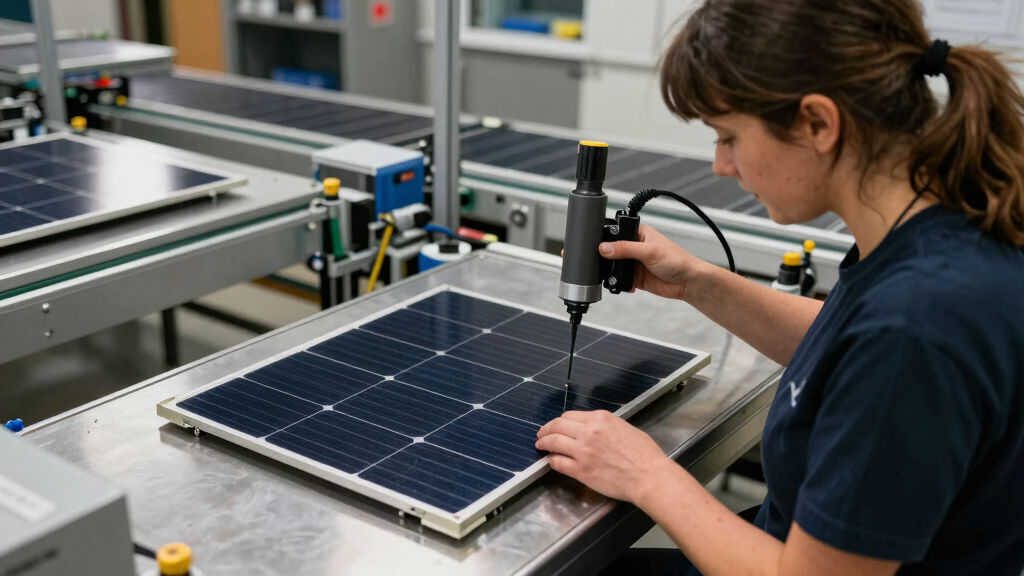
Solarge has officially begun production at its new fully automated solar module factory in Weert, Netherlands, marking a significant step in European solar manufacturing focused on sustainability and innovation. The facility produces ultra-lightweight, recyclable modules designed to meet increasing demand for environmentally friendly solar solutions.
The Weert plant, operational since May 2023, currently produces 150 MW annually, equivalent to approximately 300,000 solar panels. The company has announced plans to scale up capacity to 400 MW, with infrastructure designed to support this expansion.
Solarge’s flagship product, the SOLO module, departs from traditional designs by eliminating glass, aluminium frames, and environmentally problematic substances such as PFAs and antimony. The module weighs only 5.5 kg/m², roughly half the weight of conventional panels, allowing installation on surfaces with structural limitations without reinforcement.
The company emphasizes its commitment to circularity; the SOLO module is the first solar panel certified under the Cradle to Cradle Certified Circularity 4.1 standard at Silver level, confirming its design for lifecycle and resource efficiency. Solarge offers a buy-back guarantee to recover and recycle all materials without downcycling.
Implications of Solarge’s Lightweight, Recyclable Modules
This development signifies a notable advance in sustainable solar technology, addressing key challenges such as module weight and end-of-life recycling. It enhances the feasibility of installing solar on structurally limited surfaces and supports Europe’s push for circular economy solutions in renewable energy.
By obtaining the first Cradle to Cradle Circularity 4.1 Silver certification for a solar panel, Solarge sets a new standard for environmentally conscious manufacturing, potentially influencing industry practices and regulatory standards across Europe and beyond.
recyclable lightweight solar panels
As an affiliate, we earn on qualifying purchases.
As an affiliate, we earn on qualifying purchases.
European Solar Manufacturing and Circularity Goals
European solar manufacturers are increasingly focusing on innovation to differentiate from Asian competitors, emphasizing sustainability, lightweight design, and circularity. Solarge’s factory in Weert is part of a broader trend toward automated, environmentally friendly production lines, with other facilities across Europe adopting similar strategies. The push for circularity aligns with EU policies aiming to reduce waste and promote sustainable resource use in renewable energy infrastructure.
Prior to this, other European factories, such as those operated by Sunmaxx, SoliTek, and Belga Solar, have advanced manufacturing capabilities, but Solarge’s emphasis on recyclability and lightweight modules marks a distinctive approach within the industry.
“Solarge’s focus on circularity and lightweight design addresses critical industry challenges, setting new standards for sustainable solar modules.”
— an anonymous researcher
Cradle to Cradle certified solar modules
As an affiliate, we earn on qualifying purchases.
As an affiliate, we earn on qualifying purchases.
Uncertainties About Future Capacity and Market Impact
It is not yet clear how quickly Solarge will scale up production to 400 MW or how the market will adopt these lightweight, recyclable modules. The long-term durability and cost competitiveness of the modules compared to traditional panels remain to be fully demonstrated in diverse conditions.
Further, regulatory developments and supply chain factors could influence the factory’s expansion and the wider adoption of circular modules.
solar panels without glass or aluminum frames
As an affiliate, we earn on qualifying purchases.
As an affiliate, we earn on qualifying purchases.
Next Steps for Solarge and Industry Adoption
Solarge plans to increase its production capacity to 400 MW, with subsequent efforts to expand sales across Europe. The company will likely seek additional certifications and partnerships to promote adoption of its circular modules. Industry observers will monitor how the modules perform in real-world conditions and how regulatory frameworks support circular manufacturing practices.
Further, competitors may accelerate their own innovations in recyclable solar modules, shaping the competitive landscape in Europe’s PV industry.
eco-friendly solar energy panels
As an affiliate, we earn on qualifying purchases.
As an affiliate, we earn on qualifying purchases.
Key Questions
What makes Solarge’s modules different from traditional solar panels?
They are lighter, weighing only 5.5 kg/m², and are made without glass, aluminium frames, PFAs, or antimony, making them fully recyclable and suitable for structurally limited surfaces.
What certification has Solarge achieved for its modules?
The SOLO module is the first solar panel certified under the Cradle to Cradle Certified Circularity 4.1 standard at Silver level, confirming its design for sustainability and circularity.
What are the advantages of lightweight modules for installation?
They can be installed on surfaces with structural limitations without reinforcement, expanding usable areas on rooftops, carports, and infrastructure projects.
When will Solarge’s factory reach its full planned capacity?
The factory currently produces 150 MW annually, with plans to expand to 400 MW, but the timeline for full capacity realization has not been specified.
How might this development influence the European PV industry?
It sets a new standard for eco-friendly, recyclable modules, encouraging industry-wide adoption of circular manufacturing practices and innovation in lightweight PV solutions.
Source: PV Magazine
Fall yard work Picks
leaf blowers
As an affiliate, we earn on qualifying purchases.