
TL;DR

Get home appliances delivered free — and shop member deals
- Fast, free delivery on millions of items
- Access to Prime Big Deal Days deals on October 6–7
- Prime Video, Amazon Music and more included
Scientists from China have developed a pseudo-planar heterojunction organic solar cell achieving a world-record efficiency of 20.21%. The breakthrough involves a new interfacial buffering technique that enhances device stability and performance.
Chinese researchers have achieved a world-record efficiency of 20.21% in pseudo-planar heterojunction organic solar cells, using a novel interfacial buffering strategy to improve stability and performance.
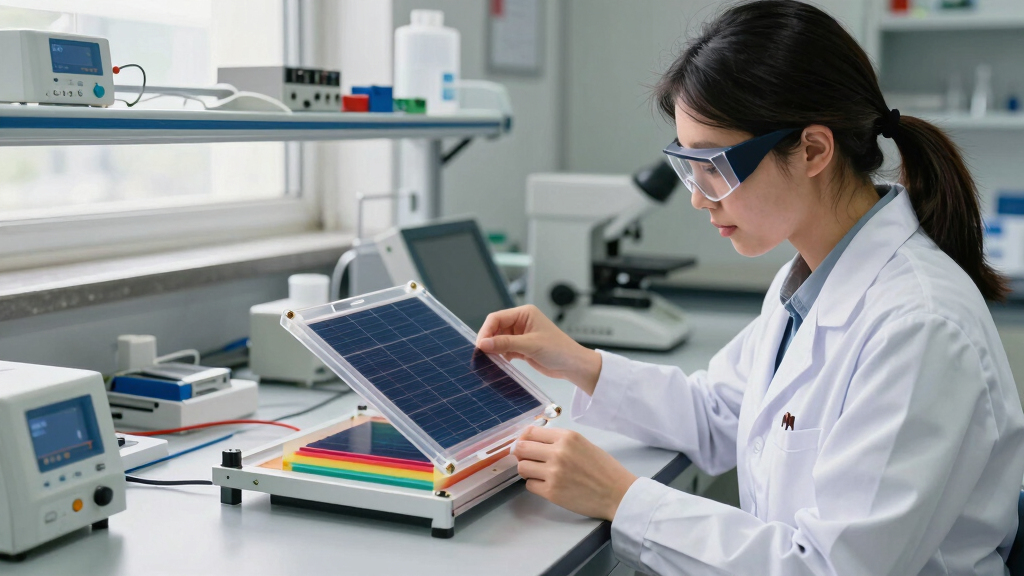
The team incorporated a highly crystalline polymer, D18, as a buffer layer between donor and acceptor materials in the solar cell architecture. This buffer minimizes solvent-induced swelling and erosion during fabrication, preserving the integrity of the active layers. The resulting device, based on a PM6 donor and L8-BO acceptor, demonstrated a power conversion efficiency (PCE) of 19.80%, outperforming conventional designs.
Further enhancement was achieved by adding a non-fullerene acceptor, BTP-eC9, pre-blended with L8-BO, raising the efficiency to 20.21%. This marks one of the highest efficiencies reported for this class of organic solar cells. The researchers attribute the performance gains to improved morphology, reduced interfacial traps, and faster charge transfer kinetics, leading to better exciton separation and reduced recombination.
Implications of the Record Efficiency in Organic Solar Cells
This development signifies a major step forward in organic photovoltaic technology, demonstrating that high efficiencies are achievable with scalable fabrication methods. The use of a buffering layer to prevent solvent damage could lead to more reliable, durable, and commercially viable organic solar modules, potentially accelerating adoption in renewable energy markets.
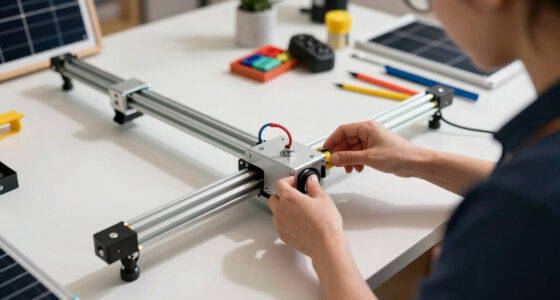
organic solar panel with interfacial buffer layer
As an affiliate, we earn on qualifying purchases.
As an affiliate, we earn on qualifying purchases.
Advances in Pseudo-Planar Heterojunction Organic Solar Cells
Organic solar cells have long sought higher efficiencies and stability. The pseudo-planar heterojunction structure combines features of planar and bulk heterojunction designs, offering efficient charge separation and manageable fabrication. Prior efforts faced challenges with solvent-induced morphology degradation during layer deposition, limiting performance gains. Recent research has focused on interface engineering and new material combinations to overcome these barriers, with this latest record representing a significant milestone.
“The interfacial buffering strategy effectively prevents solvent erosion, enabling higher device stability and performance.”
— an anonymous researcher
high efficiency organic photovoltaic modules
As an affiliate, we earn on qualifying purchases.
As an affiliate, we earn on qualifying purchases.
Remaining Questions on Long-term Stability and Scalability
It is not yet clear how these devices will perform under real-world conditions over extended periods. The scalability of the fabrication process and the reproducibility of such high efficiencies in large-area modules remain to be demonstrated.
pseudo-planar heterojunction solar cells
As an affiliate, we earn on qualifying purchases.
As an affiliate, we earn on qualifying purchases.
Next Steps Toward Commercial Application and Further Optimization
Researchers are expected to focus on testing the long-term stability of these cells, scaling up the fabrication process, and integrating the technology into larger modules. Further material optimization and device engineering will aim to maintain high efficiency while improving durability and manufacturing consistency.
As an affiliate, we earn on qualifying purchases.
Key Questions
How does the interfacial buffering layer improve efficiency?
The buffer layer prevents solvent erosion during fabrication, maintaining the integrity of the active layers and enabling better morphology control, which leads to higher charge separation efficiency and reduced recombination.
Can this technology be scaled for commercial production?
While promising, scalability and long-term stability testing are ongoing. The fabrication method is designed to be compatible with scalable processes, but further development is needed before commercial deployment.
How does this record compare to previous efficiencies in organic solar cells?
This efficiency of 20.21% surpasses many previous reports for pseudo-planar heterojunction structures, marking a new benchmark in the field of organic photovoltaics.
What materials are used in this new solar cell design?
The active layers include the donor polymer PM6, the crystalline buffer polymer D18, and the acceptors L8-BO and BTP-eC9, combined to optimize morphology and charge transfer.
What are the main challenges remaining for commercial viability?
Key challenges include ensuring long-term stability under operational conditions, scaling up the fabrication process, and reducing production costs to competitive levels.
Source: PV Magazine
Fall yard work Picks
leaf blowers
As an affiliate, we earn on qualifying purchases.