Finding the best humanoid robotic arms in 2026 requires balancing performance, flexibility, and ease of use. The AI Robotic Arm Kit with Servo Motors from LeRobot stands out as the best overall, thanks to its affordability and open-source design, making it ideal for hobbyists and educators. For those seeking advanced AI capabilities, the Hiwonder AI Robotic Arm Kit with VLA Model Development offers cutting-edge scene understanding and voice control. The main tradeoffs in this category revolve around complexity versus accessibility—more capable models tend to require technical expertise or higher budgets. Keep reading for a detailed comparison to help you choose the right robotic arm for your needs.
Open a free Amazon Business account
Business pricing, bulk buying and tax-exempt orders.
Create a free accountAs an affiliate, we earn on qualifying purchases.
Complete the kit


Key Takeaways
- Open-source and modular designs provide greater customization but often demand technical skills.
- Higher payload and precision typically come with increased cost and complexity.
- AI integration varies widely; more advanced AI features are usually found in premium models.
- Ease of assembly and user-friendliness differ significantly, influencing suitability for beginners.
- Price ranges are broad, so aligning your budget with required features is essential for making a smart choice.


More Details on Our Top Picks
AI Robotic Arm Kit with Servo Motors – LeRobot SO-ARM101 Pro Low-Cost, 6-DOF, Open-Source, Compatible with NVIDIA Jetson
The LeRobot SO-ARM101 Pro stands out as the best overall option for those seeking a flexible, open-source humanoid arm tailored for AI applications. Its compatibility with NVIDIA Jetson devices makes it ideal for AI training and research, providing real-time tracking and improved wiring that enhance performance. Compared to the Yahboom ROS2 6DOF arm, the SO-ARM101 Pro offers a more accessible entry point into open-source AI robotics without sacrificing core functionality, though it lacks included 3D-printed parts and detailed motor specs. This model’s open-source design and compatibility make it particularly appealing to developers and enthusiasts willing to handle assembly and calibration. Its main tradeoff is the need for technical expertise and limited load capacity, which may limit its use for heavier tasks.
Pros:- Open-source design with extensive learning resources
- Compatible with NVIDIA Jetson edge devices for AI applications
- Enhanced wiring and real-time tracking features
Cons:- Does not include 3D-printed parts, requiring additional fabrication
- Requires technical assembly and calibration knowledge
- Limited load capacity and unspecified motor specs
Best for: AI developers and robotics researchers seeking a customizable, open-source platform compatible with NVIDIA Jetson devices
Not ideal for: Beginners with limited technical skills or hobbyists seeking a plug-and-play robotic arm
- Number of Degrees of Freedom:6-DOF
- Compatibility:LeRobot, Hugging Face, NVIDIA Jetson
- Includes 3D-printed parts:No
- Supported Devices:reComputer Mini J4012, Orin NX 16 GB
Our verdict“This pick suits experienced developers aiming for AI-focused robotics research and customization.”
HIWONDER Humanoid Robot with ChatGPT and Raspberry Pi 5 8GB
The HIWONDER Humanoid Robot excels as an educational platform with advanced AI features, including ChatGPT, making it ideal for learning robotics, AI, and programming. Built on the powerful Raspberry Pi 5 8GB, it offers 18 degrees of freedom, supporting complex interactions like target tracking and voice commands, much like the Yahboom ROS2 arm but with a focus on AI-driven conversation and interaction. While its AI capabilities and open-source approach make it a standout for learners and hobbyists, the setup process can be intricate, and details on hardware durability or battery life are limited. This robot is best suited for motivated students or educational institutions aiming to explore multimodal AI in humanoids, though less suited for those seeking straightforward, plug-and-play solutions.
Pros:- Powerful AI integration with ChatGPT and multimodal capabilities
- Supports open-source development with extensive educational resources
- Advanced vision, voice recognition, and motion control
Cons:- Complex setup requiring advanced technical knowledge
- Limited details on hardware durability and battery longevity
- Potentially high cost for educational use
Best for: Students and educators interested in AI and programming with a focus on interactive humanoids
Not ideal for: Hobbyists seeking a simple, low-maintenance robot or users needing detailed hardware durability info
- Processor:Raspberry Pi 5 8GB
- Degrees of Freedom:18DOF
- Camera:HD wide-angle
- AI Models:ChatGPT, OpenCV, MediaPipe
Our verdict“This robot is perfect for dedicated learners and institutions aiming to explore AI-driven humanoids in depth.”
Yahboom ROS2 6DOF Robotic Arm with AI and 3D Recognition – Standard Kit
The Yahboom ROS2 6DOF Robotic Arm offers high-precision control with multiple operation modes, including wireless, app, and mouse, making it suitable for more experienced users. Its integration of AI for scene recognition and intelligent grasping enhances its capabilities beyond basic automation, setting it apart from simpler kits like the KLAYERS SO-ARM100. While it delivers accurate movement thanks to high-quality metal gear servos and supports payloads up to 500g, its complex setup and reliance on Windows software may challenge beginners. This arm is best suited for advanced hobbyists, students in robotics, or research labs exploring AI-driven manipulation, though it might be overkill for simple educational use or casual hobbyists.
Pros:- High-precision metal gear servos for accurate movement
- Multiple control options for flexible operation
- AI integration for scene recognition and intelligent grasping
Cons:- Requires Windows for control software, limiting compatibility
- Complex setup may deter beginners
- Limited support for Mac OS
Best for: Advanced robotics students and researchers needing precise control and AI scene recognition
Not ideal for: Beginners or users with limited Windows experience looking for a straightforward setup
- Brand:Yahboom
- Model:DOFBOT SE
- Control Methods:Wireless, app, mouse
- Servo Type:6 bus servos with metal gears
- Supported Payload:200g-500g
- Warranty:90 days
Our verdict“This arm suits those seeking precision and AI capabilities for complex robotics tasks, best for experienced users.”
KLAYERS SO-ARM101 SE Open-Source 6-Axis Robotic Arm Kit with Camera
The KLAYERS SO-ARM101 SE is a fully open-source, highly customizable 6-DOF arm that incorporates durable photosensitive resin 3D-printed parts and a HD camera, making it a solid choice for newcomers and hobbyists. Its high-torque bus servos support complex tasks, and the inclusion of a camera allows for visual processing projects. Compared with the SO-ARM100, this model offers more flexibility with its control methods and a focus on durability. However, assembly may be daunting for those new to robotics, and limited software support information could pose challenges. This kit is best for motivated learners ready to tackle assembly and coding, especially those interested in integrating AI or computer vision with Hugging Face projects.
Pros:- Open-source and compatible with Hugging Face projects
- Flexible 6-DOF motion for complex tasks
- Durable, high-quality 3D-printed parts with included camera
Cons:- Assembly required, potentially challenging for first-timers
- Limited software compatibility details
- Potential complexity in setup and calibration
Best for: Beginners and hobbyists eager to learn through hands-on assembly and open-source customization
Not ideal for: Users seeking a ready-to-run robot or those with limited technical experience
- Number of Axes:6
- Servo Torque:30 kg·cm @ 12V
- Material:Photosensitive resin
- Includes:Camera, USB hub, metal desk-mount arms
Our verdict“Ideal for dedicated beginners willing to assemble and program a versatile humanoid arm with AI capabilities.”
KLAYERS SO-ARM100 Open-Source 6-Axis Robotic Arm Kit
The KLAYERS SO-ARM100 offers a straightforward, all-in-one open-source 6-DOF solution designed for beginners interested in precise, flexible movements. Its high-torque bus servos deliver reliable strength, and the durable photosensitive resin parts provide a solid foundation for learning basic robotic control and programming. Compared to the SE version, the SO-ARM100 is a more cost-effective choice, though it may lack some of the advanced AI scene recognition features. Assembly complexity is similar, requiring patience and some technical skill, but it’s well-suited for newcomers eager to explore robotics with minimal fuss. Its main limitation is the lack of detailed software support information, which might cause difficulties in more advanced integrations.
Pros:- Open-source with Hugging Face project compatibility
- High-torque servos for strong, precise movements
- Complete all-in-one kit suitable for learning and experimentation
Cons:- Assembly may be challenging for absolute beginners
- Limited info on software compatibility beyond Hugging Face
- No detailed user reviews or pricing info available
Best for: Beginners and hobbyists seeking a complete, ready-to-assemble robotic arm for educational purposes
Not ideal for: Experienced users requiring AI scene recognition or industrial-grade precision
- Number of Axes:6
- Servo Torque:19.5 kg·cm @ 7.4V
- Material:Photosensitive resin
- Compatibility:Hugging Face
Our verdict“Best suited for newcomers eager to build and program a versatile humanoid robot with fundamental features.”
reBot B601-DM Assembled Robotic Arm Kit with Gripper, 6+1 DoF, Open-Source, Python SDK & ROS1/ROS2 Compatible for AI Robotics & STEM Education
The reBot B601-DM stands out for its comprehensive open-source ecosystem and high-level customization, making it ideal for robotics researchers and developers. Compared with the Yahboom MyCobot 320, it offers a more advanced 6+1 degrees of freedom and supports ROS1/ROS2, which is essential for complex AI integrations. Its pre-assembled design reduces setup time, but its complex software configuration can challenge beginners. This model’s high payload of 1.5 kg and precise 0.2 mm repeatability make it suitable for prototyping, yet the cost may be prohibitive for hobbyists or educational settings with limited budgets. Overall, this arm makes the most sense for teams focused on advanced robotics research and development rather than entry-level projects.
Pros:- Pre-assembled for quick deployment, saving setup time
- Supports ROS and Python SDK for extensive customization
- High payload capacity and 0.2 mm repeatability suitable for research
Cons:- Complex setup may require familiarity with robotics software
- High cost could limit accessibility for some users
Best for: Advanced robotics developers and research labs needing customizable, high-precision hardware
Not ideal for: Hobbyists or educators seeking affordable, easy-to-assemble solutions with minimal setup
- Number of Degrees of Freedom:6+1
- Payload:1.5 kg
- Reach:767 mm
- Repeatability:0.2 mm
- Memory Storage Capacity:16 GB
- Connectivity Technology:Bluetooth, Ethernet, USB, Wi-Fi
- Operating System:Linux, MacOS, ROS1, ROS2, Windows
- Item Dimensions:16.41″L x 9.88″W x 27.16″H
Our verdict“This arm is perfect for research teams and professionals seeking a highly customizable, open-source robotic platform.”
KLAYERS SO-ARM101 SE Open-Source 6-Axis Robotic Arm with Photosensitive Resin Parts
The KLAYERS SO-ARM101 SE appeals to enthusiasts and developers interested in detailed, durable components, thanks to its 3D-printed photosensitive resin parts and high-torque servos. While the Hiwonder AI Robotic Arm Kit offers advanced AI features, the KLAYERS model prioritizes precision and craftsmanship, making it more suitable for intricate tasks and prototyping. Its open-source support and tutorials provide a clear pathway for learning, but setup complexity and the need for robotics familiarity can challenge newcomers. The durable resin parts and 30 kg·cm torque make it capable of handling complex motions, although beginners may find the initial assembly and calibration demanding. This pick makes the most sense for users who want detailed customization and are comfortable with technical setup.
Pros:- Open-source with comprehensive tutorials and support
- Durable, detailed resin parts for precise craftsmanship
- High-torque servos enable complex, demanding tasks
Cons:- Requires familiarity with robotics and programming
- Setup and calibration can be complex for newcomers
Best for: Intermediate to advanced hobbyists and developers focused on detailed, customizable robotic projects
Not ideal for: Beginners or educational users seeking quick, plug-and-play solutions without extensive setup
- Number of axes:6
- Servo torque:30 kg·cm @ 12V
- Material:Photosensitive resin
- Compatibility:Hugging Face LeRobot
Our verdict“Ideal for users who prioritize customization, durability, and detailed craftsmanship over simplicity.”
HIWONDER AI Robotic Arm Kit with Imitation Learning and VLA Model Development
The HIWONDER AI Robotic Arm Kit emphasizes AI integration, supporting advanced vision, voice, and multimodal models, making it a top choice for AI developers and educators. Its high-precision control and smooth motion stand out against simpler robotic arms like the Yahboom MyCobot 320, which lacks such AI features. The kit’s full-metal construction and AI capabilities come with a steep learning curve, especially when configuring multimodal AI models, and the setup can be daunting for those without technical expertise. The 500g payload limits heavier tasks, but the arm’s support for AI vision modules and imitation learning opens doors for cutting-edge AI research. This pick suits advanced AI-focused projects rather than basic educational use.
Pros:- Supports advanced AI vision and voice interaction
- Smooth operation with high-precision control algorithms
- Open-source code and tutorials facilitate customization
Cons:- Complex setup requiring technical skills
- Limited payload capacity for heavier objects
Best for: AI researchers and developers seeking to integrate multimodal models with robotic manipulation
Not ideal for: Beginners or hobbyists who need straightforward, low-cost robotic arms
- Architecture:ESP32 + AT32 dual-chip
- Reach:500mm
- Payload:500g
- Repeatability:±2mm
- AI Vision Module:K230 with 30+ features
- Control:PC, App, remote control
Our verdict“Best suited for AI-focused projects where advanced vision and interaction capabilities are prioritized over payload capacity.”
Yahboom Robotic Arm ROS Industrial Grade 1kg Payload 7 DOF AI Collaboration MyCobot 320 M5 for Education and Research
The Yahboom MyCobot 320 offers a balanced mix of industrial-grade features and educational accessibility, with 7 degrees of freedom and a 1kg payload. Compared to the Hiwonder AI Robotic Arm Kit, it provides a more straightforward control interface via ROS, Python, and Arduino, making it suitable for students and entry-level researchers. Its compact size and open-source interfaces enable easy customization, but its 1mm repeatability and limited payload restrict use in highly precise or demanding tasks. The setup is manageable for those with some technical knowledge, making it a practical choice for classroom environments or small research projects. Overall, this arm is best for users who want a reliable, versatile platform without the complexity of high-end AI features.
Pros:- Supports ROS, Python, and Arduino for broad control options
- Open-source interface allows for easy customization
- Compact size with a 350mm radius suitable for limited spaces
Cons:- Limited payload and repeatability for demanding tasks
- Complex features might overwhelm absolute beginners
Best for: Educational institutions and beginner researchers needing a reliable, versatile robotic arm
Not ideal for: Advanced AI developers or users requiring high-precision, heavy-lifting robots
- Payload:1kg
- Degrees of Freedom:7
- Working Radius:350mm
- Voltage:24V
- Repeatability:1mm
- Control Interfaces:Industrial electrical, PLC, open source
Our verdict“This arm is well-suited for educational purposes and introductory research projects requiring versatility and ease of use.”
Hiwonder SO-ARM101 6-Axis Robotic Arm Kit with AI Vision and Open Source Compatibility
The Hiwonder SO-ARM101 excels when AI vision and environmental awareness are priorities, thanks to its dual-camera system and high-torque servo motors. Unlike the reBot B601-DM, which emphasizes research flexibility, this model integrates AI perception directly, making it ideal for projects involving scene recognition or imitation learning. Its open-source compatibility provides a rich platform for customization, but setup complexity and the need for technical expertise can be barriers for newcomers. The 12 high-torque servo motors ensure smooth, stable movements, yet the kit’s cost and assembly requirements make it more suitable for dedicated developers or advanced hobbyists. If your goal involves AI-driven manipulation with environmental sensing, this arm is a strong contender.
Pros:- Supports advanced AI imitation learning with dual-camera vision
- High-performance servo motors for stable, precise motion
- Open-source framework facilitates extensive customization
Cons:- Setup may be complex for those without technical expertise
- Potentially high cost for hobbyist budgets
Best for: Developers and researchers focused on AI perception and environmental interaction projects
Not ideal for: Beginners or users seeking straightforward, low-cost robotic arms without AI features
- Number of axes:6
- Servo motors:12 high-torque
- Camera system:Dual-camera (gripper-mounted and external)
- Compatibility:Open-source (LeRobot framework)
- Included parts:3D printed, assembled components
Our verdict“This arm is best for AI-focused development where environmental sensing and advanced control are key priorities.”
SO-ARM101 6DOF Open Source Robotic Arm, LeRobot Compatible Python AI Robot DIY Kit for STEM & Research, Standard/Pro, DIY/Pre-Assembled Available
The SO-ARM101 excels as an open-source platform tailored for learners and researchers who want to customize their robotic arm. Compared with the Hiwonder AI Robotic Arm Kit, SO-ARM101 offers greater flexibility through its modular hardware and software, but it demands a higher level of technical skill for assembly and programming. Its support for AI models and Python integration makes it ideal for experimentation, although its payload limits restrict heavier applications. This model’s open-source firmware and detailed documentation provide a strong foundation for innovation, yet the need for technical knowledge can be a barrier for beginners. It’s best suited for advanced students or researchers seeking a customizable, educational tool.Pros:- Open-source hardware and software for extensive customization
- Supports AI models and Python programming for advanced applications
- Modular design with 3D-printable parts for flexible configurations
Cons:- Requires technical knowledge for assembly and coding
- Limited payload capacity of 100g to 200g, restricting heavier tasks
Best for: Advanced students, researchers, or DIY enthusiasts who want to modify and develop AI-driven robotic systems.
Not ideal for: Beginners or hobbyists seeking a plug-and-play robotic arm without programming requirements.
- Degrees of Freedom:6DOF
- Axes:5+1
- Payload:100g (Standard), 200g (Pro)
- Compatibility:LeRobot OS, Python
- Features:Anti-backlash gears, roller bearings
- Firmware:Open-source
Our verdict“This pick makes the most sense for tech-savvy users aiming to develop customized AI robotics projects.”
INSIPRE Humanoid Robot Hand with 3KG Grip, Force and Position Control, ROS Support
The INSIPRE Humanoid Robot Hand stands out for its high dexterity, supporting delicate tasks with a robust 3kg grip and sub-millimeter repeatability. Unlike the Hiwonder AI Robotic Arm Kit, which offers comprehensive full-arm capabilities, this hand focuses on realistic, precise manipulation, making it ideal for prosthetics or fine assembly. Its force sensing and ROS compatibility enable seamless integration into complex robotic systems, though the setup complexity might challenge newcomers. High cost and limited system info could deter some users, but for those needing detailed control and tactile feedback, it delivers impressive performance. This hand is best suited for developers and labs focused on dexterous, delicate operations, not general-purpose automation.Pros:- High dexterity with 6 degrees of freedom and 12 joints
- Real-time force sensing for delicate handling
- Seamless ROS support allows easy system integration
- Robust 3kg load capacity for versatile applications
Cons:- Setup may be technically demanding for newcomers
- Potentially high cost for advanced features
- Limited info on compatibility with broader systems
Best for: Robotics researchers or prosthetics developers requiring high dexterity and force sensing.
Not ideal for: Beginners or hobbyists seeking an all-in-one robotic arm solution without complex integration needs.
- Degrees of Freedom:6
- Joints:12
- Grip Strength:3 kg
- Force Sensing:Yes
- ROS Support:Yes
- Repeatability:Sub-millimeter
Our verdict“This hand makes the most sense for advanced users who prioritize precision, force sensing, and integration into complex robotics systems.”
Hiwonder AI Robotic Arm Kit with Large AI Models, VLA Model Development, 6DOF Full Metal Robot Arm, K230 AI Vision, Voice Control, Scene Understanding, NexArm Advanced Kit
The Hiwonder NexArm Advanced Kit offers a fully metal 6DOF arm equipped with integrated AI vision, voice control, and multimodal AI capabilities, making it a standout for complex AI research and education. Unlike the SO-ARM101, which emphasizes open hardware and DIY customization, NexArm focuses on high precision and advanced AI features, although its complexity and price point are geared toward users aged 15 and older with programming experience. Its ±2mm repeatability ensures accurate movement, suitable for sophisticated tasks, but the higher cost may limit accessibility for casual hobbyists. The extensive tutorials and open-source code make it a powerful platform for innovation, especially for those interested in AI-driven robotics.Pros:- High precision with ±2mm repeatability and smooth trajectories
- Integrated AI vision, voice control, and scene understanding
- Open-source code with extensive tutorials for customization
- Compatible with large AI models for complex tasks
Cons:- Designed for users aged 15 and up, with a learning curve
- Requires programming and AI framework familiarity
- Higher price due to advanced AI features
Best for: Students, developers, or researchers aiming to explore AI, scene understanding, and high-precision robotics.
Not ideal for: Beginners or casual hobbyists looking for a simple, entry-level robotic arm solution.
- Reach:500mm
- Payload:500g
- Repeatability:±2mm
- AI Vision Module:K230 with 30+ features
- Number of Items:1
- Manufacturer Recommended Age:15+
Our verdict“This model best serves advanced users dedicated to AI research and high-precision robotic development.”
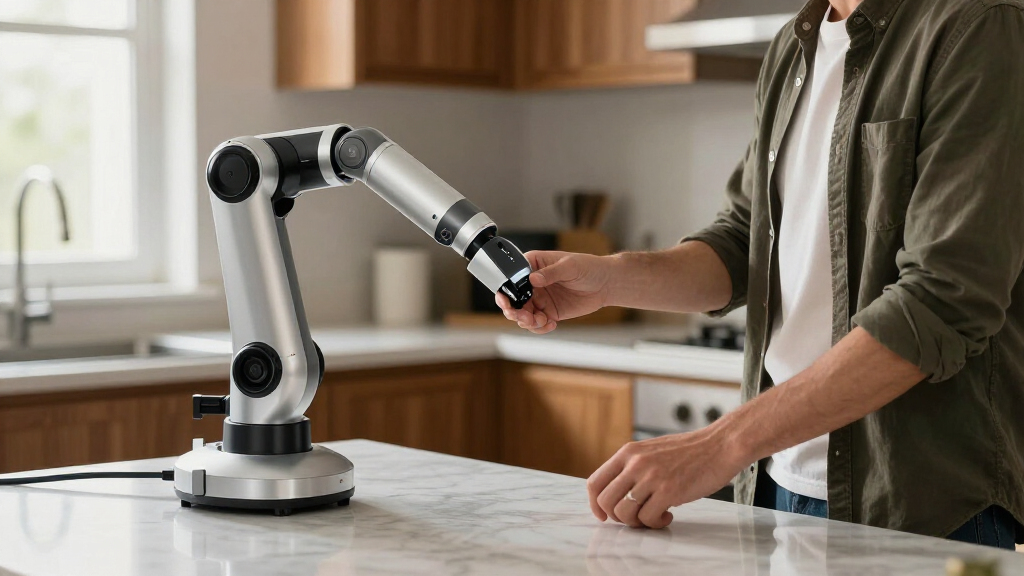
How We Picked
This selection was based on evaluating each robotic arm’s performance, build quality, versatility, ease of use, and value. We prioritized models that balance technical capability with accessibility, ensuring options are suitable for both newcomers and experienced users. Compatibility with popular platforms like ROS or Python SDKs was also a key factor, as it determines ease of integration into existing projects. The ranking reflects a combination of user feedback, feature set, and overall robustness, highlighting the best options across different use cases and budgets.Factors to Consider When Choosing Best Humanoid Robotic Arms
Choosing the right humanoid robotic arm involves understanding several key factors. Beyond features and price, it’s important to consider how the arm’s design aligns with your skill level, intended use, and future expandability. This guide explores critical considerations to help you make an informed decision and avoid common pitfalls.Performance and Precision
Performance metrics like repeatability, payload capacity, and degrees of freedom directly impact what tasks the robotic arm can handle. A higher precision arm is better suited for detailed assembly or research, while lower-precision models may suffice for educational demonstrations. Balancing these specs with your project’s complexity ensures you don’t overpay for capabilities you won’t use.
Ease of Use and Assembly
Some robotic arms come pre-assembled, while others require extensive DIY assembly. Beginners should prioritize models with clear instructions, modular components, and good documentation to reduce frustration. Advanced users may prefer open-source kits that allow customization but at the cost of a steeper learning curve.
Compatibility and Integration
Compatibility with platforms like ROS, Python SDKs, or AI frameworks can significantly streamline development. Consider whether the robotic arm supports your existing software tools or requires additional adapters. Well-supported integration options help prevent compatibility issues that can delay your projects.
Build Quality and Materials
The durability of the robotic arm depends on its construction, with metal frames typically offering better longevity than plastic. For industrial or heavy-use applications, investing in a sturdy, well-made model can save money long-term by reducing maintenance and repairs.
Budget and Value
Pricing varies widely, so define your budget early. Cheaper models may lack advanced AI features or robustness, but offer a good starting point for learning. Premium options provide more capabilities and durability but require a higher investment. Prioritize features that align closely with your goals to maximize value.
Frequently Asked Questions
Can I upgrade or customize a humanoid robotic arm later?
Many open-source or modular robotic arms are designed for customization, allowing you to upgrade components or add new features over time. However, compatibility and physical constraints can limit the extent of upgrades, especially with integrated AI modules or proprietary systems. Planning for future expansion should be part of your initial choice, ensuring the base model supports your evolving needs.
What’s the difference between open-source and closed-source robotic arms?
Open-source robotic arms provide access to design files, code, and firmware, enabling customization and community support. They are often more affordable and flexible but require technical skills to modify and maintain. Closed-source options tend to be more user-friendly, with dedicated support and pre-configured systems, making them suitable for users who prefer plug-and-play solutions without extensive tinkering.
How important is AI capability in a humanoid robotic arm?
AI features can significantly enhance a robotic arm’s functionality, enabling tasks like scene recognition, voice command, or autonomous decision-making. If your project involves complex automation or research, investing in AI-enabled models makes sense. For basic pick-and-place or educational use, simpler mechanical arms may suffice, avoiding unnecessary complexity and cost.
Are these robotic arms suitable for industrial or heavy-duty applications?
Many of the options listed focus on educational, research, and hobbyist uses, with some capable of light industrial tasks. For demanding industrial environments, specialized robotic arms with higher payloads, certified safety features, and industrial-grade durability are necessary. The listed models are more appropriate for prototyping, learning, or light automation projects.
What should I consider if I want a robotic arm for STEM education?
For educational purposes, look for models that are easy to assemble, come with comprehensive documentation, and support popular programming languages like Python or ROS. Durability and safety features are also important, especially for classroom environments. Budget-friendly, open-source kits often provide the best learning experience by encouraging experimentation and customization.
Conclusion
For general use and those new to robotics, the LeRobot SO-ARM101 Pro offers a balanced combination of affordability, ease of assembly, and upgrade potential, earning it the title of best overall. If you’re seeking advanced AI capabilities for research or development, the Hiwonder AI Robotic Arm Kit with VLA Model Development is a compelling choice, though it requires more technical skill. Budget-conscious hobbyists should consider entry-level open-source kits, while professionals needing industrial-grade reliability should look beyond this list. Ultimately, your choice depends on your experience level, project goals, and budget.
Flea & tick season Picks
flea and tick prevention
As an affiliate, we earn on qualifying purchases.